MCQ
A body is moving in a circular path with a constant speed. It has
  • A
    A constant velocity
  • B
    A constant acceleration
  • An acceleration of constant magnitude
  • D
    An acceleration which varies with time

Answer

Correct option: C.
An acceleration of constant magnitude
c
(c) Centripetal acceleration $ = \frac{{{v^2}}}{r}=$ constant. Direction keeps changing.

Need a full question paper?

Generate a complete, print-ready paper with questions like this in minutes — across 16+ boards, with answer keys.

Start Generating Free

Similar questions

Assertion $(A):$ The total translational kinetic energy of all the molecules of a given mass of an ideal gas is $1.5$ times the product of its pressure and volume.

Reason $(R):$ The molecules of gas collide with each other and the velocities of the molecules change due to the collision.
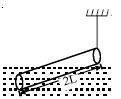
A slender homogeneous rod of length $2L$ floats partly immersed in water, being supported by a string fastened to one of its ends, as shown. The specific gravity of the rod is $0.75$. The length of rod that extends out of water is : 
An ice cream has a marked value of $700 \,kcal$. How many kilowatt- hour of energy will it deliver to the body as it is digested ............ $kWh$
If the law of gravitation, instead of being inversesquare law, becomes an inversecube law.
  1. Planets will not have elliptic orbits.
  2. Circular orbits of planets is not possible.
  3. Projectile motion of a stone thrown by hand on the surface of the earth will be approximately parabolic.
  4. There will be no gravitational force inside a spherical shell of uniform density.
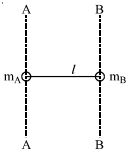
$A$ point mass $m_A$ is connected to a point mass $m_B$ by a massless rod of length $l$ as shown in the figure. It is observed that the ratio of the moment of inertia of the system about the two axes $BB$ and $AA$, which is parallel to each other and perpendicular to the rod is $\frac{{{I_{BB}}}}{{{I_{AA}}}}=3$. The distance of the centre of mass of the system from the mass $A$ is
A plane wave $y=A\,\, sin\,\, \omega \left( {t - \frac{x}{v}} \right)$ undergo a normal incidence on a plane boundary separating medium $M_1$ and $M_2$ and splits into a reflected and transmitted wave having speeds $v_1$ and $v_2$ then
A car covers $A B$ distance with first one-third at velocity $v _{1} ms ^{-1}$, second one-third at $v _{2} ms ^{-1}$ and last one-third at $v _{3} ms ^{-1}$. If $v _{3}=3 v _{1}, v _{2}=2 v _{1}$ and $v _{1}=11\,ms ^{-1}$ then the average velocity of the car is________ $ms ^{-1} .$
A man can swim with velocity $v$ relative to water. He has to cross a river of width $d $ flowing with a velocity $u (u > v)$. The distance through which he is carried down stream by the river is $x$. Which of the following statement is correct
An ideal gas at ${27^o}C$ is compressed adiabatically to $\frac{8}{{27}}$ of its original volume. If $\gamma = \frac{5}{3}$, then the rise in temperature is........ $K$
If the external forces acting on a system have zero resultant, the centre of mass: