A body of mass $5\, gm$ is executing $S.H.M.$ about a point with amplitude $10 \,cm$. Its maximum velocity is $100\, cm/sec$. Its velocity will be $50\, cm/sec$ at a distance
Medium
Download our app for free and get started
(c) It is given ${v_{\max }} = 100\,cm/sec$, $a = 10\, cm.$
==> ${v_{\max }} = a\omega $
==> $\omega = \frac{{100}}{{10}} = 10\,rad/sec$
Hence $v = \omega \sqrt {{a^2} - {y^2}} $
==>$50 = 10\sqrt {{{(10)}^2} - {y^2}} $
==> $y = 5\sqrt 3 \,cm$

Download our appand get started for free
Experience the future of education. Simply download our apps or reach out to us for more information. Let's shape the future of learning together!No signup needed.*
Similar Questions
- 1$Y = A \sin \left(\omega t +\phi_{0}\right)$ is the time-displacement equation of a SHM. At $t=0$ the displacement of the particle is $Y =\frac{ A }{2}$ and it is moving along negative $x$ -direction. Then the initial phase angle $\phi_{0}$ will be ...... .View Solution
- 2For a particle showing motion under the force $F=-5(x-2)^2$, the motion is .......View Solution
- 3A bob of mass $'m'$ suspended by a thread of length $l$ undergoes simple harmonic oscillations with time period ${T}$. If the bob is immersed in a liquid that has density $\frac{1}{4}$ times that of the bob and the length of the thread is increased by $1 / 3^{\text {rd }}$ of the original length, then the time period of the simple harmonic oscillations will be :-View Solution
- 4View SolutionIf a watch with a wound spring is taken on to the moon, it
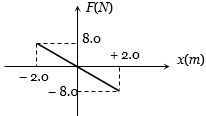
- 5A body of mass $0.01 kg$ executes simple harmonic motion $(S.H.M.)$ about $x = 0$ under the influence of a force shown below : The period of the $S.H.M.$ is .... $s$View Solution
- 6The bob of simple pendulum having length $l$, is displaced from mean position to an angular position $\theta$ with respect to vertical. If it is released, then velocity of bob at lowest positionView Solution
- 7The velocity vector $v$ and displacement vector $x$ of a particle executing SHM are related as $\frac{v d v}{d x}=-\omega^2 x$ with the initial condition $v=v_0$ at $x=0$. The velocity $v$, when displacement is $x$, isView Solution
- 8The function ${\sin ^2}(\omega t)$ representsView Solution
- 9The displacement y of a particle executing periodic motion is given by $y = 4{\cos ^2}(t/2)\sin (1000t)$. This expression may be considered to be a result of the superposition of ........... independent harmonic motionsView Solution
- 10View SolutionWhich of the following statements is not true ? In the case of a simple pendulum for small amplitudes the period of oscillation is