Question
A body performs simple harmonic motion according to the following equation :
$
x=6 \sin \left(3 \pi t+\frac{\pi}{3}\right)
$
Find out : (i) amplitude (ii) period (iii) initial art (iv) displacement, velocity and acceleration at time $t = 2$.
Answer

Given equation :
$x=6 \sin \left(3 \pi t+\frac{\pi}{3}\right)$
The general equation of simple harmonic motion is as follows :
$x=A \sin (\omega t+\phi)$
Comparing it with the given equation
(i) Dimension $A =6 m$
(ii) $\omega=3 \pi$
$\begin{aligned}\text {But}\quad\omega & =\frac{2 \pi}{T} \\T & =\frac{2 \pi}{\omega}=\frac{2 \pi}{3 \pi}=\frac{2}{3} sec \\T & =0 \cdot 666 sec .\end{aligned}$
(iii) Initial phase $=\frac{\pi}{3}$ radian
(iv) $x=6 \sin \left(3 \pi t +\frac{\pi}{3}\right)$ by keeping $t=2$ in
$\begin{aligned}x & =6 \sin \left(3 \pi \times 2+\frac{\pi}{3}\right) \\& =6 \sin \frac{\pi}{3}=6 \times \frac{\sqrt{3}}{2}=3 \sqrt{3}\end{aligned}$
Displacement $=3 \sqrt{3} m$.
$A =6$ and $\omega=3 \pi$ putting these values in the equation of velocity,
$\begin{array}{l}v= 3 \pi\left[(6)^2-(3 \sqrt{3})^2\right]^{\frac{1}{2}} \\\quad\left(\because v=\omega \sqrt{A^2-x^2}\right) \\=3 \pi(36-27)^{\frac{1}{2}}=3 \pi \times 3=9 \pi\end{array}$
Acceleration $a=\omega^2 x=(3 \pi)^2 \times 3 \sqrt{3}$
$=9 \pi^2 \times 3 \sqrt{3}=27 \sqrt{3} \pi^2$
Amplitude $=6$, period $=0.666 sec$.
Initial phase $=\frac{\pi}{3}$, displacement $=3 \sqrt{3} m / s$
Velocity $=9 \pi m / s$ and acceleration
$=27 \sqrt{3} \pi^2 m / s^2$

Need a full question paper?

Generate a complete, print-ready paper with questions like this in minutes — across 16+ boards, with answer keys.

Start Generating Free

Similar questions

What is simple pendulum? Show that the motion of the pendulum is S.H.M. and hence deduce an expression for the time period of pendulum. Also define second's pendulum.
Three identical charges, each having a value $1.0 \times 10^{-8}C$, are placed at the corners of an equilateral triangle of side $20cm$. Find the electric field and potential at the centre of the triangle.
Let us assume that our galaxy consists of $2.5 \times 10^{11}$ stars each of one solar mass. How long will a star at a distance of $50,000ly$ from the galactic centre take to complete one revolution? Take the diameter of the Milky Way to be $10^5ly$.
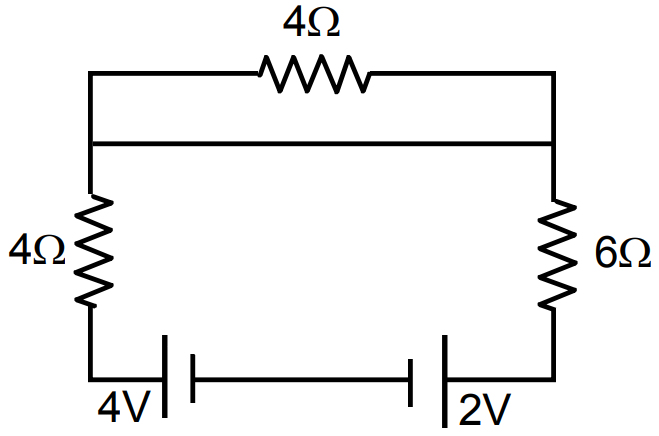
Find the currents through the three reaiators shown in figure.
Given below are some functions of x and t to represent the displacement of an elastic wave.$​​​​\text{y}=100\cos(100\pi\text{t+0.5x})$
During a total solar eclipse the moon almost entirely covers the sphere of the sun. Write the relation between the distances and sizes of the sun and moon.
Explain the reason for capillarity and mention some practical examples based on capillarity.
Suppose the smaller pulley of the previous problem has its radius $5.0cm$ and moment of inertia $0.10kg-m^2$. Find the tension in the part of the string joining the pulleys.
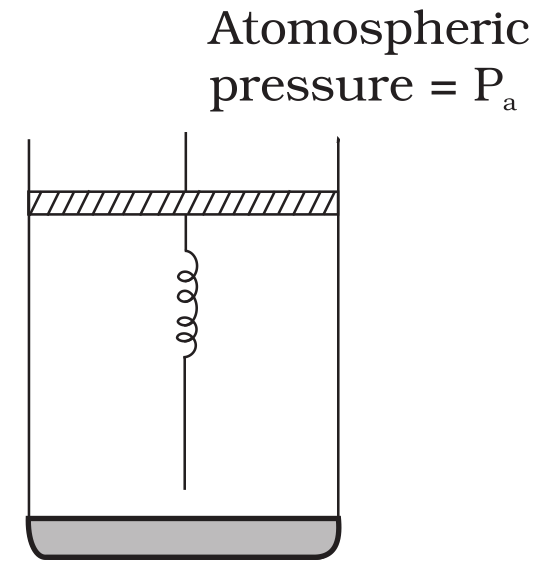
Consider one mole of perfect gas in a cylinder of unit cross section with a piston attached (Fig.) A spring (spring constant k) is attached (unstretched length L) to the piston and to the bottom of the cylinder. Initially the spring is unstretched and the gas is in equilibrium. A certain amount of heat Q is supplied to the gas causing an increase of volume from $V_o$ to $V_1$.
  1. What is the initial pressure of the system.
  2. What is the final pressure of the system.
  3. Uing the first law of thermodynamics, write down a relation between $Q, P_a, V, V_o$ and $k$.
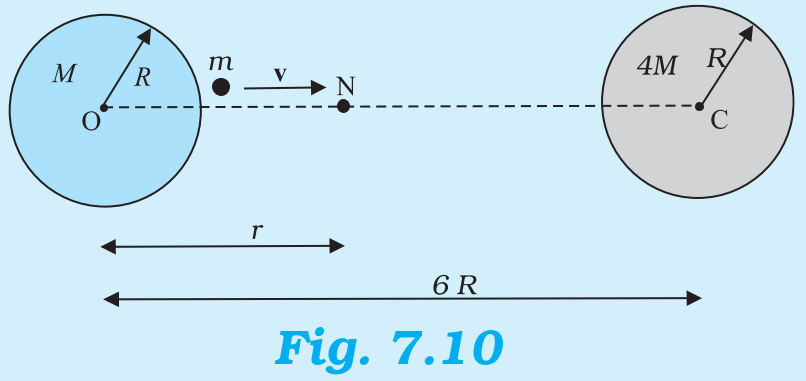
Two uniform solid spheres of equal radii $R$, but mass $M$ and $4 M$ have a centre to centre separation $6 R$, as shown in Fig. $7.10$. The two spheres are held fixed. A projectile of mass $m$ is projected from the surface of the sphere of mass $M$ directly towards the centre of the second sphere. Obtain an expression for the minimum speed $v$ of the projectile so that it reaches the surface of the second sphere.
Image