Question
A building is to be constructed in the form of a triangular pyramid, ABCD as shown in the figure.
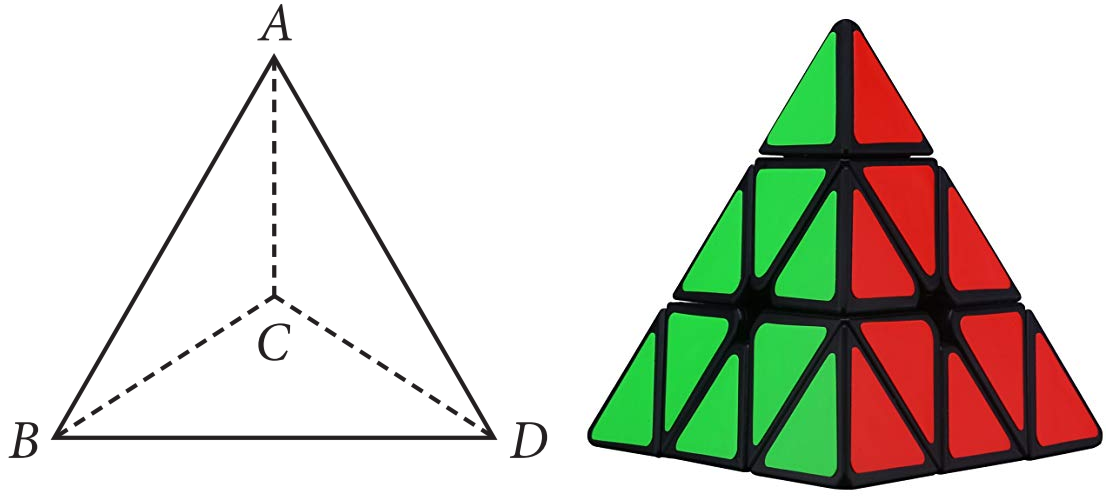
Let its angular points are A(0, 1, 2), B(3, 0, 1), C(4, 3, 6), and D(2, 3, 2), and G be the point of intersection of the medians of $\triangle\text{BCD}.$
Based on the above information, answer the following questions.
  1. The coordinates of point Gare:
  1. (2, 3, 3)
  2. (3, 3, 2)
  3. (3, 2, 3)
  4. (0, 2, 3)
  1. The length of vector $\overline{\text{AG}}$ is:
  1. $\sqrt{17}\text{ units}$
  2. $\sqrt{11}\text{ units}$
  3. $\sqrt{13}\text{ units}$
  4. $\sqrt{19}\text{ units}$
  1. Area of $\triangle\text{ABC}$ (in sq. units) is:
  1. $\sqrt{10}$
  2. $2\sqrt{10}$
  3. $3\sqrt{10}$
  4. $5\sqrt{10}$
  1. The sum of lengths of $\overline{\text{AB}}$ and $\overline{\text{AC}}$ is:
  1. 5 units
  2. 9.32 units
  3. 10 units
  4. 11 units
  1. The length of the perpendicular from the vertex D on the opposite face is:
  1. $\frac{6}{\sqrt{10}}\text{ units}$
  2. $\frac{2}{\sqrt{10}}\text{ units}$
  3. $\frac{3}{\sqrt{10}}\text{ units}$
  4. $8\sqrt{10}\text{ units}$

Answer

  1. (c) (3, 2, 3)
Solution:
Clearly, G be the centroid of $\triangle\text{BCD},$ therefore coordinates of G are
$\Big(\frac{3+4+2}{3},\frac{0+3+3}{3},\frac{1+6+2}{3}\Big)$
= (3, 2, 3)
  1. (b) $\sqrt{11}\text{ units}$
​​​​​​​​​​​​​​Solution:
Since, $\text{A}\equiv(0,1,2)$ and G = (3, 2, 3)
$\therefore\overline{\text{AG}}=(3-0)\hat{\text{i}}+(2-1)\hat{\text{j}}+(3-2)\hat{\text{k}}=3\hat{\text{i}}+\hat{\text{j}}+\hat{\text{k}}$
$\Rightarrow|\overline{\text{AG}}|^2=3^2+1^2+1^2=9+1+1=11$
$\Rightarrow|\overline{\text{AG}}|=\sqrt{11}$
  1. (c) $3\sqrt{10}$
​​​​​​​​​​​​​​​​​​​​​Solution:
Clearly, area of $\triangle\text{ABC}=\frac{1}{2}|\overline{\text{AB}}\times\overline{\text{AC}}|$
Here, $\overline{\text{AB}}\times\overline{\text{AC}}=\begin{vmatrix}\hat{\text{i}}&\hat{\text{j}}&\hat{\text{k}}\\3-0&0-1&1-2\\4-0&3-1&6-2\end{vmatrix}$
$=\begin{vmatrix}\hat{\text{i}}&\hat{\text{j}}&\hat{\text{k}}\\3&-1&-1\\4&2&4\end{vmatrix}$
$=\hat{\text{i}}(-4+2)-\hat{\text{j}}(12+4)+\hat{\text{k}}(6+4)$
$=-2\hat{\text{i}}-16\hat{\text{j}}+10\hat{\text{k}}$
$\therefore|\overline{\text{AB}}\times\overline{\text{AC}}|=\sqrt{(-2)^2+(-16)^2+10^2}$
$=\sqrt{4+256+100}=\sqrt{360}=6\sqrt{10}$
Hence, area of  $\triangle\text{ABC}=\frac{1}{2}\times6\sqrt{10}=3\sqrt{10}\text{sq}.\text{units}.$
  1. (b) 9.32 units
​​​​​​​​​​​​​​​​​​​​​​​​​​​​Solution:
Here,​​​​​​​ $\overline{\text{AB}}=3\hat{\text{i}}-\hat{\text{j}}-\hat{\text{k}}$
$\Rightarrow|\overline{\text{AB}}|=\sqrt{9+1+1}=\sqrt{11}$
Also, $\overline{\text{AC}}=4\hat{\text{i}}+2\hat{\text{j}}+4\hat{\text{k}}$
$\Rightarrow|\overline{\text{AC}}|=\sqrt{16+4+16}=\sqrt{36}=6$
Now, $|\overline{\text{AB}}|+\overline{\text{AC}}|=\sqrt{11}+6$
= 3.32 + 6 = 9.32 units.
  1. (a) $\frac{6}{\sqrt{10}}\text{ units}$
​​​​​​​​​​​​​​​​​​​​​​​​​​​​Solution:
The length of the perpendicular from the vertex D on the opposite face
$=|\text{Projection of }\overline{\text{AC}}\text{ on}\overline{\text{ AB}}\times\overline{\text{AC}}|$
$=\begin{vmatrix}\frac{(2\hat{\text{i}}+2\hat{\text{j}})\cdot(-2\hat{\text{i}}+16\hat{\text{j}}+10\hat{\text{k}})}{\sqrt{(-2)^2+(-6)^2+10^2}}\\\end{vmatrix}$
$=\begin{vmatrix}\frac{-4-32}{\sqrt{360}}\\\end{vmatrix}=\frac{36}{6\sqrt{10}}$
$=\frac{6}{\sqrt{10}}\text{ units}.$

Need a full question paper?

Generate a complete, print-ready paper with questions like this in minutes — across 16+ boards, with answer keys.

Start Generating Free

Similar questions

The upward speed $v(I)$ of a rocket at time $I$ is approximated by $\text{v}(\text{t})=\text{at}^2+\text{bt}+\text{c},0\leq\text{t}\leq100,$ here $a, b$ and $c$ are constants. It has been found that the speed at $\times t = 3, t = 6$ and $t = 9$ seconds are respectively $64, 133$ and $208$ miles per second..

If $\begin{bmatrix}9&3&1\\36&6&1\\81&9&1\end{bmatrix}^{-1}=\frac{1}{18}\begin{bmatrix}1&-2&1\\-15&24&-9\\54&-54&18\end{bmatrix},$ then answer the following questions.
  1. The value of $b + c$ is:
  1. $20$
  2. $21$
  3. $\frac{3}{4}$
  4. $\frac{4}{3}$
  1. The value of $a + c$ is:
  1. $1$
  2. $20$
  3. $\frac{4}{3}$
  4. None of these.
  1. $v(t)$ is given by:
  1. $\text{t}^2+20\text{t}+1$
  2. $\frac{1}{3}\text{t}^2+20\text{t}+1$
  3. $\text{t}^2+\frac{1}{3}\text{t}+20$
  4. $\text{t}^2+\text{t}+1$
  1. The speed at time $1 = 15 $seconds is:
  1. $346$ miles/ sec
  2. $356$ miles/ sec
  3. $366$ miles/ sec
  4. $376$ miles/ sec
  1. The time at which the speed of rocket is $784$ miles/ sec is:
  1. $20$ seconds
  2. $30$ seconds
  3. $25$ seconds
  4. $27$ seconds
Read the following text carefully and answer the questions that follow :
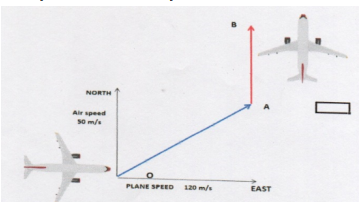
A plane started from airport $O$ with a velocity of $120 m/s$ towards east.
Air is blowing at a velocity of $50 m/s$ towards the north As shown in the figure.
The plane travelled $1$ hr in $OA$ direction with the resultant velocity. From $A$ and $B$ travelled $1$ hr with keeping velocity of $120 m/s$ and finally landed at $B$.
Image
i. What is the resultant velocity from $O$ to $A$?
ii. What is the direction of travel of plane $O$ to $A$ with east?
iii. What is the total displacement from $O$ to $A$?
OR
What is the resultant velocity from $A$ to $B$ ?
Read the following passage and answer the questions given below. 

Image

The temperature of a person during an intestinal illness is given by $f(x)=-0.1 x^2+m x+98.6,0 \leq x \leq 12, \mathrm{~m}$ being a constant, where $\mathrm{f}(\mathrm{x})$ is the temperature in ${ }^{\circ} \mathrm{F}$ at $x$ days.

(i) Is the function differentiable in the interval $(0,12)$ ? Justify your answer.

(ii) If 6 is the critical point of the function, then find the value of the constant $\mathrm{m}$.

(iii) Find the intervals in which the function is strictly increasing/strictly decreasing.
OR
(iii) Find the points of local maximum/local minimum, if any, in the interval (0, 12) as well as the points of absolute maximum/absolute minimum in the interval [0, 12]. Also, find the corresponding local maximum/local minimum and the absolute maximum/absolute minimum values of the function. 

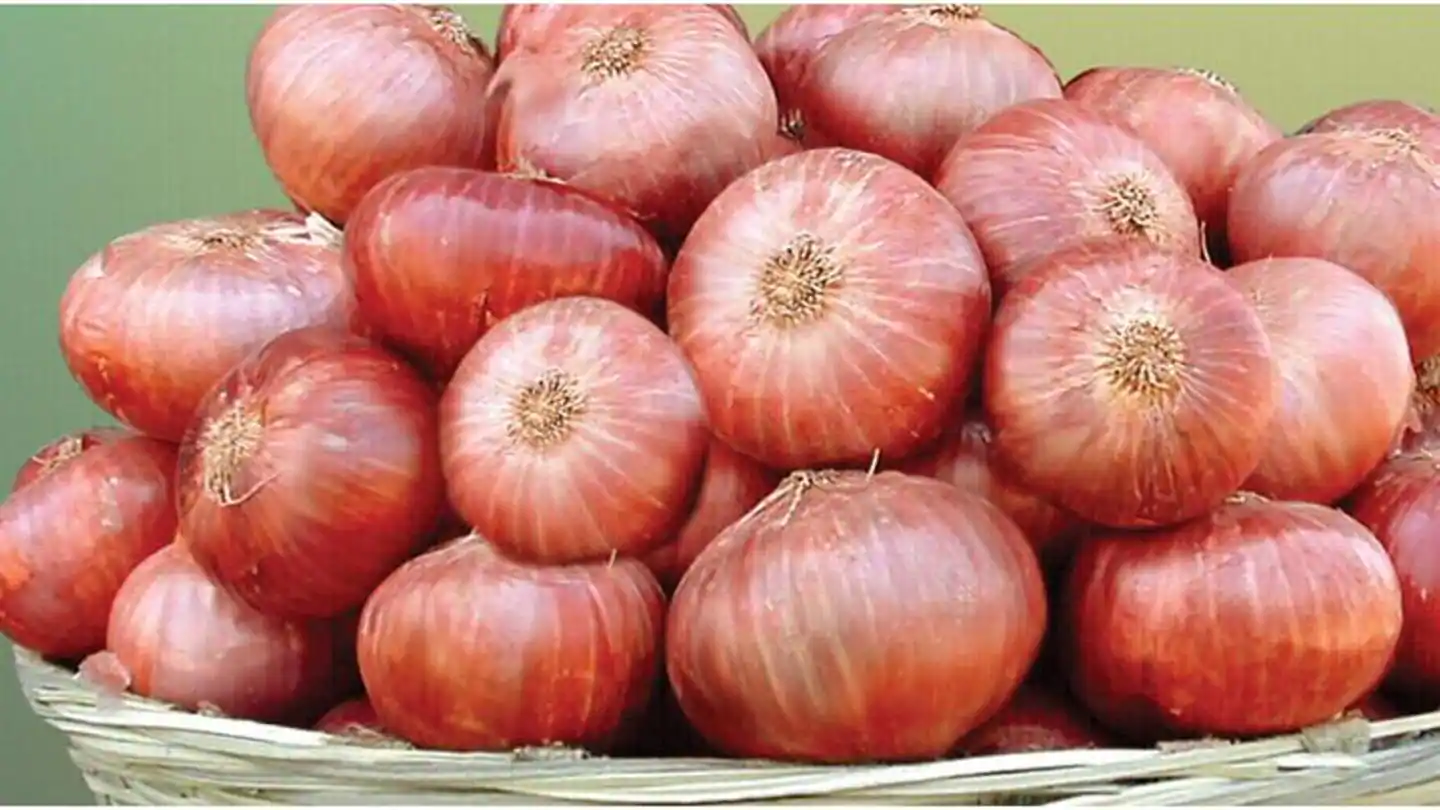
The Government declare that farmers can get $₹\ 300$ per quintal for their onions on $1^{st}$ July and after that, the price will be dropped by $₹\ 3$ per quintal per extra day. Shyams father has $80$ quintal of onions in the field on $1^{st}$ July, and he estimates that crop is increasing at the rate of $1$ quintal per day.

Based on the above information, answer the following questions.
  1. If $x$ is the number of days after $1^{st}$ July, then price and quantity of onion respectively can be expressed as.
  1. $₹\ (300 - 3x), (80 + x)$ quintals
  2. $₹\ (300 - 3x), (80 - x)$ quintals
  3. $₹\ (300 + x), 80$ quintals
  4. None of these
  1. Revenue $R$ as a function of $x$ can be represented as.
  1. $R(x) = 3x^2 - 60x - 24000$
  2. $R(x) = 3x^2 + 60x - 24000$
  3. $R(x) = 3x^2 + 40x - 16000$
  4. $R(x) = 3x^2 - 60x - 14000$
  1. Find the number of days after $1^{st}$ July, when Shyam's father attain maximum revenue.
  1. $10$
  2. $20$
  3. $12$
  4. $22$
  1. On which day should Shyam's father harvest the onions to maximise his revenue?
  1. $11^{th}$ July
  2. $20^{th}$ July
  3. $12^{th}$ July
  4. $22^{nd}$ July
  1. Maximum revenue is equal to.
  1. $₹\ 20,000$
  2. $₹\ 24,000$
  3. $₹\ 24,300$
  4. $₹\ 24,700$
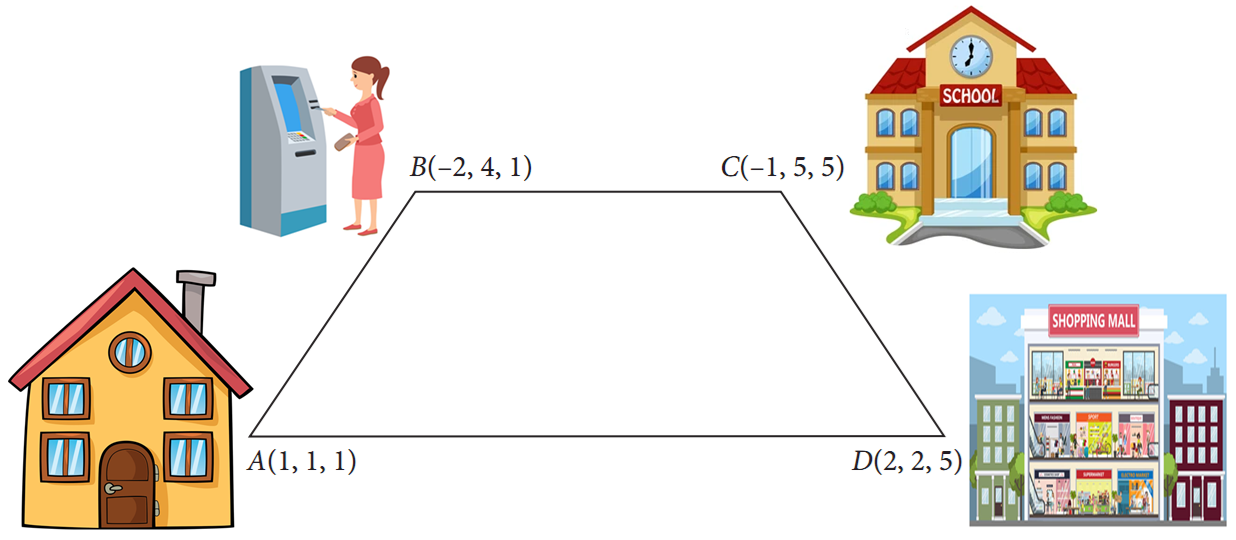
Ritika starts walking from his house to shopping mall. Instead of going to the mall directly, she first goes to a ATM, from there to her daughter's school and then reaches the mall. ln the diagram, A, B, C, and D represent the coordinates of House, ATM, School and Mall respectively.

Based on the above information, answer the following questions.
  1. Distance between House (A) and ATM (B) is:
  1. $3\text{ units}$
  2. $3\sqrt{2}\text{ units}$
  3. $\sqrt{2}\text{ units}$
  4. $4\sqrt{2}\text{ units}$
  1. Distance between ATM (B) and School (C) is:
  1. $\sqrt{2}\text{ units}$
  2. $2\sqrt{2}\text{ units}$
  3. $3\sqrt{2}\text{ units}$
  4. $4\sqrt{2}\text{ units}$
  1. Distance between School (C) and Shopping mall (D) is:
  1. $3\sqrt{2}\text{ units}$
  2. $5\sqrt{2}\text{ units}$
  3. $7\sqrt{2}\text{ units}$
  4. $10\sqrt{2}\text{ units}$
  1. What is the total distance travelled by Ritika:
  1. $4\sqrt{2}\text{ units}$
  2. $6\sqrt{2}\text{ units}$
  3. $8\sqrt{2}\text{ units}$
  4. $9\sqrt{2}\text{ units}$
  1. What is the extra distance travelled by Ritika in reaching the shopping mall?
  1. $3\sqrt{2}\text{ units}$
  2. $5\sqrt{2}\text{ units}$
  3. $6\sqrt{2}\text{ units}$
  4. $7\sqrt{2}\text{ units}$
Two motorcycles A and Bare running at the speed more than allowed speed on the road along the lines $\vec{\text{r}}=\lambda(\hat{\text{i}}+2\hat{\text{j}}-\hat{\text{k}})$ and $\vec{\text{r}}=3\hat{\text{i}}+3\hat{\text{j}}+\mu(2\hat{\text{i}+\hat{\text{j}}+\hat{\text{k}}}),$ respectively. Based on the above information, answer the following questions.
  1. The cartesian equation of the line along which motorcycle A is running is:
  1. $\frac{\text{x}+1}{1}=\frac{\text{y}+1}{2}=\frac{\text{z}-1}{-1}$
  2. $\frac{\text{x}}{1}=\frac{\text{y}}{2}=\frac{\text{z}}{-1}$
  3. $\frac{\text{x}}{1}=\frac{\text{y}}{2}=\frac{\text{z}}{1}$
  4. None of these
  1. The direction cosines of line along which motorcycle A is running, are:
  1. < 1, -2, 1 >
  2. < I, 2, -1 >
  3. $<\frac{1}{\sqrt{6}},\frac{-2}{\sqrt{6}},\frac{1}{\sqrt{6}}>$
  4. $<\frac{1}{\sqrt{6}},\frac{2}{\sqrt{6}},\frac{-1}{\sqrt{6}}>$
  1. The direction ratios of line along which motorcycle Bis running, are:
  1. < 1, 0, 2 >
  2. < 2, 1, 0 >
  3. < 1, 1, 2 >
  4. < 2, 1, 1 >
  1. The shortest distance between the gives lines is:
  1. 4 units
  2. $2\sqrt{3}\text{ units}$
  3. $3\sqrt{2}\text{ units}$
  4. 0 units
  1. The motorcycles will meet with an accident at the point:
  1. (-1, 1, 2)
  2. (2, 1, -1)
  3. (1, 2, -1)
  4. Does not exist
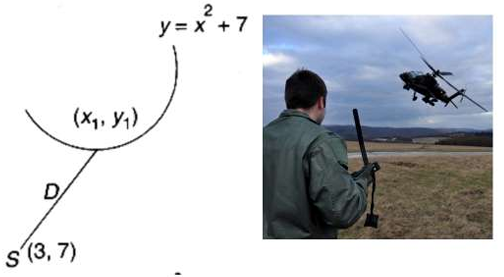
An Apache helicopter of the enemy is flying along the curve given by $y=x^2+7$. A soldier, placed at $(3,7)$ want to shoot down the helicopter when it is nearest to him.

Image

(i) If $\mathrm{P}\left(\mathrm{x}_1, \mathrm{y}_1\right)$ be the position of a helicopter on curve $\mathrm{y}=\mathrm{x}^2+7$, then find distance $\mathrm{D}$ from $\mathrm{P}$ to soldier place at $(3,7)$.

(ii) Find the critical point such that distance is minimum.

(iii) Verify by second derivative test that distance is minimum at $(1,8)$.

OR

Find the minimum distance between soldier and helicopter?

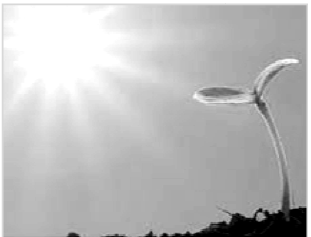
Read the following passage and answer the questions given below: elation between the height of the plant $\left(y^{\prime}\right.$ in cm $)$ with respect to its exposure to is governed by the following equation  $y=4 x-\frac{1}{2} x^2$, where ' $x$ ' is the number of days exposed to the sunlight, for $x \leq 3$

Image

(i) Find  the rate of growth of the plant with respect to the number of days exposed to the sunlight.

(ii) Does the rate of  growth of the plant increase or decrease in the first three days? 
What will be the height of the plant after 2 days?

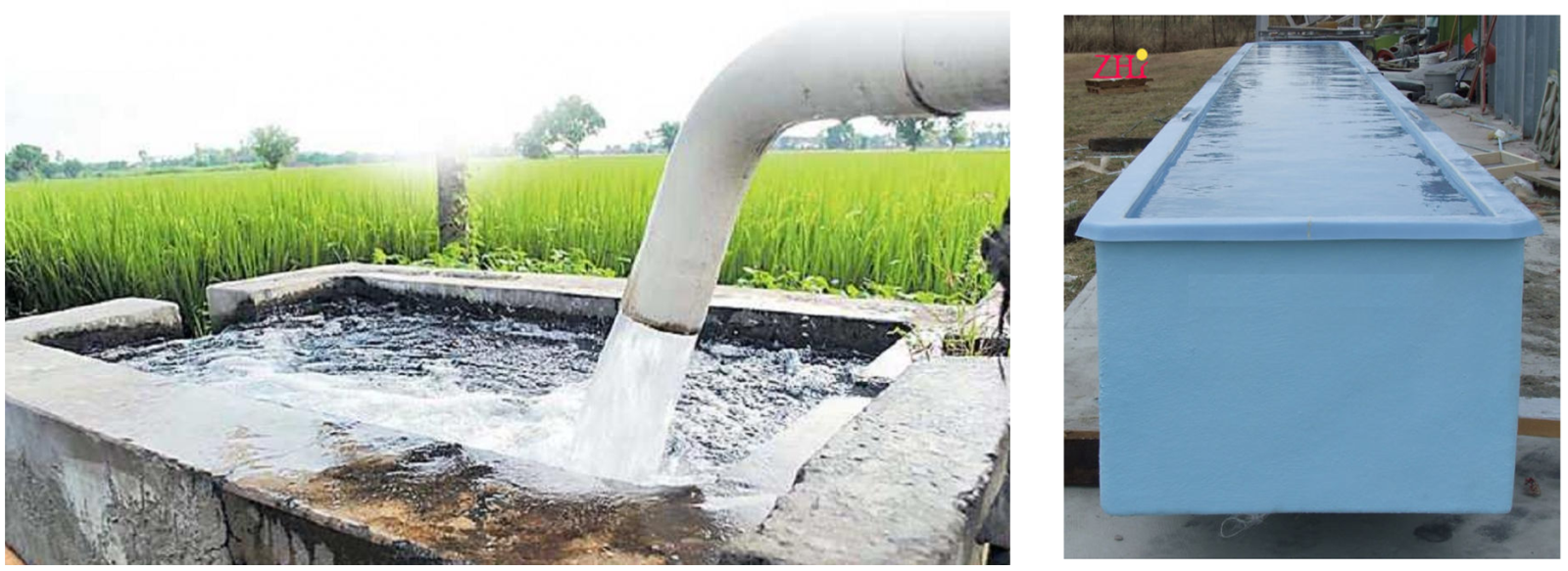
An open water tank of aluminium sheet of negligible thickness, with a square base and vertical sides, is to be constructed in a farm for irrigation. It should hold $32000 \ l$ of water, that comes out from a tube well.

Based on above information, answer the following questions.
  1. If the length, width, and height of the open tank be $x, x$ and $y ,m$ respectively, then total surface area of tank is.
  1. $(x^2 + 2xy)m^2$
  2. $(2x^2 + 4xy)m^2$
  3. $(2x^2 + 2xy)m^2$
  4. $(2x^2 + 8xy)m^2$
  1. The relation between $x $ and $y$ is.
  1. $x^2y = 32$
  2. $xy^2 = 32$
  3. $x^2y^2 = 32$
  4. $xy = 32$
  1. The outer surface area of tank will be minimum when depth of tank is equal to.
  1. Half of its width.
  2. Its width.
  3. $\big(\frac{1}{4}\big)^\text{th}$ of its Width
  4. $\big(\frac{1}{3}\big)^\text{rd}$ of its Width
  1. The cost of material will be least when width of tank is equal to.
  1. Half of its depth
  2. Twice of its depth
  3. $\big(\frac{1}{4}\big)^\text{th}$ of its depth
  4. Thrice of its depth
  1. If cost of aluminium sheet is $ ₹ \frac{360}{\text{m}^2}$ then the minimum cost for the construction of tank will be.
  1. $₹ \ 15, 000$
  2. $₹ \ 16, 280$
  3. $₹ \ 17, 280$
  4. $₹ \ 18, 280$
If two vectors are represented by the two sides of a triangle taken in order, then their sum is represented by the third side of the triangle taken in opposite order and this is known as triangle law of vector addition. Based on the above information, answer the following questions.
  1. If $\vec{\text{p}},\vec{\text{q}},\vec{\text{r}}$ are the vectors represented by the sides of a triangle taken in order, then $\vec{\text{q}},+\vec{\text{r}}=$
  1. $\vec{\text{p}}$
  2. $2\vec{\text{p}}$
  3. $-\vec{\text{p}}$
  4. None of these
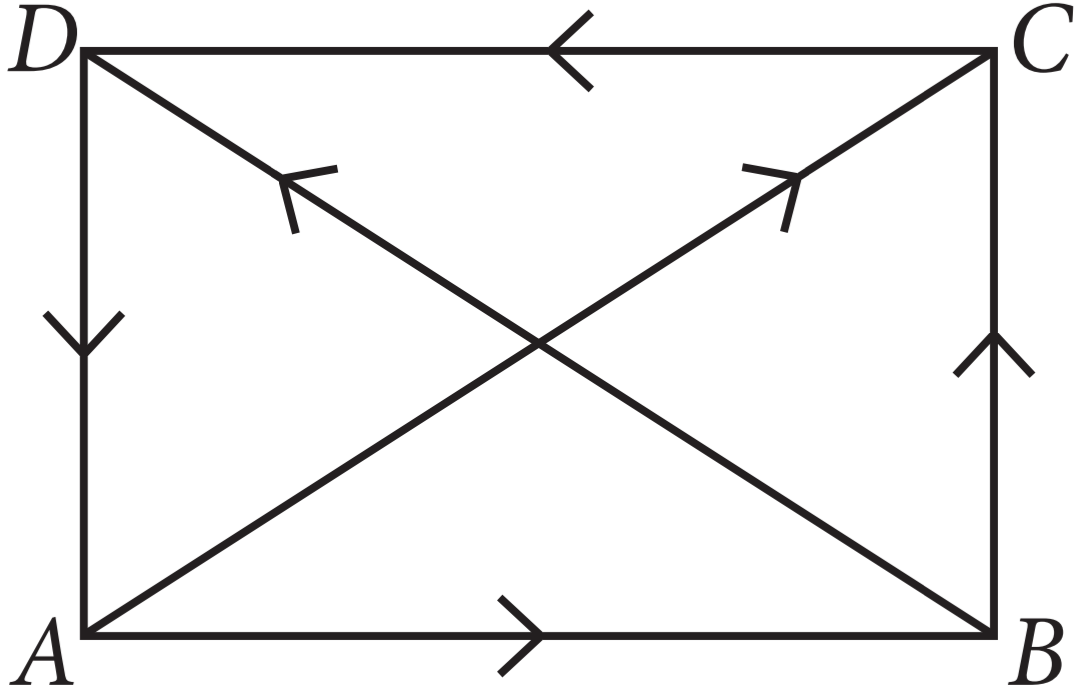
  1. If ABCD is a parallelogram and AC and BD are its diagonals, then $\overline{\text{AC}}+\overline{\text{BD}}=$
  1. $2\overline{\text{DA}}$
  2. $2\overline{\text{AB}}$
  3. $2\overline{\text{BC}}$
  4. $2\overline{\text{BD}}$
  1. If ABCD is a parallelogram, where $\overline{\text{AB}}=2\vec{\text{a}}$ and $\overline{\text{BC}}=2\vec{\text{b}},$ then $\overline{\text{AC}}-\overline{\text{BD}}=$
  1. $3\vec{\text{a}}$
  2. $4\vec{\text{a}}$
  3. $2\vec{\text{b}}$
  4. $4\vec{\text{b}}$
  1. If ABCD is a quadrilateral whose diagonals are $\overline{\text{AC}}$ and $\overline{\text{BD}},$ then $\overline{\text{BA}}+\overline{\text{DC}}=$
  1. $\overline{\text{AC}}+\overline{\text{DB}}$
  2.  $\overline{\text{AC}}+\overline{\text{BD}}$
  3. $\overline{\text{BC}}+\overline{\text{AD}}$
  4. $\overline{\text{BD}}+\overline{\text{CA}}$
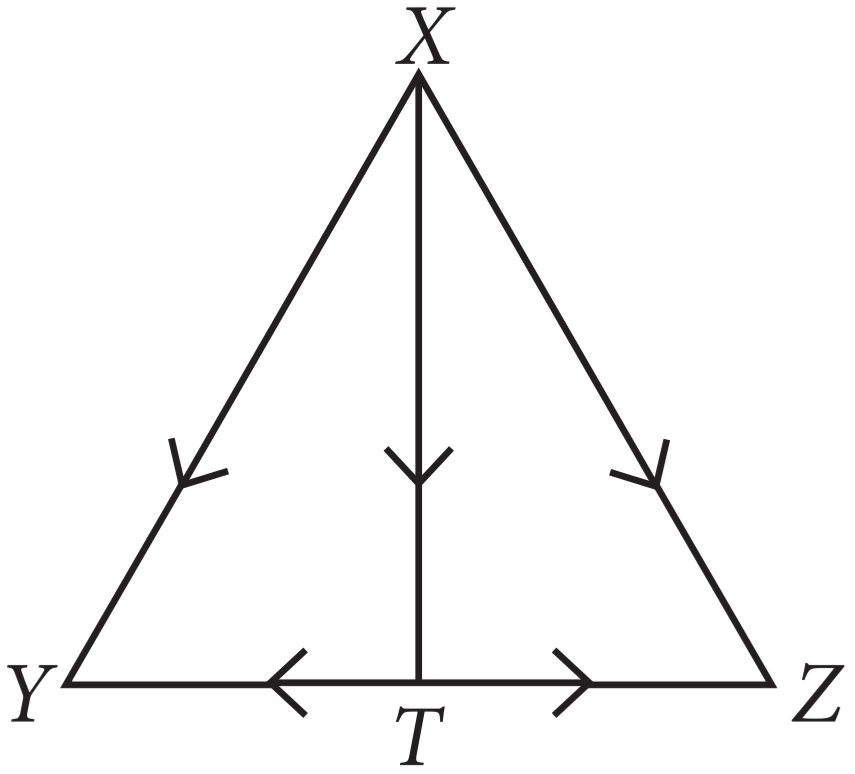
  1. If T is the mid point of side YZ of $\triangle\text{XYZ},$ then $\overline{\text{XY}}+\overline{\text{XZ}}=$
  1. $2\overline{\text{YT}}$
  2. $2\overline{\text{XT}}$
  3. $2\overline{\text{TZ}}$
  4. None of these