Question
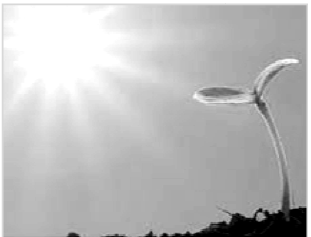
Read the following passage and answer the questions given below: elation between the height of the plant $\left(y^{\prime}\right.$ in cm $)$ with respect to its exposure to is governed by the following equation  $y=4 x-\frac{1}{2} x^2$, where ' $x$ ' is the number of days exposed to the sunlight, for $x \leq 3$
Image

(i) Find  the rate of growth of the plant with respect to the number of days exposed to the sunlight.

(ii) Does the rate of  growth of the plant increase or decrease in the first three days? 
What will be the height of the plant after 2 days?
Answer

$y=4 x-\frac{1}{2} x^2$ 

(i) The rate of growth of the plant with respect to the number of days exposed to sunlight is given by $\frac{d y}{d x}=4-x$

(ii) Let rate of growth be represented by the function $g(x)=\frac{d y}{d x}$

Now, $g^{\prime}(x)=\frac{d}{d x}\left(\frac{d y}{d x}\right)=-1<0$

$\Rightarrow g(x)$ decreases.

So the rate of growth of the plant decreases for the first three days.

Height of the plant after 2 days is $y=4 \times 2-\frac{1}{2}(2)^2=6 \mathrm{~cm}$.

Need a full question paper?

Generate a complete, print-ready paper with questions like this in minutes — across 16+ boards, with answer keys.

Start Generating Free

Similar questions

 A card is lost from a pack of $52$ cards. From the remaining cards two cards are drawn at random.

Based on the above information, answer the following questions.
  1. The probability of drawing two diamonds, given that a card of diamond is missing, is:
  1. $\frac{21}{425}$
  2. $\frac{22}{425}$
  3. $\frac{23}{425}$
  4. $\frac{1}{425}$
  1. The probability of drawing two diamonds, given that a card of heart is missing, is:
  1. $\frac{26}{425}$
  2. $\frac{22}{425}$
  3. $\frac{19}{425}$
  4.  $\frac{23}{425}$
  1. Let $A$ be the event of drawing two diamonds from remaining $51$ cards and $E_1, E_2, E_3$ and $E_4$ be the events that lost card is of diamond, club, spade and heart respectively, then the approximate value of $\displaystyle\sum_{\text{i}=1}^{4}\text{P(A|E}_\text{i})$ is:
  1. $0.17$
  2. $0.24$
  3. $0.25$
  4. $0.18$
  1. $AU$ of a sudden, missing card is found and, then two cards are drawn simultaneously without replacement. Probability that both drawn cards are king is:
  1. $\frac{1}{52}$
  2. $\frac{1}{221}$
  3. $\frac{1}{121}$
  4. $\frac{2}{221}$
  1. If two cards are drawn from a well shuffled pack of $52$ cards, one by one with replacement, then probability of getting not a king in $1^{st}$ and $2^{nd}$ draw is:
  1. $\frac{144}{169}$
  2. $\frac{12}{169}$
  3. $\frac{64}{169}$
  4. None of these 
In an office three employees Govind, Priyanka and Tahseen process incoming copies of a certain form. Govind process $50 \%$ of the forms, Priyanka processes $20 \%$ and Tahseen the remaining $30 \%$ of the forms. Govind has an error rate of 0.06 , Priyanka has an error rate of 0.04 and Tahseen has an error rate of 0.03 . 

Image

(i) The manager of the company wants to do a quality check. During inspection he selects a form at random from the days output of processed forms. If the form selected at random has an error, find the probability that the form is NOT processed by Govind.

(ii) Find the probability that Priyanka processed the form and committed an error.

Three shopkeepers $A, B$ and $C$ go to a store to buy stationary. A purchase $12$ dozen notebooks, $5$ dozen pens and $6$ dozen pencils. $B$ purchases $10$ dozen notebooks, $6$ dozen pens and $7$ dozen pencils. $C$ purchases $11$ dozen notebooks, $13$ dozen pens and $8$ dozen pencils. A notebook costs $₹. 40,$ a pen costs $₹. 12$ and a pencil costs $₹. 3.$

Based on the above information, answer the following questions.
  1. The number of items purchased by shopkeepers $A, B$ and $C$ represented in matrix form as:
  1. $\begin{matrix}\text{Notebooks}&\text{Pens}&\text{Pencils}\end{matrix}\\\begin{bmatrix}144&\ \ \ \ \ \ \ \ 60&\ \ \ \ \ 72\\120&\ \ \ \ \ \ \ \ \ 720&\ \ \ \ \ 84\\132&\ \ \ \ \ \ \ \ \ 156&\ \ \ \ \ 96\end{bmatrix}\begin{matrix}\text{A}\\\text{B}\\\text{C}\end{matrix}$
  2. $\begin{matrix}\text{Notebooks}&\text{Pens}&\text{Pencils}\end{matrix}\\\begin{bmatrix}144&\ \ \ \ \ \ \ \ 72&\ \ \ \ \ 60\\120&\ \ \ \ \ \ \ \ \ 84&\ \ \ \ \ 72\\132&\ \ \ \ \ \ \ \ \ 156&\ \ \ \ \ 96\end{bmatrix}\begin{matrix}\text{A}\\\text{B}\\\text{C}\end{matrix}$
  3. $\begin{matrix}\text{Notebooks}&\text{Pens}&\text{Pencils}\end{matrix}\\\begin{bmatrix}144&\ \ \ \ \ \ \ \ 72&\ \ \ \ \ 72\\120&\ \ \ \ \ \ \ \ \ 156&\ \ \ \ \ 84\\132&\ \ \ \ \ \ \ \ \ 84&\ \ \ \ \ 96\end{bmatrix}\begin{matrix}\text{A}\\\text{B}\\\text{C}\end{matrix}$
  4. $\begin{matrix}\text{Notebooks}&\text{Pens}&\text{Pencils}\end{matrix}\\\begin{bmatrix}144&\ \ \ \ \ \ \ \ 60&\ \ \ \ \ 60\\120&\ \ \ \ \ \ \ \ \ 84&\ \ \ \ \ 72\\132&\ \ \ \ \ \ \ \ \ 156&\ \ \ \ \ 96\end{bmatrix}\begin{matrix}\text{A}\\\text{B}\\\text{C}\end{matrix}$
  1. If $Y$ represents the matrix formed by the cost of each item, then $XY$ equals.
  1. $\begin{bmatrix}5741\\6780 \\8040\end{bmatrix}$
  2. $\begin{bmatrix}6696\\5916 \\7440\end{bmatrix}$
  3. $\begin{bmatrix}5916\\6696 \\7440\end{bmatrix}$
  4. $\begin{bmatrix}6740\\5740 \\8140\end{bmatrix}$
  1. Bill of $A$ is equal to:
  1. $₹. 6740$
  2. $₹. 8140$
  3. $₹. 5740$
  4. $₹. 6696$
  1. If $A^2 = A,$ then $(A + 1)^{3 }- 7A =$
  1. $A$
  2. $A - I$
  3. $I$
  4. $A + I$
  1. If $A$ and $B$ are $3 \times 3$ matrices such that $A^2 - B^2 = (A - B) (A+ B),$ then
  1. Either $A$ or $B$ is zero matrix.
  2. Either $A$ or $B$ is unit matrix.
  3. $A = B$
  4. $AB = BA$
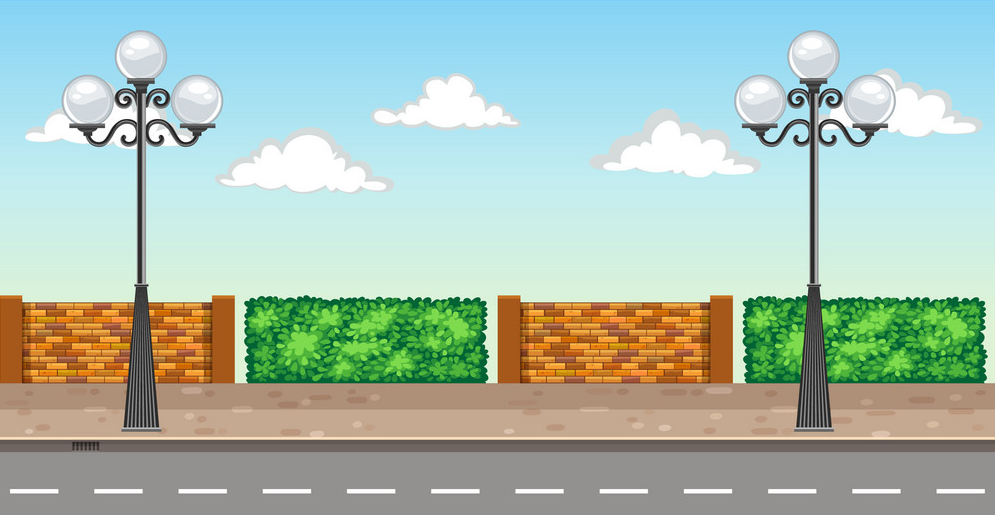
In a street, two lamp posts are 600 feet apart. The light intensity at a distanced from the first (stronger) lamp post is $\frac{1000}{\text{d}^2}$ the light intensity at distance d from the second (weaker) lamp post is $\frac{125}{\text{d}^2}$ (in both cases the light intensity is inversely proportional to the square of the distance to the light source). The combined light intensity is the sum of the two light intensities coming from both lamp posts.

Based on the above information, answer the following questions.
  1. If you are in between the lamp posts, at distance x feet from the stronger tight, then the formula for the combined light intensity coming from both lamp posts as function of x, is
  1. $\frac{1000}{\text{x}^2}+\frac{125}{\text{x}^2}$
  2. $\frac{1000}{\big(600-\text{x}^2\big)}+\frac{125}{\text{x}^2}$
  3. $\frac{1000}{\text{x}^2}+\frac{125}{\big(600-\text{x}^2\big)}$
  4. $\text{None of these}$
  1. The maximum value of x can not be.
  1. 100
  2. 200
  3. 600
  4. None of these
  1. The minimum value of x can not be.
  1. 0
  2. 100
  3. 200
  4. None of these
  1. If l(x) denote the combined tight intensity, then l(x) will be minimum when x =
  1. 200
  2. 400
  3. 600
  4. 800
  1. The darkest spot between the two lights is.
  1. At a distance of 200 feet from the weaker lamp post.
  2. At distance of 200 feet from the stronger lamp post.
  3. At a distance of 400 feet from the weaker lamp post.
  4. None of these
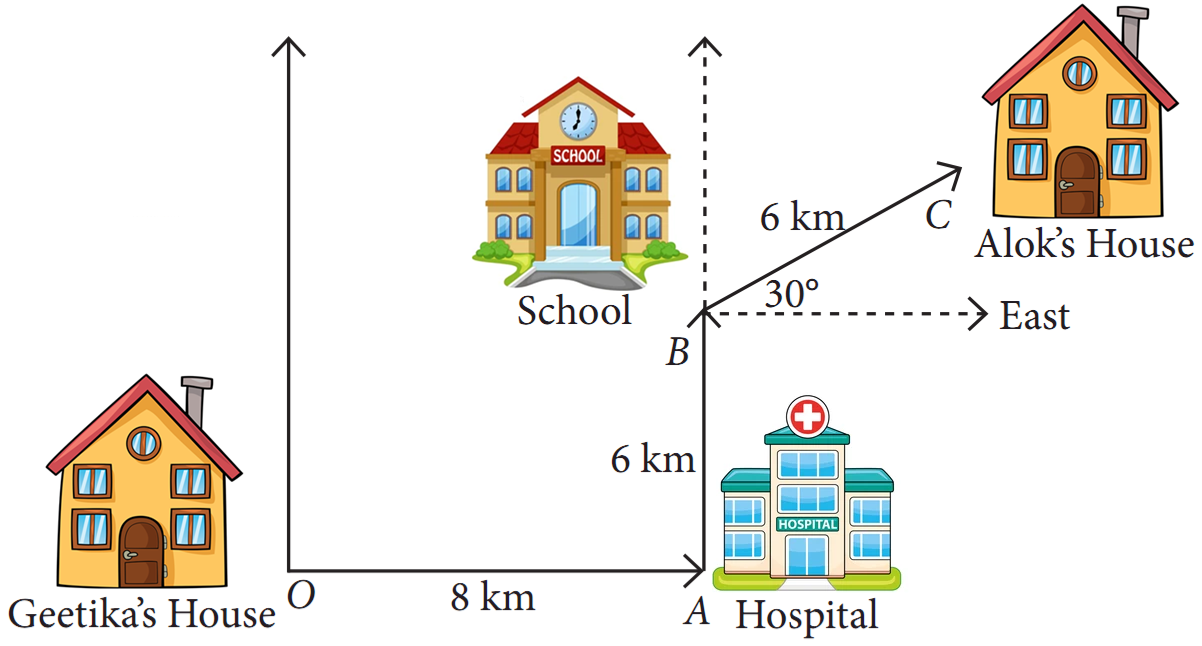
Geetika's house is situated at Shalimar Bagh at point O, for going to Alok's house she first travels 8km by bus in the East. Here at point A, a hospital is situated. From Hospital, Geetika takes an auto and goes 6km in the North, here at point B school is situated. From school, she travels by bus to reach Alok's house which is at 30º East, 6km from point B.

Based on the above information, answer the following questions.
  1. What is the vector distance between Geetika's house and school?
  1. $8\hat{\text{i}}-6\hat{\text{j}}$
  2. $8\hat{\text{i}}+6\hat{\text{j}}$
  3. $8\hat{\text{i}}$
  4. $6\hat{\text{j}}$
  1. How much distance Geetika travels to reach school?
  1. 14km
  2. 15km
  3. 16km
  4. 17km
  1. What is the vector distance from school to Alok's house?
  1. $\sqrt{3}\hat{\text{i}}+\hat{\text{j}}$
  2. $3\sqrt{3}\hat{\text{i}}+3\hat{\text{j}}$
  3. $6\hat{\text{i}}$
  4. $6\hat{\text{j}}$
  1. What is the vector distance from Geetika's house to Alok's house?
  1. $(8+3\sqrt{3})\hat{\text{i}}+9\hat{\text{j}}$
  2. $4\hat{\text{i}}+6\hat{\text{j}}$
  3. $15\hat{\text{i}}$
  4. $16\hat{\text{j}}$
  1. What is the total distance travelled by Geetika from her house to Alok's house?
  1. 19km
  2. 20km
  3. 21km
  4. 22km
Read the following text carefully and answer the questions that follow :
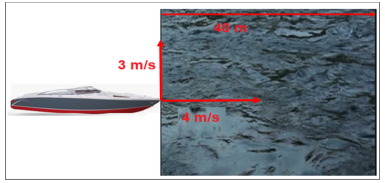
Once Ramesh was going to his native place at a village near Agra. From Delhi and Agra he went by flight, In the way, there was a river. Ramesh reached the river by taxi. Then Ramesh used a boat for crossing the river. The boat heads directly across the river $40$ m wide at $4 m/s$. The current was flowing downstream at $3 m/s.$
Image
$i.$  What is the resultant velocity of the boat? $(1)$
$ii.$  How much time does it take the boat to cross the river? $(1)$
$iii$. How far downstream is the boat when it reaches the other side? $(2)$​​​​​​​
OR
If speeds of boat and current were $1.5 m/s$ and $2.0 m/s$ then what will be resultant velocity? $(2)$
If y = f(u) is a differentiable function of u and u = g(x) is a differentiable function of x, then y = f(g(x)] is a differentiable function of x and $\frac{\text{dy}}{\text{dx}}=\frac{\text{dy}}{\text{du}}\times\frac{\text{du}}{\text{dx}}.$ This rule is also known as CHAIN RULE.
Based on the above information, find the derivative of functions w.r.t. x in the following questions.
  1. $\cos\sqrt{\text{x}}$
  1. $\frac{-\sin\sqrt{\text{x}}}{2\sqrt{\text{x}}}$
  2. $\frac{\sin\sqrt{\text{x}}}{2\sqrt{\text{x}}}$
  3. $\sin\sqrt{\text{x}}$
  4. $-\sin\sqrt{\text{x}}$
  1. $7^{\text{x}+\frac{1}{\text{x}}}$
  1. $\Big(\frac{\text{x}^2-1}{\text{x}^2}\Big)\cdot7^{\text{x}+\frac{1}{\text{x}}}\cdot\log7$
  2. $\Big(\frac{\text{x}^2+1}{\text{x}^2}\Big)\cdot7^{\text{x}+\frac{1}{\text{x}}}\cdot\log7$
  3. $\Big(\frac{\text{x}^2-1}{\text{x}^2}\Big)\cdot7^{\text{x}-\frac{1}{\text{x}}}\cdot\log7$
  4. $\Big(\frac{\text{x}^2+1}{\text{x}^2}\Big)\cdot7^{\text{x}-\frac{1}{\text{x}}}\cdot\log7$
  1. $\sqrt\frac{{1-\cos\text{x}}}{1+\cos\text{x}}$
  1. $\frac{1}{2}\sec^2\frac{\text{x}}{2}$
  2. $-\frac{1}{2}\sec^2\frac{\text{x}}{2}$
  3. $\sec^2\frac{\text{x}}{2}$
  4. $-\sec^2\frac{\text{x}}{2}$
  1. $\frac{1}{\text{b}}\tan^{-1}\Big(\frac{\text{x}}{\text{b}}\Big)+\frac{1}{\text{a}}\tan^{-1}\Big(\frac{\text{x}}{\text{a}}\Big)$
  1. $\frac{-1}{\text{x}^2+\text{b}^2}+\frac{1}{\text{x}^2+\text{a}^2}$
  2. $\frac{1}{\text{x}^2+\text{b}^2}+\frac{1}{\text{x}^2+\text{a}^2}$
  3. $\frac{1}{\text{x}^2+\text{b}^2}-\frac{1}{\text{x}^2+\text{a}^2}$
  4. None of these.
  1. $\sec^{-1}\text{x}+\text{cosec}^{-1}\frac{\text{x}}{\sqrt{\text{x}^2-1}}$
  1. $\frac{2}{\sqrt{\text{x}^2-1}}$
  2. $\frac{-2}{\sqrt{\text{x}^2-1}}$
  3. $\frac{1}{|\text{x}|\sqrt{\text{x}^2-1}}$
  4. $\frac{2}{|\text{x}|\sqrt{\text{x}^2-1}}$
It is known that, if the interest is compounded continuously, the principal changes at the rate equal to the product of the rate of bank interest per annum and the principal. Let $P$ denotes the principal at any time $t$ and rate of interest be $r\%$ per annum.

Based on the above information, answer the following question.
  1. Find the value of $\frac{\text{dP}}{\text{dt}}.$
  1. $\frac{\text{Pr}}{1000}$
  2. $\frac{\text{Pr}}{100}$
  3. $\frac{\text{Pr}}{10}$
  4. $\text{Pr}$
  1. If $P_0$ be the initial principal, then find the solution of differential equation formed in given situation.
  1. $\log\Big(\frac{\text{P}}{\text{P}_0}\Big)=\frac{\text{rt}}{100}$
  2. $\log\Big(\frac{\text{P}}{\text{P}_0}\Big)=\frac{\text{rt}}{10}$
  3. $\log\Big(\frac{\text{P}}{\text{P}_0}\Big)=\text{rt}$
  4. $\log\Big(\frac{\text{P}}{\text{P}_0}\Big)=100\text{rt}$
  1. If the interest is compounded continuously at $5\%$ per annum, in how many years will $₹ 100$ double it self $?$
  1. $12.728$ years
  2. $14.789$ years
  3. $13.862$ years
  4. $15.872$ years
  1. At what interest rate will $₹ 100$ double itself in $10$ years$?\ (\log_\text{e}2 = 0.6931 ).$
  1. $9.66\%$
  2. $8.239\%$
  3. $7.341\%$
  4. $6.931\%$
  1. How much will $₹ 1000$ be worth at $5\%$ interest after $10$ years$?\ (e^{0.5} = 1.648).$
  1. $₹ 1648$
  2. $₹ 1500$
  3. $₹ 1664$
  4. $₹ 1572$
It is known that, if the interest is compounded continuously, the principal changes at the rate equal to the product of the rate of bank interest per annum and the principal. Let $P$ denotes the principal at any time $t$ and rate of interest be $r\%$ per annum.

Based on the above information, answer the following question.
  1. Find the value of $\frac{\text{dP}}{\text{dt}}.$
  1. $\frac{\text{Pr}}{1000}$
  2. $\frac{\text{Pr}}{100}$
  3. $\frac{\text{Pr}}{10}$
  4. $\text{Pr}$
  1. If $P_0$ be the initial principal, then find the solution of differential equation formed in given situation.
  1. $\log\Big(\frac{\text{P}}{\text{P}_0}\Big)=\frac{\text{rt}}{100}$
  2. $\log\Big(\frac{\text{P}}{\text{P}_0}\Big)=\frac{\text{rt}}{10}$
  3. $\log\Big(\frac{\text{P}}{\text{P}_0}\Big)=\text{rt}$
  4. $\log\Big(\frac{\text{P}}{\text{P}_0}\Big)=100\text{rt}$
  1. If the interest is compounded continuously at $5\%$ per annum, in how many years will $₹\ 100$ double itself?
  1. $12.728$ years
  2. $14.789$ years
  3. $13.862$ years
  4. $15.872$ years
  1. At what interest rate will $₹\ 100$ double itself in $10$ years? $(\log_\text{e}2 = 0.6931 ).$
  1. $9.66\%$
  2. $8.239\%$
  3. $7.341\%$
  4. $6.931\%$
  1. How much will $₹\ 1000$ be worth at $5\%$ interest after $10$ years? $(e^{0.5} = 1.648)$.
  1. $₹\ 1648$
  2. $₹\ 1500$
  3. $₹\ 1664$
  4. $₹\ 1572$
Order: The order of a differential equation is the order of the highest order derivative appearing in the differential equation.
Degree: The degree of differential equation is the power of the highest order derivative, when differential coefficients are made free from radicals and fractions. Also, differential equation must be a polynomial equation in derivatives for the degree to be defined.
Based on the above information, answer the following questions.
  1. Find the degree of the differential equation $2\frac{\text{d}^2\text{y}}{\text{dx}^2}+3\sqrt{1-\Big(\frac{\text{dy}}{\text{dx}}\Big)^2-\text{y}=0}.$
  1. $3$
  2. $4$
  3. $3$
  4. $1$
  1. Order and degree of the differential equation $\text{y}\frac{\text{dy}}{\text{dx}}=\frac{\text{x}}{\frac{\text{dy}}{\text{dx}}+\Big(\frac{\text{dy}}{\text{dx}}\Big)^3}$ are respectively.
  1. $1, 1$
  2. $1, 2$
  3. $1, 3$
  4. $1, 4$
  1. Find order and degree of the equation $y'" + y^2 + e^{y'} = 0.$
  1. Order $= 3,$ degree $=$ undefined.
  2. Order $= 1,$ degree $= 3.$
  3. Order $= 2,$ degree $=$ undefined.
  4. Order $= 1,$ degree $= 2.$
  1. Determine degree of the differential equation $(\sqrt{\text{a+x}})\times\Big(\frac{\text{dy}}{\text{dx}}\Big)+\text{x}=0.$
  1. $3$
  2. Not defined
  3. $1$
  4. $2$
  1. Order and degree of the differential equation $\Bigg(1+\Big(\frac{\text{dy}}{\text{dx}}\Big)^3\Bigg)^\frac{7}{3}=7\frac{\text{d}^2\text{y}}{\text{dx}^2}$ are respectively.
  1. $2, 1$
  2. $2, 3$
  3. $1, 3$
  4. $1,\ \frac{7}{3}$