A bulb of $100\, W$ is connected in parallel with an ideal inductance of $1\, H$. This arrangement is connected to a $90\,V$ battery through a switch. On pressing the switch, the
Easy
Download our app for free and get started
inductance will act like a short circuit, so whole of the current will pass through the inductance and no current will flow through the bulb. Therefore, the bulb will not glow.

Download our appand get started for free
Experience the future of education. Simply download our apps or reach out to us for more information. Let's shape the future of learning together!No signup needed.*
Similar Questions
- 1Three resistors are connected to form the sides of a triangle $ABC$, the resistance of the sides $AB$, $BC$ and $CA$ are $40\,ohms$, $60\,ohms$ and $100\,ohms$ respectively. The effective resistance between the points $A$ and $B$ in $ohms$ will beView Solution
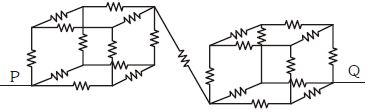
- 2Find the equivalent resistance between $P$ and $Q.$ (If each wire has a resistance $R$ )View Solution
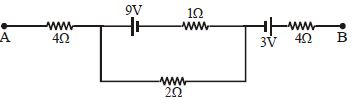
- 3In the circuit shown in figure, potential difference between points $A$ and $B$ is $16\, V$. The current passing through $2\,\Omega $ resistance will be ................. $\mathrm{A}$View Solution
- 4Two wires of the same dimensions but resistivities ${\rho _1}$ and ${\rho _2}$ are connected in series. The equivalent resistivity of the combination isView Solution
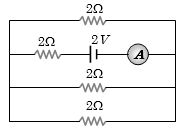
- 5View SolutionThe reading of the ammeter as per figure shown is
- 6View SolutionThe brightness of a bulb will be reduced, if a resistance is connected in
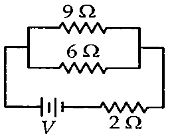
- 7If power dissipated in the $9 \,\Omega$ resistor in the circuit shown is $36\,W$, the potential difference across the $2 \,\Omega$ resistor is .......... $V$View Solution
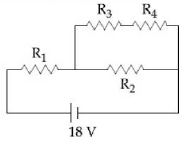
- 8In the given circuit the internal resistance of the $18\,V$ cell is negligible. If $R_1 = 400 \,\Omega ,\,R_3 = 100\,\Omega $ and $R_4 = 500\,\Omega $ and the reading of an ideal voltmeter across $R_4$ is $5\,V,$ then the value of $R_2$ will be ........... $\Omega$View Solution
- 9A $5\;ampere$ fuse wire can withstand a maximum power of $1\; watt$ in the circuit. The resistance of the fuse wire isView Solution
- 10View SolutionThrough a semiconductor, an electric current is due to drift of