Two wires of the same dimensions but resistivities ${\rho _1}$ and ${\rho _2}$ are connected in series. The equivalent resistivity of the combination is
Easy
Download our app for free and get started
(b) ${R_{eq}} = {R_1} + {R_2}$==>$\frac{{{\rho _{eff.2l}}}}{A} = \frac{{{\rho _1}l}}{A} + \frac{{{\rho _2}l}}{A}$$ \Rightarrow \,{\rho _{eff.}} = \frac{{{\rho _1} + {\rho _2}}}{2}$.

Download our appand get started for free
Experience the future of education. Simply download our apps or reach out to us for more information. Let's shape the future of learning together!No signup needed.*
Similar Questions
- 1A torch battery consisting of two cells of $1.45\, volts$ and an internal resistance $0.15\,\Omega $, each cell sending currents through the filament of the lamps having resistance $1.5\,ohms$. The value of current will be ....... $A$View Solution
- 2View SolutionThe net resistance of a voltmeter should be large to ensure that
- 3In a potentiometer arrangement, a cell of $emf$ $1.25\,V$ gives a balance point at $35.0\,cm$ length of the wire. If the cell is replaced by another cell and the balance point shifts to $63.0\,cm,$ the $emf$ of the second cell ............... $V$View Solution
- 4Four resistances $10$ $\Omega$, $5$ $\Omega$, $7$ $\Omega$ and $3$ $\Omega$ are connected so that they form the sides of a rectangle $AB$, $BC$, $CD$ and $DA$ respectively. Another resistance of $10$ $\Omega$ is connected across the diagonal $AC$. The equivalent resistance between $A$ and $B $ is .............. $\Omega$View Solution
- 5Ten $60 \,W , 220 \,V$ bulbs are connected in series to $220 \,V$ supply. Power consumed in the circuit is ......... $W$View Solution
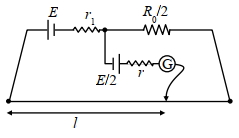
- 6In order to measure the internal resistance $r_1$ of a cell of emf $E$, a meter bridge of wire resistance $R_0=50 \Omega$, a resistance $R_0 / 2$, another cell of emf $E / 2$ (internal resistance $r$ ) and a galvanometer $G$ are used in a circuit, as shown in the figure. If the null point is found at $l=72 cm$, then the value of $r_1=$ . . . . $\Omega$View Solution
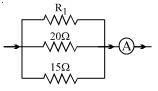
- 7In the given circuit the current flowing through the resisitance $20$ $\mathrm{ohms}$ is $0.3$ $\mathrm{ampere}$ while the ammeter reads $0.8$ $\mathrm{ampere}.$ What is the value of $R_1$? ................ $\mathrm{ohm}$View Solution
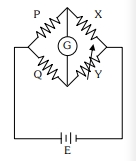
- 8A wheatstone bridge is used to determine the value of unknown resistance $X$ by adjusting the variable resistance $Y$ as shown in the figure. For the most precise measurement of $X$, the resistances $P$ and $Q$:View Solution
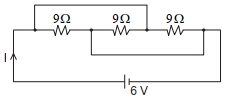
- 9The current $I$ flowing through the given circuit will be $.....A$.View Solution
- 10Three equal resistors connected in series across a source of $e.m.f.$ together dissipate $10\, watt$. If the same resistors are connected in parallel across the same $e.m.f.$, then the power dissipated will be .............. $watt$View Solution