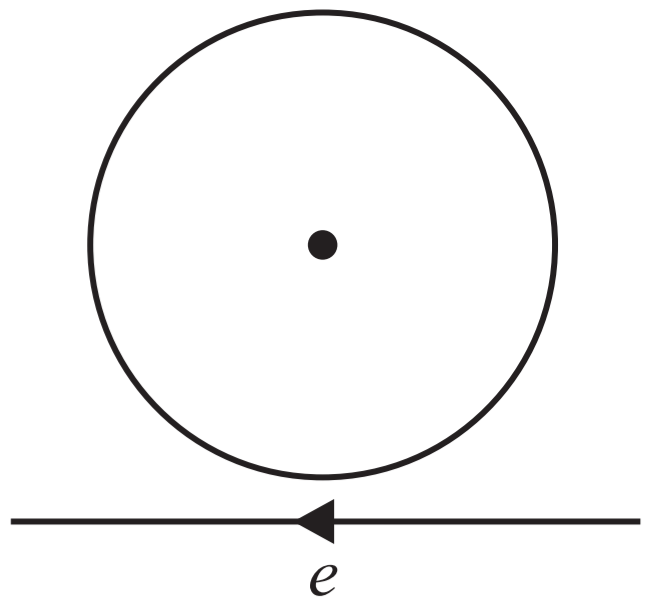
Question
A capacitor is a device to store energy. The process of charging up a capacitor involves the transferring of electric charges from its one place to another. This work done in charging the capacitor is stored as its electrical potential energy.
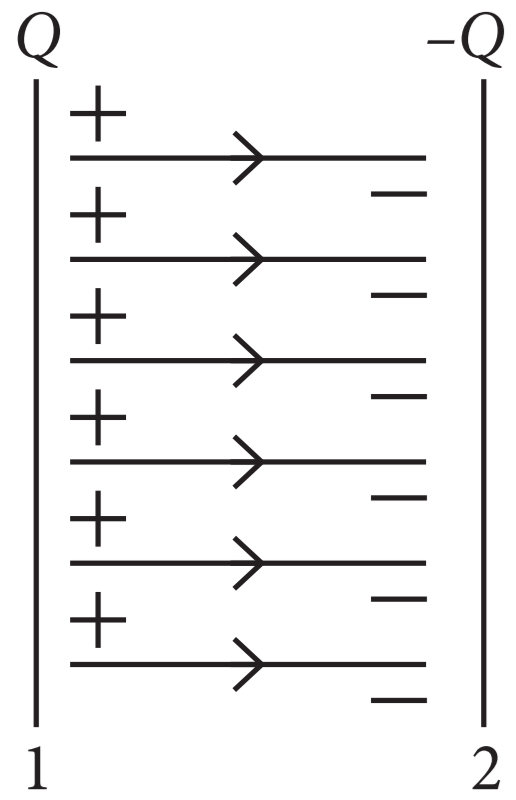
If q is the charge and V is the potential difference across a capacitor at any instant during its charging, then small work done in storing an additional small charge dq against the repulsion of charge q already stored on it is $\text{dW}=\text{V.dq}=(\frac{\text{q}}{\text{C}})\text{dq}.$

  1. A system of 2 capacitors of capacitance $2\mu\text{F}$ and $4\mu\text{F}$ is connected in series across a potential difference of 6 V. The energy stored in the system is:
  1. $3\mu\text{J}$
  2. $24\mu\text{J}$
  3. $30\mu\text{J}$
  4. $108\mu\text{J}$
  1. A capacitor of capacitance of $10\mu\text{F}$ is charged to 10V. The energy stored in it is:
  1. $100\mu\text{J}$
  2. $500\mu\text{J}$
  3. $1000\mu\text{J}$
  4. $1\mu\text{J}$
  1. A parallel plate air capacitor has capacity C farad, potential V volt and energy E joule. When the gap between the plates is completely filled with dielectric:
  1. Both V and E increase.
  2. Both V and E decrease.
  3. V decreases, E increases.
  4. V increases, E decreases.
  1. A capacitor with capacitance $5\mu\text{F}$ s charged to $5\mu\text{C}.$ If the plates are pulled apart to reduce the capacitance to $2\mu\text{F},$ how much work is done?
  1. 6.25 × 10-6J
  2. 3.75 × 10⁻⁶J
  3. 2.16 × 10⁻⁶J
  4. 2.55 × 10⁻⁶J
  1. A metallic sphere ofradius 18cm has been given a charge of 5 × 10-6C. The energy of the charged conductor is:
  1. 0.2J
  2. 0.6J
  3. 1.2J
  4. 2.4J

Answer

  1. (b) $24\mu\text{J}$

Explanation:

As, $\text{C}_1=2\mu\text{F},\text{C}_2=4\mu\text{F}$

ln series combination, the equivalent capacitance will be, 

$\text{C}=\frac{\text{C}_1\text{C}_2}{\text{C}_1+\text{C}_2}=\Big(\frac{2\times4}{2+4}\Big)\mu\text{F}$

$=\frac{4}{3}\mu\text{F}$

Potential difference applied, V = 6V

Energy stored in the system, $\text{U}=\frac{1}{2}\text{CV}^2$

$=\frac{1}{2}\times\frac{4}{3}\times10^{-6}\times(6)^2$

$\text{J}=24\mu\text{J}.$

  1. (b) $500\mu\text{J}$

​​​​​​​​​​​​​​Explanation:

The energy stored in a capacitor is

$\text{U}=\frac{1}{2}\text{CV}^2$

$=\frac{1}{2}\times(10\times10^{-6})(10)^2=500\mu\text{J}.$

  1. (b) Both V and E decrease.

​​​​​​​​​​​​​​​​​​​​​Explanation:

When the gap between the plates is completely filled with dielectric of dielectric constant K, then potential is:

$\text{V}=\frac{\text{Qd}}{\text{A}\in_0\text{K}}$ (i)

and electric field is

$\text{E}=\frac{\text{Q}}{\text{A}\in_0\text{K}}$ (ii)

From equations (i) and (ii), both electric field and potential decrease.

  1. (b) 3.75 × 10⁻⁶J

​​​​​​​​​​​​​​​​​​​​​​​​​​​​Explanation:

Work done $=\text{U}_\text{f}-\text{U}_\text{i}=\frac{1}{2}\frac{\text{q}^2}{\text{C}_\text{f}}-\frac{1}{2}\frac{\text{q}^2}{\text{C}_\text{i}}$

$=\frac{\text{q}^2}{2}\Big[\frac{1}{\text{C}_\text{f}}-\frac{1}{\text{C}_\text{i}}\Big]$

$=\frac{(5\times10^{-6})^2}{2}\Big[\frac{1}{2\times10^{-6}}-\frac{1}{5\times10^{-6}}\Big]$

= 3.75 × 10⁻⁶J

  1. (b) 0.6J

​​​​​​​​​​​​​​​​​​​​​​​​​​​​​​​​​​​Explanation:

Here r = 18cm = 18 × 10-2m, q = 5 × 10⁻⁶C

As, $\text{C}=4\pi\in_0\text{r}=\frac{18\times10^{-2}}{9\times10^9}=2\times10^{-11}\text{F}$

Energy of charged conductor is

$\text{U}=\frac{\text{q}^2}{\text{2C}}=\frac{(5\times10^{-6})^2\text{C}}{2\times2\times10^{-11}\text{F}}=0.625\text{J}.$

Need a full question paper?

Generate a complete, print-ready paper with questions like this in minutes — across 16+ boards, with answer keys.

Start Generating Free

Similar questions

A bar magnet whose area of cross-section is $0.25 cm^2$ is kept in a magnetising field of intensity of $5000 A / m$. If magnitude of magnetic flux passing through the bar is $2.5 \times 10^{-5}$ weber, then calculate :(a) Magnetic induction (b) Magnetic susceptibility (c) Intensity of magnetisation.
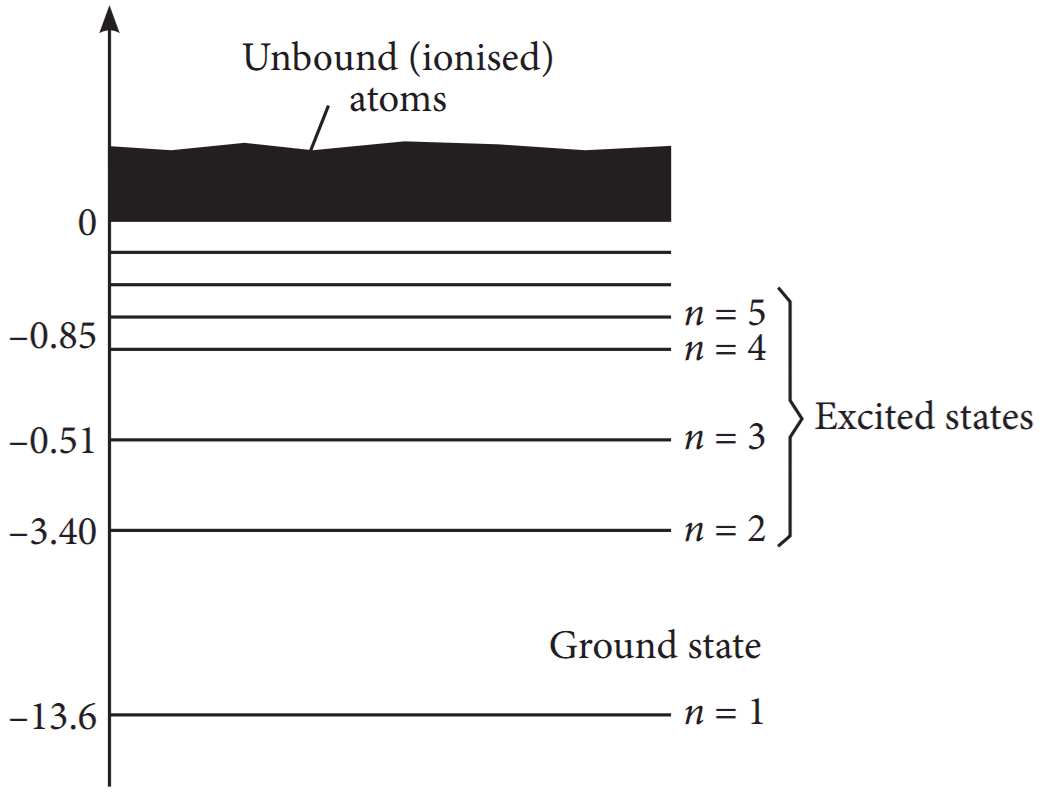
Suppose in an imaginary world the angular momentum is quantized to be even integral multiples of $\frac{\text{h}}{2\pi}$ What is the longest possible wavelength emitted by hydrogen atoms in visible range in such a world according to Bohr's model?
After a good meal at a party you wash your hands and find that you have forgotten to bring your handkerchief. You shake your hands vigorously to remove the water as much as you can. Why is water removed in this process?
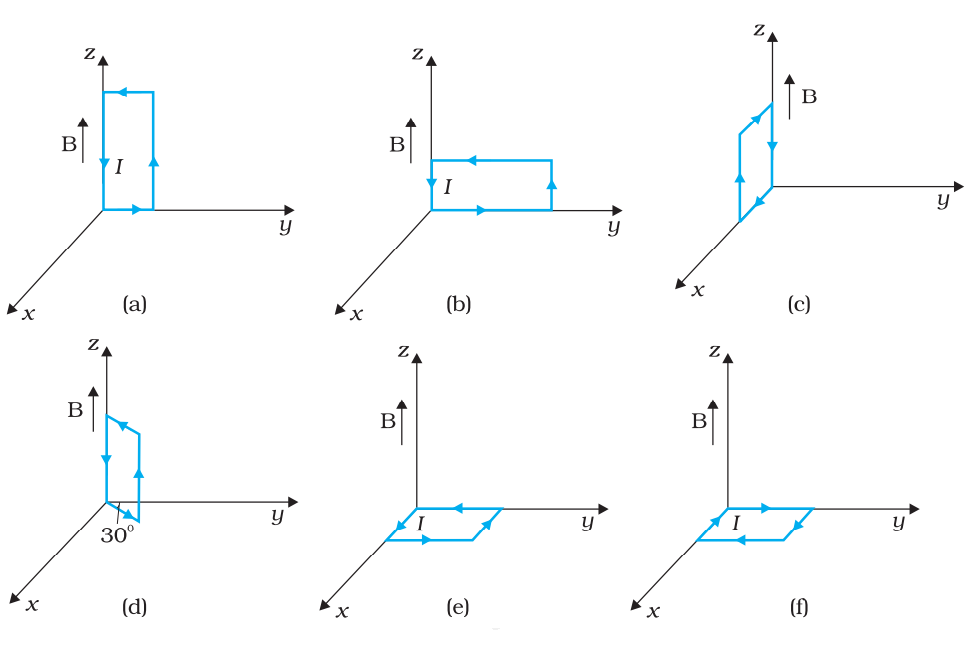
A uniform magnetic field of 3000 G is established along the positive z-direction. A rectangular loop of sides 10 cm and 5 cm carries a current of 12 A. What is the torque on the loop in the different cases shown in Fig.? What is the force on each case? Which case corresponds to stable equilibrium?

A hot body is placed in a closed room maintained at a lower temperature. Is the number of photons in the room increasing?
Two q charges of the same nature are located at a distance d from each other, the third charge of value Q Coulomb is at the mid-point of the line joining them. For what value of Q will the system be in equilibrium?
Microwave oven: The spectrum of electromagnetic radiation contains a part known as microwaves. These waves have frequency and energy smaller than visible light and wavelength larger than it. What is the principle of a microwave oven and how does it work? Our objective is to cook food or warm it up. All food items such as fruit, vegetables, meat, cereals, etc., contain water as a constituent. Now, what does it mean when we say that a certain object has become warmer? When the temperature of a body rises, the energy of the random motion of atoms and molecules increases and the molecules travel or vibrate or rotate with higher energies. The frequency of rotation of water molecules is about 2.45 gigahertz (GHz). If water receives microwaves of this frequency, its molecules absorb this radiation, which is equivalent to heating up water. These molecules share this energy with neighbouring food molecules, heating up the food. One should use porcelain vessels and non-metal containers in a microwave oven because of the danger of getting a shock from accumulated electric charges. Metals may also melt from heating. The porcelain container remains unaffected and cool, because its large molecules vibrate and rotate with much smaller frequencies, and thus cannot absorb microwaves. Hence, they do not get eaten up. Thus, the basic principle of a microwave oven is to generate microwave radiation of appropriate frequency in the working space of the oven where we keep food. This way energy is not wasted in heating up the vessel. In the conventional heating method, the vessel on the burner gets heated first and then the food inside gets heated because of transfer of energy from the vessel. In the microwave oven, on the other hand, energy is directly delivered to water molecules which is shared by the entire food.

(i) As compared to visible light microwave has frequency and energy
(a) Frequency is less but energy is more
(b) less than visible light
(c) more than visible light
(d) equal to visible light

(ii) When the temperature of a body rises
(a) the energy of the random motion of atoms and molecules decreases.
(b) the energy of the random motion of atoms and molecules remains same.
(c) the energy of the random motion of atoms and molecules increases
(d) the random motion of atoms and molecules becomes streamlined.

(iii) he frequency of rotation of water molecules is about
(a) 2.45 THz
(b) 2.45 kHz
(c) 2.45 MHz
(d) 2.45 GHz

OR

In the microwave oven
(a) Energy is directly delivered to the food grains.
(b) The vessel gets heated first and then the water molecules collect heat from the body of the vessel
(c) Energy is directly delivered to water molecules which is shared by the entire food
(d) The vessel gets heated first, and then the food grains inside

(iv) Why should one use porcelain vessels and non-metal containers in a microwave oven?
(a) Because it will prevent the food items to become hot
(b) Because it will get too much hot
(c) Because of the danger of getting a shock from accumulated electric charges
(d) Because it may crack due to high frequency
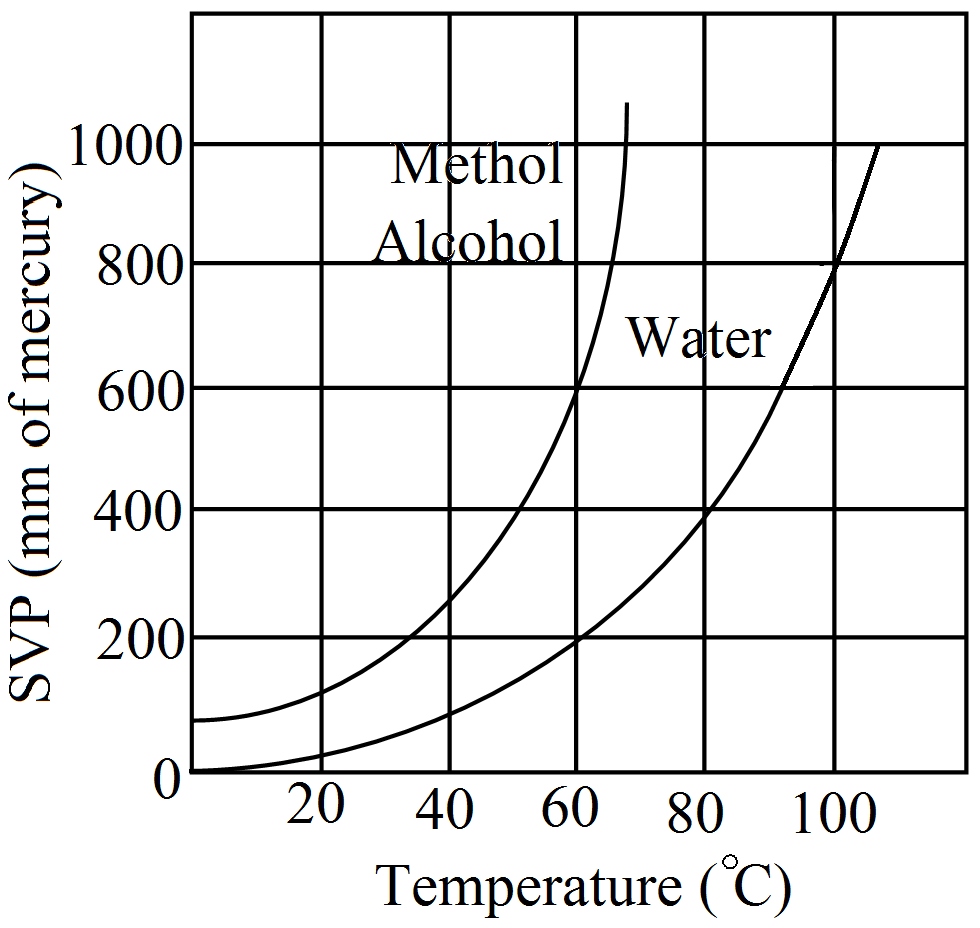
The human body has an average temperature of 98°F. Assume that the vapour pressure of the blood in the veins behaves like that of pure water. Find the minimum atmospheric pressure which is necessary to prevent the blood from boiling. Use figure. of the text for the vapour pressures.


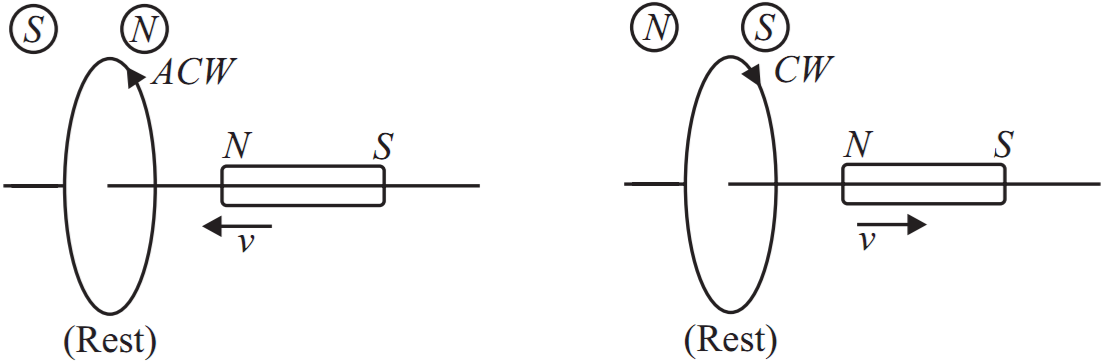
Lenz's law states that the direction of induced current in a circuit is such that it opposes the change which produces it. Tims, if the magnetic flux linked with a closed circuit increases, the induced current flows in such a direction that a magnetic flux is created in the opposite direction of the original magnetic flux. If the magnetic flux linked with the closed circuit decreases, the induced current flows in such a direction so as to create a magnetic flux in the direction of the original flux.

  1. Which of the following statements is correct?
  1. The induced e.m.f is not in the direction opposing the change in magnetic flux so as to oppose the cause which produces it.
  2. The relative motion between the coil and magnet produces change in magnetic flux.
  3. Emf is induced only if the magnet is moved towards coil.
  4. Emf is induced only if the coil is moved towards magnet.
  1. The polarity of induced emf is given by:
  1. Ampere's circuital law.
  2. Biot-Savart law.
  3. Lenz's law.
  4. Fleming's right hand rule.
  1. Lenz's law is a consequence of the law of conservation of:
  1. Charge.
  2. Mass.
  3. Momentum.
  4. Energy.
  1. Near a circular loop of conducting wire as shown in the figure, an electron moves along a straight line. The direction of the induced current if any in the loop is:

  1. Variable.
  2. Clockwise.
  3. Anticlockwise.
  4. Zero.
  1. Two identical circular coils A and Bare kept in a horizontal tube side by side without touching each other. If the current in the coil A increases with time, in response, the coil B:
  1. Is attracted by A.
  2. Remains stationary.
  3. Is repelled.
  4. Rotates.