Question types

Electrostatic Potential and Capacitance question types

557 questions across 8 question groups — pick any mix to generate a Physics paper with step-by-step answer keys.

557
Questions
8
Question groups
5
Question types
Sample Questions

Electrostatic Potential and Capacitance questions

One sample from each question group in this chapter. Select any group above to see the full set with answer keys.

Q 1M.C.Q [1M]1 Mark
A point charge is situated at an axial point of a small electric dipole at a large distance from it. The charge experiences a force F. If the distance of the charge is doubled, the force acting on the charge will become:
  • A
    $2\text{F}$
  • B
    $\frac{\text{F}}{2}$
  • C
    $\frac{\text{F}}{4}$
  • D
    $\frac{\text{F}}{8}$
View full solution
Q 2M.C.Q [1M]1 Mark
An electric dipole consisting of charges +q and -q separated by a distance L is in stable equilibrium in a uniform electric field $\vec{\text{E}}.$ The electrostatic potential energy of the dipole is:
  • A
    qLE
  • B
    zero
  • C
    –qLE
  • D
    –2 qEL
View full solution
Q 3M.C.Q [1M]1 Mark
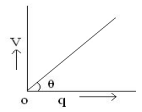
For an isolated object, the graph between potential and charge is given below. The capacity of an object is-
Image
  • A
    $\sin \theta$
  • B
    $\cos \theta$
  • C
    $\tan \theta$
  • $\cot \theta$

Answer: D.

View full solution
Q 4M.C.Q [1M]1 Mark
When air in a capacitor is replaced by a medium of dielectric constant K, the capacity
  • A
    Decreases K times
  • Increases K times
  • C
    Increases times
  • D
    Remains constant

Answer: B.

View full solution
For two statements are given-one labelled Assertion (A) and the other labelled Reason (R). Select the correct answer to these questions from the codes (a), (b), (c) and (d) as given below.
  1. Both A and R are true, and R is the correct explanation of A.
  2. Both A and R are true, but R is not the correct explanation of A.
  3. A is true, but R is false.
  4. A is false, and R is also false.
Assertion (A): Lines of force are perpendicular to conductor surface.
Reason (R): Generally electric field is perpendicular to equipotential surface.
View full solution
For two statements are given-one labelled Assertion (A) and the other labelled Reason (R). Select the correct answer to these questions from the codes (a), (b), (c) and (d) as given below.
  1. Both A and R are true, and R is the correct explanation of A.
  2. Both A and R are true, but R is not the correct explanation of A.
  3. A is true, but R is false.
  4. A is false, and R is also false.
Assertion (A): Positive charge always moves from a higher potential point to a lower potential point.
Reason (R): Electric potential is a vector quantity.
View full solution
For two statements are given-one labelled Assertion (A) and the other labelled Reason (R). Select the correct answer to these questions from the codes (a), (b), (c) and (d) as given below.
  1. Both A and R are true, and R is the correct explanation of A.
  2. Both A and R are true, but R is not the correct explanation of A.
  3. A is true, but R is false.
  4. A is false, and R is also false.
Assertion (A): The surface of a conductor is an equipotential surface.
Reason (R): Conductor allows the flow of charge.
View full solution
For two statements are given-one labelled Assertion (A) and the other labelled Reason (R). Select the correct answer to these questions from the codes (a), (b), (c) and (d) as given below.
  1. Both A and R are true, and R is the correct explanation of A.
  2. Both A and R are true, but R is not the correct explanation of A.
  3. A is true, but R is false.
  4. A is false, and R is also false.
Assertion (A): A capacitor is connected to a battery. If we move its plate further apart, work will be done against the electrostatic attraction between the plates, and the energy of the capacitor gets decreased.
Reason (R): The energy stored in capacitor is dissipated in the form of heat energy.
View full solution
For two statements are given-one labelled Assertion (A) and the other labelled Reason (R). Select the correct answer to these questions from the codes (a), (b), (c) and (d) as given below.
  1. Both A and R are true, and R is the correct explanation of A.
  2. Both A and R are true, but R is not the correct explanation of A.
  3. A is true, but R is false.
  4. A is false, and R is also false.
Assertion (A): The whole charge of a conductor cannot be transferred to another isolated conductor.
Reason (R): The total transfer of charge from one to another is not possible.
View full solution
Answer carefully:
We know that electric field is discontinuous across the surface of a charged conductor. Is electric potential also discontinuous there?
View full solution
Answer carefully:

Two large conducting spheres carrying charges Q1 and Q2 are brought close to each other. Is the magnitude of electrostatic force between them exactly given by $\frac{\text{Q}_1\text{Q}_2}{{4}\pi\in_{0}\text{r}^{2}}$, where r is the distance between their centres?

View full solution
Answer carefully:
A small test charge is released at rest at a point in an electrostatic field configuration. Will it travel along the field line passing through that point?
View full solution
Answer the following:
What are the forms of energy into which the electrical energy of the atmosphere is dissipated during a lightning? (Hint: The earth has an electric field of about 100Vm–1 at its surface in the downward direction, corresponding to a surface charge density = –10–9 Cm–2. Due to the slight conductivity of the atmosphere up to about 50km (beyond which it is good conductor), about + 1800C is pumped every second into the earth as a whole. The earth, however, does not get discharged since thunderstorms and lightning occurring continually all over the globe pump an equal amount of negative charge on the earth.)
View full solution
Describe schematically the equipotential surfaces corresponding to:
  1. a constant electric field in the z-direction.
  2. a field that uniformly increases in magnitude but remains in a constant (say, z) direction.
  3. a single positive charge at the origin, and.
  4. a uniform grid consisting of long equally spaced parallel charged wires in a plane.
View full solution
In a Van de Graaff type generator a spherical metal shell is to be a 15 × 106V electrode. The dielectric strength of the gas surrounding the electrode is 5 × 107Vm–1. What is the minimum radius of the spherical shell required? (You will learn from this exercise why one cannot build an electrostatic generator using a very small shell which requires a small charge to acquire a high potential.)
View full solution
A small sphere of radius r1 and charge q1 is enclosed by a spherical shell of radius r2 and charge q2. Show that if q1 is positive, charge will necessarily flow from the sphere to the shell (when the two are connected by a wire) no matter what the charge q2 on the shell is.
View full solution
Three capacitors each of capacitance 9 pF are connected in series.
  1. What is the total capacitance of the combination?
  2. What is the potential difference across each capacitor if the combination is connected to a 120 V supply?
View full solution
Q 233 Marks Question3 Marks
A spherical conductor of radius 12 cm has a charge of 1.6 × 10⁻⁷C distributed uniformly on its surface. What is the electric field:
  1. Inside the sphere
  2. Just outside the sphere
  3. At a point 18 cm from the centre of the sphere?
View full solution
Q 243 Marks Question3 Marks
A parallel plate capacitor with air between the plates has a capacitance of 8 pF (1pF = 10–12 F). What will be the capacitance if the distance between the plates is reduced by half, and the space between them is filled with a substance of dielectric constant 6?
View full solution
Q 253 Marks Question3 Marks
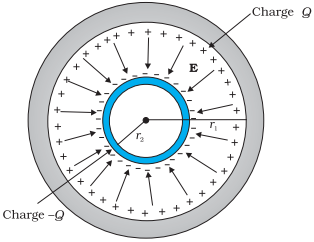
A spherical capacitor consists of two concentric spherical conductors, held in position by suitable insulating supports (2.36). Show

that the capacitance of a spherical capacitor is given by $\text{C}=\frac{{4}\pi\in_{0}\text{r}_1\text{r}_2}{\text{r}_1-\text{r}_2}$

where r1 and r2 are the radii of outer and inner spheres, respectively.

View full solution
Calculate $\frac{\text{n(T)}}{\text{n}(1000\text{K})}$ for tungsten emitter at T = 300K, 2000K and 3000K, where n(T) represents the number of thermions emitted per second by the surface at temperature T. Work function of tungsten is 4.52eV.
View full solution
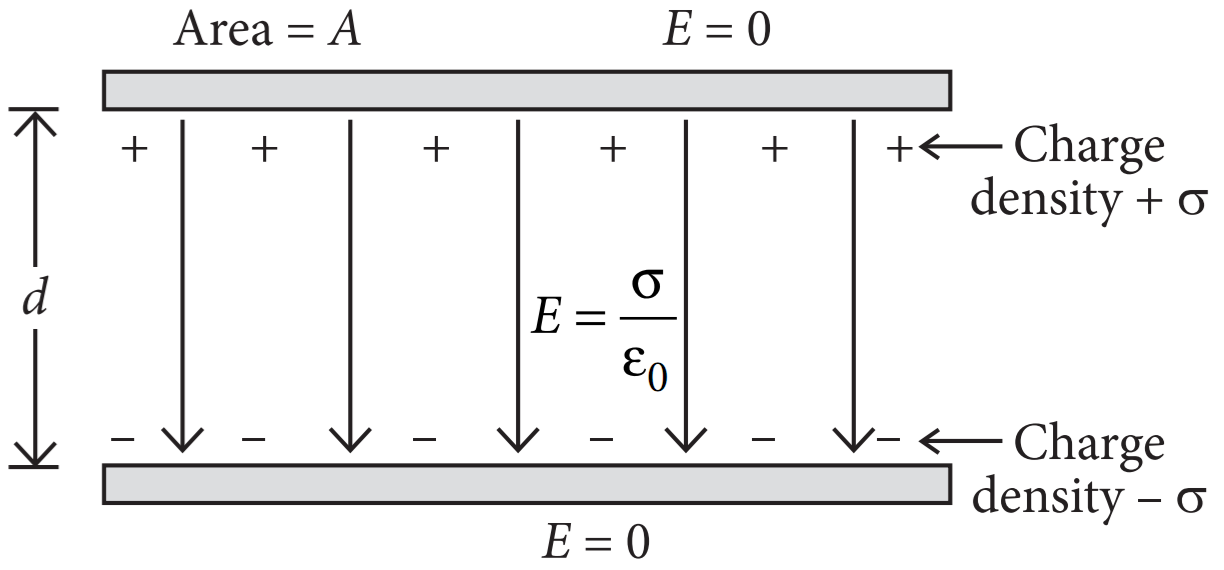
The simplest and the most widely used capacitor is the parallel plate capacitor. It consists of two large plane parallel conducting plates, separated by a small distance.

In the outer regions above the upper plate and below the lower plate, the electric fields due to the two charged plates cancel out. The net field is zero.

In the inner region between the two capacitor plates, the electric fields due to the two charged plates add up. The net field is $\frac{\sigma}{\in_0}.$

For a uniform electric field, potential difference between the plates = Electric field x distance between the plates. Capacitance of the parallel plate capacitor is the charge required to supplied to either of the conductors of the capacitor so as to increase the potential difference between then by unit amount.

  1. A parallel plate capacitor is charged and then isolated. The effect of increasing the plate separation on charge, potential and capacitance respectively are:
  1. Increases, decreases, decreases.
  2. Constant, increases, decreases.
  3. Constant, decreases, decreases.
  4. Constant, decreases, increases.
  1. In a parallel plate capacitor, the capacity increases if:
  1. Area of the plate is decreases.
  2. Distance between the plates increases.
  3. Area of the plate is increases.
  4. Dielectric constant decreases.
  1. A parallel plate capacitor has two square plates with equal and opposite charges. The surface charge densities on the plates are $+\sigma$ and $-\sigma$ respectively. In the region between the plates the magnitude of the electric field is:
  1. $\frac{\sigma}{2\in_0}$

  2. $\frac{\sigma}{\in_0}$

  3. 0
  4. None of these.
  1. If a parallel plate air capacitor consists of two circular plates of diameter 8cm. At what distance should the plates be held so as to have the same capacitance as that of sphere of diameter 20cm?
  1. 9mm
  2. 4mm
  3. 8mm
  4. 2mm
  1. If a charge of + 2.0 × 10-8C is placed on the positive plate and a charge of - 1.0 × 10-8C on the negative plate of a parallel plate capacitor of capacitance $1.2\times10^{-3}\mu\text{F},$ then the potential difference developed between the plates is:
  1. 6.25V
  2. 3.0V
  3. 12.5V
  4. 25V
View full solution
The electrical capacitance of a conductor is the measure of its ability to hold electric charge. An isolated spherical conductor of radius R. The charge Q is uniformly distributed over its entire surface. It can be assumed to be concentrated at the centre of the sphere. The potential at any point on the surface of the spherical conductor will be $\text{V}=\frac{1}{4\pi\in_0}\frac{\text{Q}}{\text{R}}.$

Capacitance of the spherical conductor situated in vacuum is $\text{C}=\frac{\text{Q}}{\text{V}}=\frac{\text{Q}}{\frac{1}{4\pi\in_0}.\frac{\text{Q}}{\text{R}}}$ or $\text{C}=4\pi\in_0\text{R}$ Clearly, the capacitance of a spherical conductor is proportional to its radius.

The radius of the spherical conductor of 1F capacitance is $\text{R}=\frac{1}{4\pi\in_0}.$ C and this radius is about 1500 times the radius of the earth $(\sim6\times10^3\text{km}).$

  1. If an isolated sphere has a capacitance 50pE Then radius is:
  1. 90cm
  2. 45cm
  3. 45m
  4. 90m
  1. How much charge should be placed on a capacitance of 25 pF to raise its potential to 105V?
  1. $1\mu\text{C}$
  2. $1.5\mu\text{C}$
  3. $2\mu\text{C}$
  4. $2.5\mu\text{C}$
  1. Dimensions of capacitance is:
  1. [M L-2 T4 A2]
  2. [M-1 L-1 T3 A1]
  3. [ML-2 T4 A2]
  4. [M0 L-2 T4 A1]
  1. Metallic sphere of radius R is charged to potential V. Then charge q is proportional to:
  1. V
  2. R
  3. Both V and R
  4. None of these
  1. If 64 identical spheres of charge q and capacitance C each are combined to form a large sphere. The charge and capacitance of the large sphere is:
  1. 64q, C
  2. 16q, 4C
  3. 64q, 4C
  4. 16q, 64C
View full solution
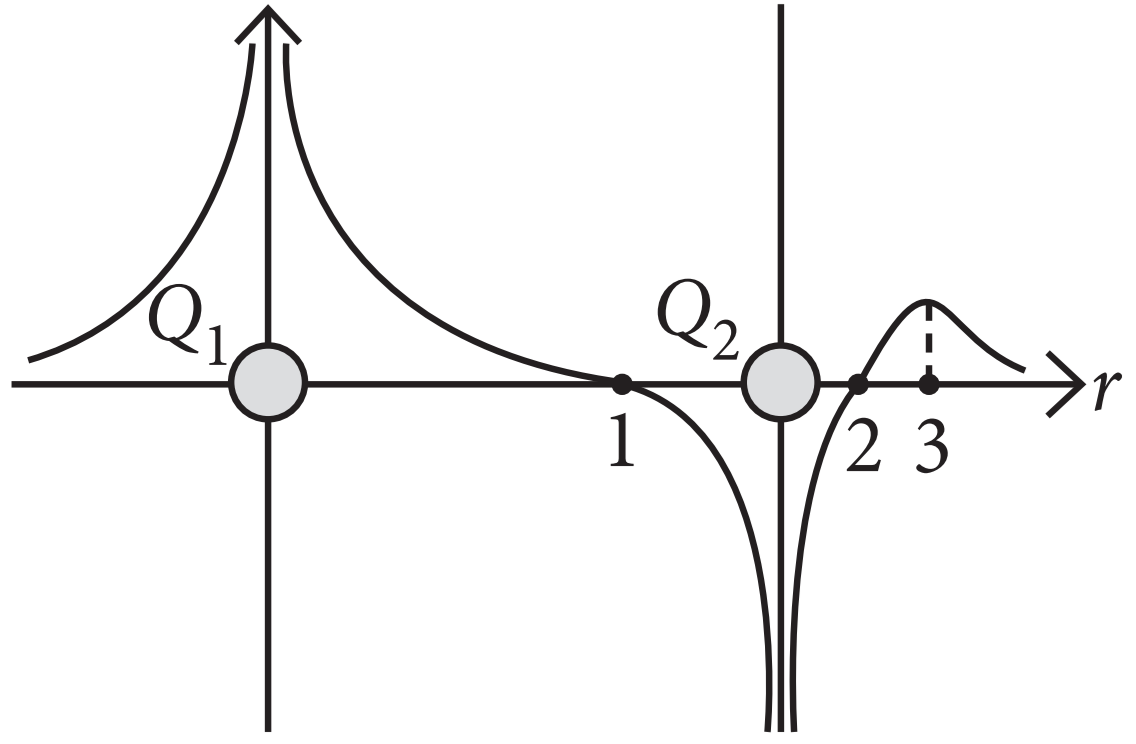
The potential at any observation point P of a static electric field is defined as the work done by the external agent (or negative of work done by electrostatic field) in slowly bringing a unit positive point charge from infinity to the observation point. Figure shows the potential variation along the line of charges. Two point charges Q1 and Q2 lie along a line at a distance from each other.

  1. At which of the points 1, 2, and 3 is the electric field is zero?
  1. 1
  2. 2
  3. 3
  4. Both (a) and (b)
  1. The signs of charges Q1 and Q2 respectively are:
  1. Positive and negative.
  2. Negative and positive.
  3. Positive and positive.
  4. Negative and negative.
  1. Which of the two charges Q1 and Q2 is greater in magnitude?
  1. Q2
  2. Q1
  3. Same.
  4. Can't determined.
  1. Which of the following statement is not true?
  1. Electrostatic force is a conservative force.
  2. Potential energy of charge q at a point is the work done per unit charge in bringing a charge from any point to infinity.
  3. When two like charges lie infinite distance apart, their potential energy is zero.
  4. Both (a) and (c).
  1. Positive and negative point charges of equal magnitude are kept at $\Big(0,0,\frac{\text{a}}{2}\Big)$ and $\Big(0,0,\frac{\text{-a}}{2}\Big)$ respectively.

The work done by the electric field when another positive point charge is moved from (-a, 0, 0) to (0, a, 0) is to:

  1. Positive.
  2. Negative.
  3. Zero.
  4. Depends on the path connecting the initial and final positions.
View full solution
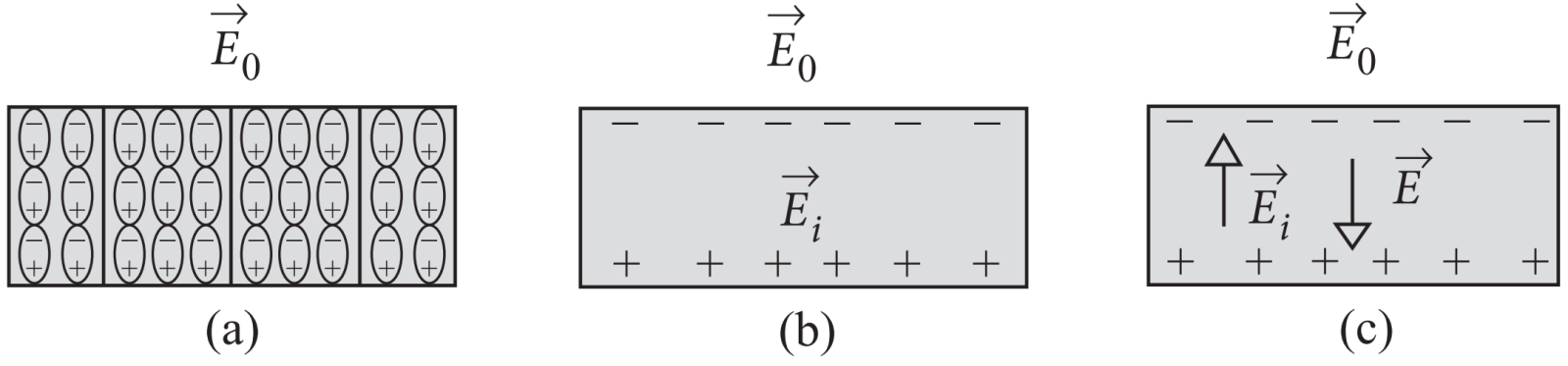
When an insulator is placed in an external field, the dipoles become aligned. Induced surface charges on the insulator establish a polarization field $\vec{\text{E}}_\text{i}$ in its interior. The net field $\vec{\text{E}}$ in the insulator is the vector sum of $\vec{\text{E}}_0$ and $\vec{\text{E}}_\text{i}$ as shown in the figure.

On the application of external electric field, the effect of aligning the electric dipoles in the insulator is called polarisation, and the field $\vec{\text{E}}_\text{i}$ is known as the polarisation field.

The dipole moment per unit volume of the dielectric is known as polarisation $(\vec{\text{P}}).$ For linear isotropic dielectrics, $\vec{\text{P}}=\chi\vec{\text{E}},$ where $\chi=$ electrical susceptibility of the dielectric medium.

  1. Which among the following is an example of polar molecule?
  1. O2
  2. H2
  3. N2
  4. HCI
  1. When air is replaced by a dielectric medium of constant K, the maximum force of attraction between two charges separated by a distance:
  1. Increases K times.
  2. Remains unchanged.
  3. Decreases K times.
  4. Increases 2K times.
  1. Which of the following is a dielectric?
  1. Copper.
  2. Glass.
  3. Antimony (Sb).
  4. None of these.
  1. For a polar molecule, which of the following statements is true?
  1. The centre of gravity of electrons and protons coincide.
  2. The centre of gravity of electrons and protons do not coincide.
  3. The charge distribution is always symmetrical.
  4. The dipole moment is always zero.
  1. When a comb rubbed with dry hair attracts pieces of paper. This is because the?
  1. Comb polarizes the piece of paper.
  2. Comb induces a net dipole moment opposite to the direction of field.
  3. Electric field due to the comb is uniform.
  4. Comb induces a net dipole moment perpendicular to the direction of field.
View full solution
A parallel plate capacitor is to be designed with a voltage rating 1kV, using a material of dielectric constant 3 and dielectric strength about 107Vm–1. (Dielectric strength is the maximum electric field a material can tolerate without breakdown, i.e., without starting to conduct electricity through partial ionisation.) For safety, we should like the field never to exceed, say 10% of the dielectric strength. What minimum area of the plates is required to have a capacitance of 50pF?
View full solution
Two tiny spheres carrying charges 1.5 µC and 2.5 µC are located 30 cm apart. Find the potential and electric field:
  1. At the mid-point of the line joining the two charges, and
  2. At a point 10 cm from this midpoint in a plane normal to the line and passing through the mid-point.
View full solution

Generate a Electrostatic Potential and Capacitance paper free

Pick question groups from the list above, set marks and difficulty, and export a branded PDF with step-by-step answer keys. First 3 chapters free — no signup.

Download App