MCQ
A capacitor is a system of two conductors separated by _____.
- AConductors.
- BDielectrics.
- CAn insulators.
- DNone.
Generate a complete, print-ready paper with questions like this in minutes — across 16+ boards, with answer keys.
The value of stopping potential in the following diagram
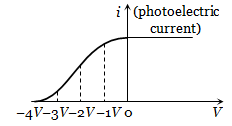
|
(a) – 4V |
(b) – 3 V |
(c) – 2V |
(d) – 1 V |
Two electrolytic cells containing  and
and  respectively are connected in series and a current is passed through them until 1 mg of copper is deposited in the first cell. The amount of silver deposited in the second cell during this time is approximately [Atomic weights of copper and silver are respectively 63.57 and 107.88]
|
(a) 1.7 mg |
(b) 3.4 mg |
(c) 5.1 mg |
(d) 6.8 mg |
A particle A has charge +q and a particle B has charge +4q with each of them having the same mass m. When allowed to fall from rest through the same electric potential difference, the ratio of their speed  will become
|
(a) 2 : 1 |
(b) 1 : 2 |
(c) 1 : 4 |
(d) 4 : 1 |
A particle of charge +q and mass m moving under the influence of a uniform electric field  and a uniform magnetic field
  follows trajectory from P to Q as shown in figure. The velocities at P and Q are v
 and -2v
 respectively. Which of the following statement(s) is/are correct

|
(a) E = |
|
(b) Rate of work done by electric field at P is |
|
(c) Rate of work done by both the fields at Q is zero |
|
(d) a, b, c |
Assertion : Photosensitivity of a metal is high if its work function is small.
Reason : Work function =  where
where  is the threshold frequency.
|
(a) If both assertion and reason are true and the reason is the correct explanation of the assertion. |
|
(b) If both assertion and reason are true but reason is not the correct explanation of the assertion. |
|
(c) If assertion is true but reason is false. |
|
(d) If the assertion and reason both are false. |
Which radiation in sunlight, causes heating effect
|
(a) Ultraviolet |
(b) Infrared |
(c) Visible light |
(d) All of these |

