Question
Which radiation in sunlight, causes heating effect
|
(a) Ultraviolet |
(b) Infrared |
(c) Visible light |
(d) All of these |
Which radiation in sunlight, causes heating effect
|
(a) Ultraviolet |
(b) Infrared |
(c) Visible light |
(d) All of these |
(b) Infrared
Generate a complete, print-ready paper with questions like this in minutes — across 16+ boards, with answer keys.
At what distance from a convex lens of focal length 30 cm, an object should be placed so that the size of the image be 1/2 of the object
|
(a) 30 cm |
(b) 60 cm |
(c) 15 cm |
(d) 90 cm |
Resistances of 6 ohm each are connected in the manner shown in adjoining figure. With the current 0.5 ampere as shown in figure, the potential difference  is
is
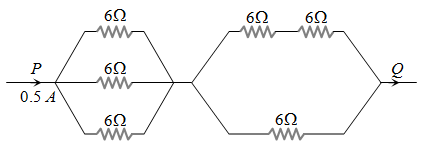
|
(a) 3.6 V |
(b) 6.0 V |
(c) 3.0 V |
(d) 7.2 V |
A proton is about 1840 times heavier than an electron. When it is accelerated by a potential difference of 1 kV, its kinetic energy will be
|
(a) 1840 keV |
(b) 1/1840 keV |
(c) 1 keV |
(d) 920 keV |
If an ammeter is connected in parallel to a circuit, it is likely to be damaged due to excess
|
(a) Current |
(b) Voltage |
(c) Resistance |
(d) All of these |
Two long wires are hanging freely. They are joined first in parallel and then in series and then are connected with a battery. In both cases, which type of force acts between the two wires
|
(a) Attraction force when in parallel and repulsion force when in series |
|
(b) Repulsion force when in parallel and attraction force when in series |
|
(c) Repulsion force in both cases |
|
(d) Attraction force in both cases |
An electric dipole is placed along the x - axis at the origin O. A point P is at a distance of 20 cm from this origin such that OP makes an angle  with the x-axis. If the electric field at P makes an angle θ with the x-axis, the value of θ would be
|
(a) |
(b) |
(c) |
(d) |
Photon and electron are given same energy ( . Wavelength associated with photon and electron are
  and
and  then correct statement will be
|
(a) |
(b) |
(c) |
(d) |


