MCQ
A capacitor of capacity $C$ has reactance $X$. If capacitance and frequency become double then reactance will be
  • A
    $2X$
  • B
    $4X$
  • C
    $X/2$
  • $X/4$

Answer

Correct option: D.
$X/4$
d
$X=\frac{1}{C \omega} \quad X^{\prime}=\frac{1}{4 C \omega}$

$X^{\prime}=\frac{X}{4}$

Need a full question paper?

Generate a complete, print-ready paper with questions like this in minutes — across 16+ boards, with answer keys.
Start Generating Free

Similar questions

A double charged lithium atom is equivalent to hydrogen whose atomic number is 3. The wavelength of required radiation for emitting electron from first to third Bohr orbit in $Li^{++}$ will be (Ionisation energy of hydrogen atom is 13.6eV) 
The de-Broglie wavelength of an electron having $80eV$ of energy is nearly .............. $\mathop {\rm{A}}\limits^o $ ($1eV = 1.6 ×10^{-19} J$, Mass of electron $= 9 ×10^{-31} kg$ Plank’s constant $= 6.6 × 10^{-34}$ $J-sec$)
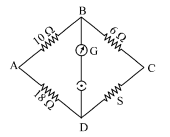
In the given figure, if the Wheatstone bridge is in balanced condition, then the value of resistance 'S' will beImage
Positive rays consists of
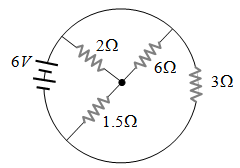
The total current supplied to the circuit by the battery is
A thermo couple uses Bismuth and Tellurium as the dissimilar metals. The sensitivity of bismuth is -72μV/℃ and that of the tellurium is 500μV/℃. If the difference between hot and cold junction is 100℃ then the maximum output will be
The electric resistance of a certain wire of iron is R. If its length and radius are both doubled, then:
Given below are two statements:

Statement $I$ : The diamagnetic property depends on temperature.

Statement $II$ : The included magnetic dipole moment in a diamagnetic sample is always opposite to the magnetizing field.

In the light of given statement, choose the correct answer from the options given below:

Unpolarized light falls on two polarizing sheets placed one on top of the other. What must be the angle between the characteristic directions of the sheets if the intensity of the final transmitted light is one-third the maximum intensity of the first transmitted beam.......$^o$
For a metallic wire, the ratio V/i (V = the applied potential difference, i = current flowing) is