Question
A car accelerates from rest at a constant rate α for some time, after which it decelerates at a constant rate $\beta$ to come to rest. If t is the total time elapsed, then calculate.
  1. The maximum velocity attained by the car.
  2. The total distance travelled by the car.
Answer

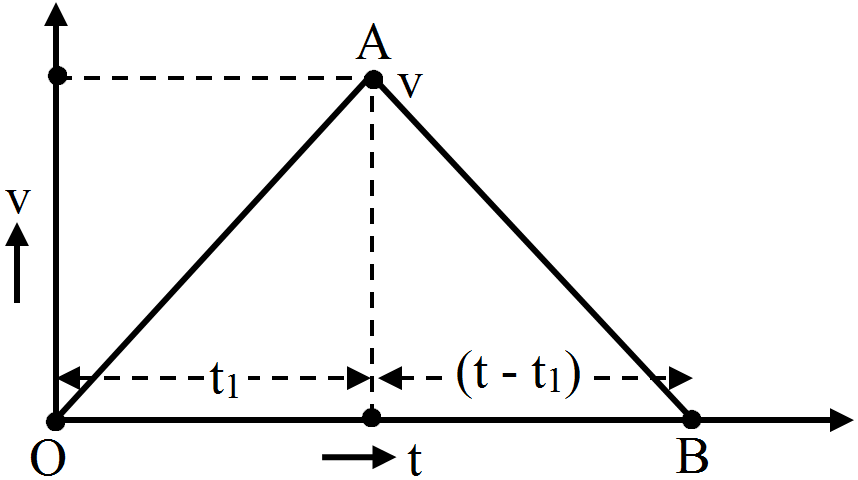
  1. Let the car accelerate at a rate $\alpha$ for time $t_1$ and attain a maximum velocity $v$. Then the car decelerates at a constant rate $\beta$ for remaining time $(t - t_1)$ and again comes to rest. Then from adjoining figure, it is clear that

$\text{v}=\alpha\text{t}_1=\beta(\text{t}-\text{t}_1)$
$\therefore \text{t}_1=\frac{\text{v}}{\alpha}$
$(\text{t}-\text{t}_1)=\frac{\text{v}}{\beta}$
Adding these two, we have
$\text{t}=\frac{\text{v}}{\alpha}+\frac{\text{v}}{\beta}=\text{v}\Big(\frac{\alpha+\beta}{\alpha\beta}\Big)$
$\Rightarrow \text{v}=\frac{\alpha\beta\text{t}}{(\alpha+\beta)}$
  1. Total distance travelled by the car $s =$ area $\text{OAB} =\frac{1}{2}(\text{t})\times(\text{v})$
$\therefore \text{s}=\frac{1}{2}\text{t}\times\frac{\alpha\beta\text{t}}{(\alpha+\beta)}$
$=\frac{1}{2}\frac{\alpha\beta}{(\alpha+\beta)}\text{t}^2$

Need a full question paper?

Generate a complete, print-ready paper with questions like this in minutes — across 16+ boards, with answer keys.

Start Generating Free

Similar questions

Oxygen is filled in a closed metal jar of volume $1.0 \times 10^{-3} \mathrm{~m}^3$ at a pressure of $1.5 \times 10^5 \mathrm{~Pa}$ and temperature 400 K . The jar has a small leak in it. The atmospheric pressure is $1.0 \times 10^5 \mathrm{~Pa}$ and the atmospheric temperature is 300 K Find the mass of the gas that leaks out by the time the pressure and the temperature inside the jar equalise with the surrounding.
i. Pick out only the vector quantities from the following: Temperature, pressure, impulse, time, power, charge.
ii. Show by drawing a neat diagram that the flight of a bird is an example of composition of vectors.
iii. A man is travelling at $10.8 km h ^{-1}$ in a topless car on a rainy day. He holds his umbrella at an angle $37^{\circ}$ to the vertical to protect himself from the rain which is falling vertically downwards. What is the velocity of the rain? $\left[\right.$ Given $\cos 37^{\circ}=\frac{4}{5}$ ]
A uniform disc of radius R is put over another uniform disc of radius 2R of the same thickness and density. The peripheries of the two discs touch each other. Locate the centre of mass of the system.
A solid aluminium sphere and a solid copper sphere of twice the radius are heated to the same temperature and are allowed to cool under identical surrounding temperatures. Assume that the emissivity of both the spheres is the same. Find the ratio of:
  1. The rate of heat loss from the aluminium sphere to the rate of heat loss from the copper sphere.
  2. The rate of fall of temperature of the aluminium sphere to the rate of fall of temperature of the copper sphere. The specific heat capacity of aluminium = $900Jkg^{-1^\circ}C^{-1}$ and that of copper= $390Jkg^{-1^\circ}C^{-1}$. The density of copper = $3.4$ times the density of aluminium.
A rod of length $1.05m$ having negligible mass is supported at its ends by two wires of steel (wire A) and aluminium (wire B) of equal lengths as shown in Fig. The cross-sectional areas of wires A and B are $1.0mm^2$ and $2.0mm^2$, respectively. At what point along the rod should a mass m be suspended in order to produce (a) equal stresses and (b) equal strains in both steel and aluminium wires.
Consider the circuit shown in the figure. Find (a) the current in the circuit (b) the potential drop across the $5\Omega$ resistor (c) the potential drop across the $10\Omega$ resistor. (d) Answer the parts (a), (b) and (c) with reference to the figure.

A spring balance has a scale that reads from $0$ to $50kg$. The length of the scale is $20cm$. A body suspended from this balance, when displaced and released, oscillates with a period of $0.6s$. What is the weight of the body?
What is called potential energy? Explain gravitational potential energy and potential energy of spring.
What is mean free path? Explain and obtain its expression and prove that $\lambda \propto T$ and $\lambda \propto \lambda_{ P }.$
A hot body placed in a surrounding of temperature $\theta_0$ obeys Newton's law of cooling $\frac{\text{d}\theta}{\text{dt}}=-\text{k}(\theta-\theta_0).$ Its temperature at $t = 0$ is $\theta_1.$ The specific heat capacity of the body is s and its mass is m. Find,
  1. The maximum heat that the body can lose.
  2. The time starting from $t = 0$ in which it will lose $90\%$ of this maximum heat.