Question
What is called potential energy? Explain gravitational potential energy and potential energy of spring.

Answer

self

Need a full question paper?

Generate a complete, print-ready paper with questions like this in minutes — across 16+ boards, with answer keys.
Start Generating Free

Similar questions

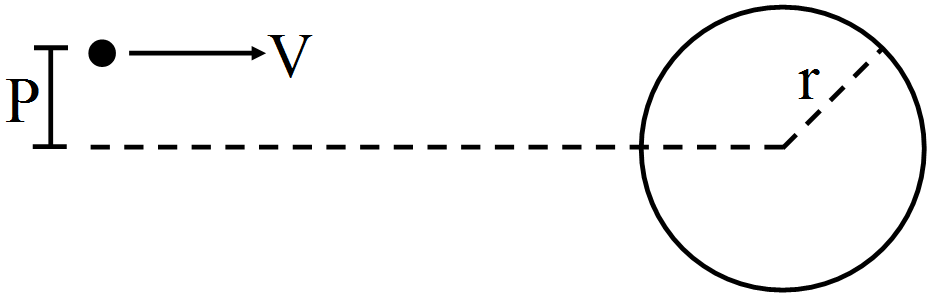
A small particle travelling with a velocity u collides elastically with a spherical body of equal mass and of radius r initially kept at rest. The centre of this spherical body is located a distance (p < r) away from the direction of motion of the particle. Find the final velocities of the two particles. [Hint: The force acts along the normal to the sphere through the contact. Treat the collision as onedimensional for this direction. In the tangential direction no force acts and the velocities do not change].
A gas mixture consists of molecules of $A, B$ and $C$ with masses $m_A > m_B > m_c$. Rank the three types of molecules in decreasing order of (a) average KE, (b) rms speeds.
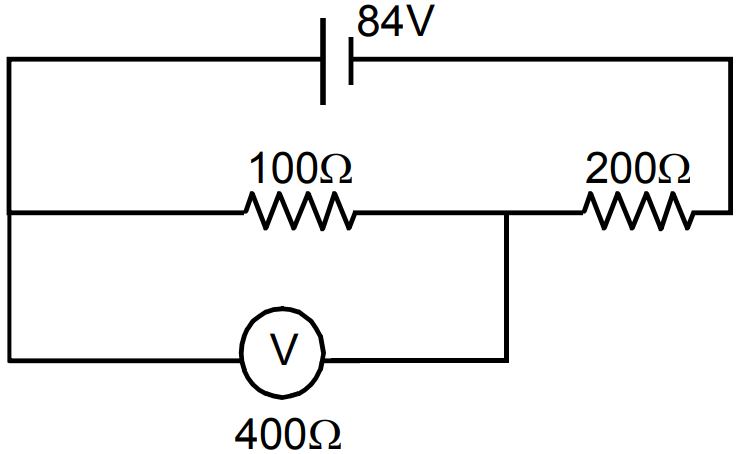
A voltmeter of resistance $400\Omega$ is used to measure the potential difference across the $100\Omega$ resistor in the circuit shown in the figure. (a) What will be the reading of the voltmeter? (b) What was the potential difference across $100\Omega$ before the voltmeter was connected?
An air chamber of volume $V$ has a neck of the area of cross-section $A$ into which a ball of mass $m$ can move without friction. Show that when the ball is pressed down through some distance and released, the ball executes SHM. Obtain the formula for the time period of this SHM, assuming pressure-volume variations of the air to be
i. isothermal and
ii. adiabatic.
A pin of length $2.00cm$ is placed perpendicular to the principal axis of a converging lens. An inverted image of size $1.00cm$ is formed at a distance of $40.0cm$ from the pin. Find the focal length of the lens and its distance from the pin.
A ball of mass m moving at a speed v makes a head-on collision with an identical ball at rest. The kinetic energy of the balls after the collision is three fourths of the original. Find the coefficient of restitution.
Hydrogen gas is contained in a closed vessel at 1atm $(100kPa)$ and $300K$. (a) Calculate the mean speed of the molecules. (b) Suppose the molecules strike the wall with this speed making an average angle of $45°$ with it. How many molecules strike each square metre of the wall per second?
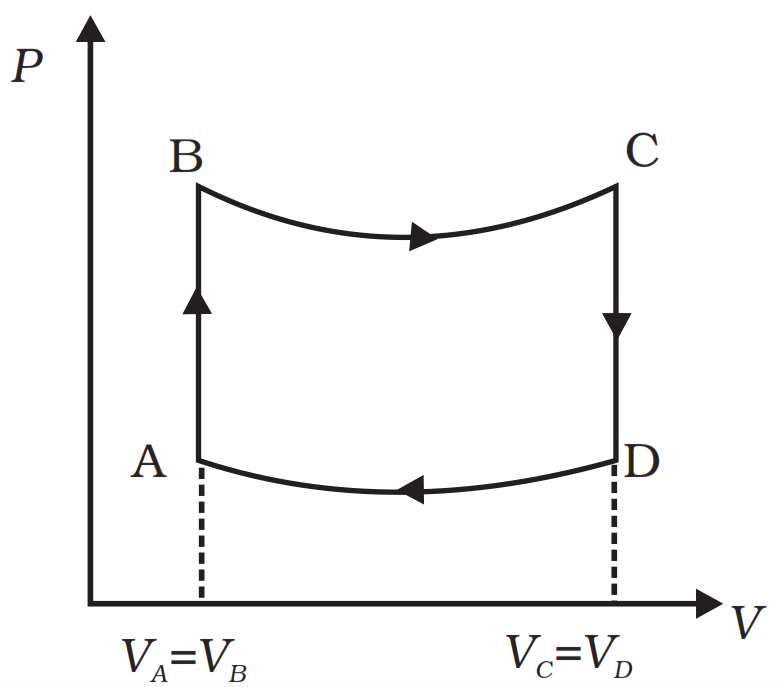
A cycle followed by an engine (made of one mole of perfect gas in a cylinder with a piston) is shown in Fig.
A to B : volume constant B to C : adiabatic C to D : volume constant D to A : adiabatic $V_C= V_D= 2V_A= 2V_B$
  1. In which part of the cycle heat is supplied to the engine from outside?
  2. In which part of the cycle heat is being given to the surrounding by the engine?
  3. What is the work done by the engine in one cycle? Write your answer in term of $P_A, P_B, V_A$.
  4. What is the efficiency of the engine?[$\gamma=\frac{5}{3}$ for the gas], $\big(\text{C}_\text{v}=\frac{3}{2}\text{R for one mole}\big)$
A 'thermacole' icebox is a cheap and an efficient method for storing small quantities of cooked food in summer in particular. A cubical icebox of side 30 cm has a thickness of 5.0 cm . If 4.0 kg of ice is put in the box, estimate the amount of ice remaining after 6 h . The outside temperature is $45^{\circ} \mathrm{C}$, and co-efficient of thermal conductivity of thermacole is $0.01 \mathrm{~J} \mathrm{~s}^{-1} \mathrm{~m}^{-1} \mathrm{~K}^{-1}$. [Heat of fusion of water $=335 \times 103 \mathrm{~J} \mathrm{~kg}^{-1}$ ].
An atom is in its excited state. Does the probability of its coming to ground state depend on whether the radiation is already present or not? If yes, does it also depend on the wavelength of the radiation present?