A car battery of $e.m.f$. $12\,V$ and internal resistance $5 \times {10^{ - 2}}\,\Omega $, receives a current of $60\; A$ from external source, then terminal voltage of battery is
AIPMT 2000, Easy


Download our appand get started for free
Experience the future of education. Simply download our apps or reach out to us for more information. Let's shape the future of learning together!No signup needed.*
Similar Questions
- 1A resistor develops $500\, J$ of thermal energy in $20 \,s$ when a current of $1.5\, A$ is passed through it. If the current is increased from $1.5 \,A$ to $3\, A$ what will be the energy (in $J$) developed in $20\, s$.View Solution
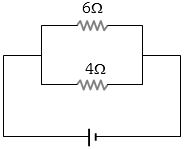
- 2In the circuit shown below, the power developed in the $6$ $\Omega$ resistor is $6\, watt$. The power in watts developed in the $4$ $ \Omega$ resistor isView Solution
- 3$A\,\,{5\,^o}C$ rise in the temperature is observed in a conductor by passing some current. When the current is doubled, then rise in temperature will be equal to ............. $^oC$View Solution
- 4Electric room radiator which operates at $225\, volts$ has resistance of $50\, ohms$. Power of the radiator is approximately ............... $W$View Solution
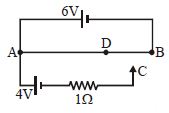
- 5A $6\, volt$ battery of negligible internal resistance resistance is connected across a uniform wire $AB$ of length $100\,cm$. The positive terminal of another battery of $emf$ $4\,V$ and internal resistance $1\,\Omega $ is joined to the point $A$ as shown in fig. Take the potential at $B$ to be zero. At which point $D$ of the wire $AB$, from left the potential is equal to the potential at $C$ ? ...................... $cm$ (approximately)View Solution
- 6Resistance of rod is calculated by measuring its length with help of meter scale of least count $1\ mm$ . Its radius is measured with help of screw gauge having $50$ division on circular scale and pitch is of $1\ mm$ . Resistivity of material is exact. Length of the wire is found to be $20\ cm$ and diameter of wire is $4\ mm$ . Find the percentage error in calculation of resistance ............... $\%$View Solution
- 7View SolutionWhich of the following quantities do not change when a resistor connected to a battery is heated due to the current?
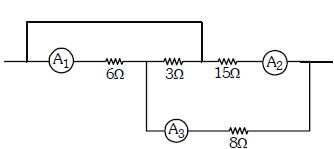
- 8A part of circuit is shown in figure. All the ammeters are ideal. If reading of ammeter $A_1$ is $1.0\ A$ , thenView Solution
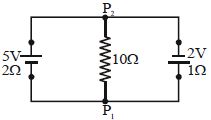
- 9A $5\, V$ battery with internal resistance $2\, \Omega$ and a $2\,V$ battery internal resistance $1\, \Omega$ are connected to a $10\, \Omega$ resistor as shown in the figure. The current in the $10\, \Omega$ resistor is :-View Solution
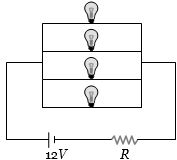
- 10Four identical electrical lamps are labelled $1.5\,V$, $0.5\,A$ which describes the condition necessary for them to operate at normal brightness. A $12\,V$ battery of negligible internal resistance is connected to lamps as shown, thenView Solution