A resistor develops $500\, J$ of thermal energy in $20 \,s$ when a current of $1.5\, A$ is passed through it. If the current is increased from $1.5 \,A$ to $3\, A$ what will be the energy (in $J$) developed in $20\, s$.
JEE MAIN 2021, Medium


Download our appand get started for free
Experience the future of education. Simply download our apps or reach out to us for more information. Let's shape the future of learning together!No signup needed.*
Similar Questions
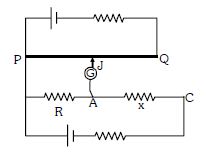
- 1Circuit for the measurement of resistance by potentiometer is shown. The galvanometer is first connected at point $A$ and zero deflection is observed at length $P J = 10\ cm$ . In second case it is connected at point $C$ and zero deflection is observed at a length $30\ cm$ from $P$ . Then the unknown resistance $X$ isView Solution
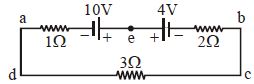
- 2View SolutionIn the circuit diagram shown below, the magnitude and direction of the flow of current respectively would be
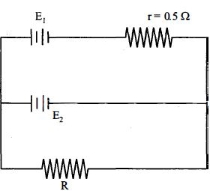
- 3A $dc$ source of $emf \,E_1 = 100\,V$ and internal resistance $r = 0.5\,\Omega ,$ a storage battery of emf $E_2 = 90\,V$ and an external resistance $R$ are connected as shown in figure. For what value of $R$ no current will pass through the battery ? ................ $\Omega$View Solution
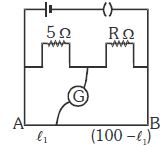
- 4The resistance in the two arms of a meter bridge are $5\,\Omega $ and $R\,\Omega $, respectively. When the resistance $R$ is shunted with an equal resistance, the new balance point is at $1.6\, l_1$. The resistance $‘R’$ is ................. $\Omega$View Solution
- 5The resistance of a heater coil is $110\, ohm$. A resistance $R$ is connected in parallel with it and the combination is joined in series with a resistance of $11\, ohm$ to a $220\, volt$ main line. The heater operates with a power of $110\, watt$. The value of $R$ in $ohm$ isView Solution
- 6Find out equivalent resistance between $A$ and $B$View Solution
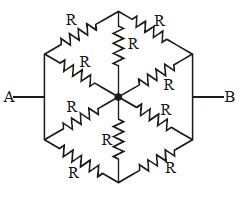
- 7In a meter bridge experiment null point is obtained at $20\, cm$ from one end of the wire when resistance $X$ is balanced against another resistance $Y$. If $X < Y$, then where will be the new position of the null point from the same end, if one decides to balance a resistance of $4X$ against $Y$ ........... $cm$View Solution
- 8View SolutionWhich of the following statements is false?
- 9In the given circuit all resistances are of value $R\,ohm$ each. The equivalent resistance between $A$ and $B$ isView Solution
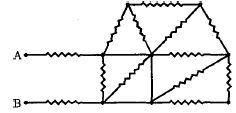
- 10Resistance of a carbon resistor determined from colour codes is $(22000 \pm 5 \%) \Omega$. The colour of third band must be :View Solution