Question
A carbon compound ‘P' on heating with excess cont. $H2SO_4$ forms another carbon compound ‘Q' which on addition of hydrogen in the presence of nickel catalyst forms a saturated carbon compound ‘R'. One molecule of ‘R' on combustion forms two molecules of carbon dioxide and three molecules of water. Identify P, Q and R and write chemical equations for the reactions involved.

Answer

Compound Q is ethene $= CH _2= CH _2+ H 2 O$
Compound R is ethane $= CH _2- CH _3$ Reaction:${\text{C}_{2}\text{H}_{5}\text{OH}}\xrightarrow[\Delta]{\text{Conc. } \text{H}_{2}\text{SO}_{4}}{\text{CH}_{2}} = \text{CH}_{2}+\text{H}_{2}\text{O} \\ $
$\text{CH}_{2}=\text{CH}_{2}\xrightarrow[\text{H}_{2}]{\text{Nickel Catalyst}}{\text{CH}_{3}-\text{CH}_{3}} + \text{H}_2\text{O} \\$
$\text{CH}_{3}-\text{CH}_{3}+\frac{7}{2}\text{O}_{2}\rightarrow 2\text{CO}_{2}+ 3\text{H}_{2}\text{O}$

Need a full question paper?

Generate a complete, print-ready paper with questions like this in minutes — across 16+ boards, with answer keys.

Start Generating Free

Similar questions


Calculate the combined resistance in each case:
What are the scientific names for the following receptors in animals?
  1. Receptors for light.
  2. Receptors for heat.
  3. Receptors for sound.
  4. Receptors for smell.
  5. Receptors for taste.
How would you distinguish between baking powder and washing soda by heating?
The organs A of a person have been damaged completely due to which too much of a poisonous waste material B has started accumulating in his blood, making it dirty. In order to save this person's life, the blood from an artery in the person's arm is made to flow into long tubes made of substance E which are kept in coiled form in a tank containing solution F. This solution contains three materials G, H and I in similar proportions to those in normal blood. As the person's blood passes through long tubes of substance E, most of the wastes present in it go into solution. The clean blood is then put back into a vein in the arm of the person for circulation.
  1. What are organs A?
  2. Name the waste substance B.
  3. What are (i) E and (ii) F? Name G, H and I.
  4. What is the process described above known as?
At what distance from a concave lens of focal length 25 cm a 10 cm tall object be placed so as to obtain its image at 20 cm from the lens. Also calculate the size of the image formed.
Draw a ray diagram to justify your answer for the above situation and label it.
An object 3cm high is placed at a distance of 8cm from a concave mirror which produces a virtual image 4.5cm high:
  1. What is the focal length of the mirror?
  2. What is the position of image?
  3. Draw a ray-diagram to show the formation of image.
Gas A, which is the major cause of global warming, combines with hydrogen oxide B in nature in the presence of an environmental factor C and a green material D to form a six carbon organic compounds E and a gas F. The gas F is necessary for breathing.
  1. What is gas A?
  2. What is the common name of B?
  3. What do you think could be C?
  4. What is material D? Where is it found?
  5. Name the organic compound E.
  6. What is gas F? Name the natural process during which it is released.
The position of certain elements in the Periodic Table are shown below.
Group
Period
1
2
3 to 12
13
14
15
16
17
18
1
G


H
2
A
 
 
I
 
 
B
 
C
3
 
D
 
 
E


F
Using the above table answer the following questions:
  1. Which element will form only covalent compounds?
  2. Which element is a non-metal with valency 2?
  3. Which element is a metal with valency 2?
  4. Out of H, C, F, which has largest atomic size?
  5. Give name of family to which H, C and F belong?
  1. Define focal length of a spherical lens.
  2. A divergent lens has a focal length of 30 cm. At what distance should an object of height 5 cm from the optical centre of the lens be placed so that its image is formed 15 cm away from the lens? Find the size of the image also.
  3. Draw a ray diagram to show the formation of image in the above situation.
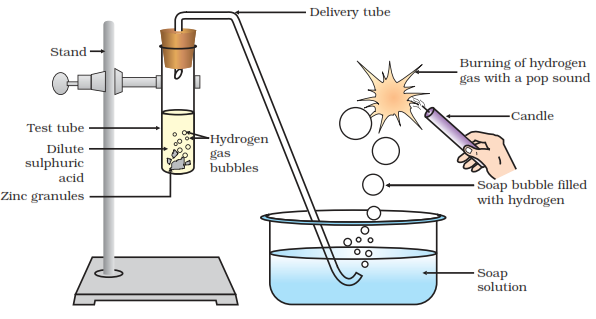
In the following schematic diagram for the preparation of hydrogen gas as shown in Figure, what would happen if following changes are made?
  1. In place of zinc granules, same amount of zinc dust is taken in the test tube.
  2. Instead of dilute sulphuric acid, dilute hydrochloric acid is taken.
  3. In place of zinc, copper turnings are taken.
  4. Sodium hydroxide is taken in place of dilute sulphuric acid and the tube is heated.