Question
How would you distinguish between baking powder and washing soda by heating?

Answer

Baking soda is sodium hydrogen carbonate $\left( NaHCO _3\right)$ which forms sodium carbonate $\left( Na _2 CO _3\right)$, water and carbon dioxide gas while heating. $2 NaHCO _3 \rightarrow Na _2 CO _3+ H _2 O + CO _2 \uparrow$
Presence of $CO _2$ can be detected with the help of lime water which turns milky after reacting with carbon dioxide gas
Washing soda is sodium carbonate deca-hydrate $\left( Na _2 CO _3 \cdot 10 H _2 O \right)$ which means there are 10 water molecules present with crystal hence named as water of crystallization
On heating washing soda, it becomes anhydrous and presence of water of crystallization can be detected with the help of anhydrous $CuSO _4$ which shows colour change from white to blue with moisture.
$Na _2 CO _3 \cdot 10 H _2 O \rightarrow Na _2 CO _3+10 H _2 O$

Need a full question paper?

Generate a complete, print-ready paper with questions like this in minutes — across 16+ boards, with answer keys.

Start Generating Free

Similar questions

Define hydrotropism. Give one example of hydrotropism. State whether this example is of positive hydrotropism or negative hydrotropism. Illustrate your answer with the help of labelled diagram.
What is meant by ‘rusting of iron’? With the help of labelled diagrams, describe an activity to find out the conditions under which iron rusts.
Arrange the following elements in the increasing order of their metallic character Mg, Ca, K, Ge, Ga.
Given below is the experimental set-up to establish that one of the atmospheric gases is essential for photosynthesis in plants.
  1. Name the atmospheric gas which is essential for photosynthesis.
  2. What is kept in watch-glass in figure 'a' and why?
  3. Write the balanced chemical equation for the process of photosynthesis.
  4. When do the desert plants takeup carbon dioxide and perform photosynthesis?
Explain the phenomenon of dispersion of white light through a glass prism, using suitable ray diagram.
An organic compound having the molecular formula $C _3 H _6 O$ can exist in the form of two isomers $A$ and $B$ having different functional groups. The isomer $A$ is a liquid which is used as a solvent for nail polish. The isomer $B$ is also a liquid. An aqueous solution of one of the lower homologues of $B$ is used for preserving biological specimens in the laboratory.
  1. What is compound A?
  2. Write the electron-dot structure of A.
  3. What is compound B?
  4. Write the electron-dot structure of B.
  5. Name the lower homologue of compound B which is used in preserving biological specimens.
What happens with $CO _2$ and $O _2$ in plants during daytime?
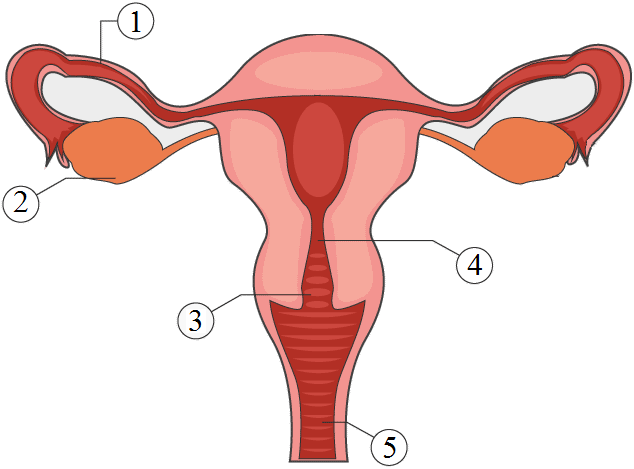
  1. Identify the given diagram. Name the parts 1 to 5.
  1. What is contraception? List three advantages of adopting contraceptive measures.
A student focussed the image of a candle flame on a white screen using a convex lens. He noted down the position of the candle screen and the lens as under,
Position of candle = 12.0cm
Position of convex lens = 50.0cm
Position of the screen = 88.0cm
  1. What is the focal length of the convex lens?
  2. Where will the image be formed if he shifts the candle towards the lens at a position of 31.0cm?
  3. What will be the nature of the image formed if he further shifts the candle towards the lens?
  4. Draw a ray diagram to show the formation of the image in case (iii) as said above.