MCQ
A carnot engine is made to work between $200\,^oC$ and $0\,^oC$ first and then between $0\,^oC$ and $-200\,^oC$. The ratio of efficiencies $\left( {\frac{{{\eta _2}}}{{{\eta _1}}}} \right)$ of the engine in two cases is
  • A
    $1:1.5$
  • B
    $1:1$
  • C
    $1:2$
  • $1.73:1$

Answer

Correct option: D.
$1.73:1$
d
$n = 1 - \frac{{{T_2}}}{{{T_1}}}$

Need a full question paper?

Generate a complete, print-ready paper with questions like this in minutes — across 16+ boards, with answer keys.

Start Generating Free

Similar questions

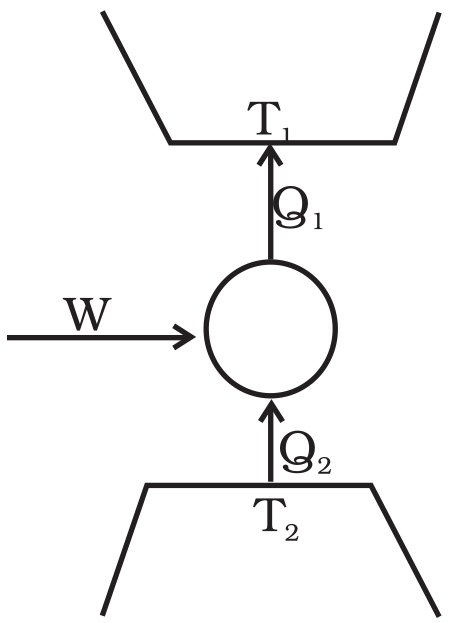
Consider a heat engine as shown in $Q_1$ and $Q_2$ are heat added to heat bath $T_1$ and heat taken from $T_2$ in one cycle of engine. W is the mechanical work done on the engine. If $\mathrm{W}>0$, then possibilities are:
If a person with a spring balance and a body hanging from it goes up and up in an aeroplane, then the reading of the weight of the body as indicated by the spring balance will
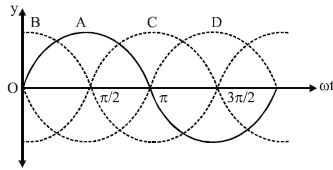
Figure given below shows four progressive waves $A, B, C$ and $D$ with their phases expressed with respect to the wave $A$ . It can be calculated from the figure that
A particle of mass $m$  moving with velocity $v $ strikes a stationary particle of mass $2m$ and sticks to it. The speed of the system will be
A gas is enclosed in a cylinder with a movable frictionless piston. Its initikl thermodynamic state at pressure $P_i=10^5 \mathrm{~Pa}$ and volume $V_i=10^{-3} \mathrm{~m}^3$ chanıes to i final state at $P_f=(1 / 32) \times 10^5 \mathrm{~Pa}$ and $V_f=8 \times 10^{-3} \mathrm{~m}^3$ in an adiabatic quasi-static process, such that $P^3 V^5=$ constant. Consider another thermodynamic process that brings the system from the same initial state to the same final state in two steps: an isobaric expansion at $P$, followed by an isochoric (isovolumetric) process at volume $V_f$. The amount of heat supplied to the system in the two-step process is approximately
The acceleration of a train travelling with speed of $400 \,m/s$ as it goes round a curve of radius $160\,m$, is
A man is watching two trains, one leaving and the other coming with equal speed of $4\,m/s$. If they sound their whistles each of frequency $240\, Hz$, the number of beats per sec heard by man will be equal to (velocity of sound in air $= 320\, m/s$)
Four particle of masses $m, 2m, 3m$ and $4m$ are arranged at the corners of a parallelogram with each side equal to $a$ and one of the angle between two adjacent sides is $60^o$. The parallelogram lies in the $x-y$ plane with mass m at the origin and $4m$ on the  $x-$ axis. The centre of mass of the arrangement will be located at 
If a man pushes a wall and is unable to displace it, he:
If a bimetallic strip is heated, it will