MCQ
A Carnot engine, whose efficiency is $40\%$, takes in heat from a source maintained at a temperature of $500\ K$. It is desired to have an engine of efficiency $60\%$. Then, the intake temperature for the same exhaust (sink) temperature must be ....... $K$
  • A
    $1200$
  • $750$
  • C
    $600 $
  • D
    efficiency of carnot engine cannot be made larger than $50 \%$

Answer

Correct option: B.
$750$
b
$0.4 = 1 = \frac{{{T_2}}}{{500}}\,and\,0.6 = 1 - \frac{{{T_2}}}{{{T_1}}}$

$On\,solving\,we\,get\,{T_2} = 750\,K$

Need a full question paper?

Generate a complete, print-ready paper with questions like this in minutes — across 16+ boards, with answer keys.

Start Generating Free

Similar questions

A spaceship of speed $v_0$ travelling along $+ y$ axis suddenly shots out one fourth of its part with speed $2v_0$ along $+ x$ -axis. $xy$ axes are fixed with respect to ground. The velocity of the remaining part is
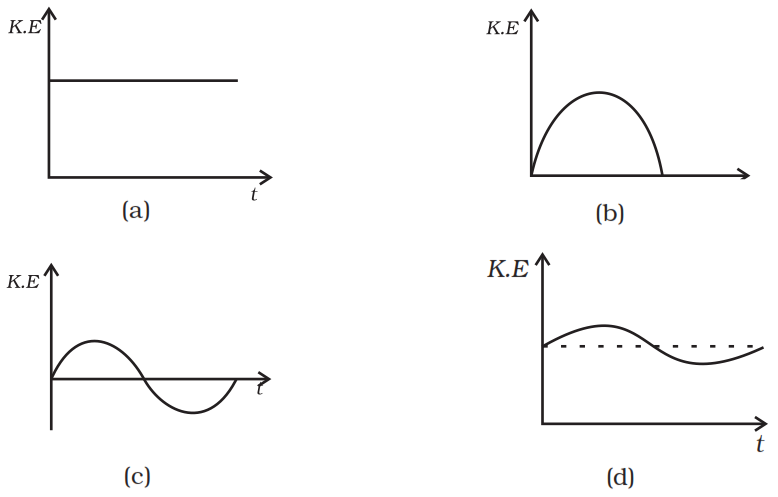
Which of the diagrams shown in most closely shows the variation in kinetic energy of the earth as it moves once around the sun in its elliptical orbit?
When liquid medicine of density $\rho$ is to be put in the eye, it is done with the help of a dropper. As the bulb on the top of the dropper is pressed, a drop forms at the opening of the dropper. We wish to estimate the size of the drop. We first assume that the drop formed at the opening is spherical because that requires a minimum increase in its surface energy. To determine the size, we calculate the net vertical force due to the surface tension $T$ when the radius of the drop is $\mathrm{R}$. When the force becomes smaller than the weight of the drop, the drop gets detached from the dropper.

$1.$ If the radius of the opening of the dropper is $\mathrm{r}$, the vertical force due to the surface tension on the drop of radius $R$ (assuming $\mathrm{r} \ll R$ ) is

$(A)$ $2 \pi r T$ $(B)$ $2 \pi R T$ $(C)$ $\frac{2 \pi r^2 T}{R}$ $(D)$ $\frac{2 \pi R^2 T}{r}$

$2.$ If $\mathrm{r}=5 \times 10^{-4} \mathrm{~m}, \rho=10^3 \mathrm{~kg} \mathrm{~m}^{-3}, \mathrm{~g}=10 \mathrm{~m} / \mathrm{s}^2, \mathrm{~T}=0.11 \mathrm{Nm}^{-1}$, the radius of the drop when it detaches from the dropper is approximately

$(A)$ $1.4 \times 10^{-3} \mathrm{~m}$ $(B)$ $3.3 \times 10^{-3} \mathrm{~m}$

$(C)$ $2.0 \times 10^{-3} \mathrm{~m}$ $(D)$ $4.1 \times 10^{-3} \mathrm{~m}$

$3.$ After the drop detaches, its surface energy is

$(A)$ $1.4 \times 10^{-6} \mathrm{~J}$ $(B)$ $2.7 \times 10^{-6} \mathrm{~J}$

$(C)$ $5.4 \times 10^{-6} \mathrm{~J}$ $(D)$ $8.1 \times 10^{-6} \mathrm{~J}$

Give the answer question $1,2$ and $3.$
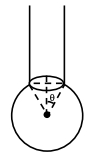
For a particle in uniform circular motion, the acceleration $\vec a$ at a point $P(R,\theta)$ on the circle of radius $R$ is (Here $\theta$ is measured from the $x-$ axis)
The value of internal energy of an ideal gas depends on :
Three vessels of equal volume contain gases at the same temperature and pressure. The first vessel contains neon (monoatomic), the second contains chlorine (diatomic) and third contains uranium hexafloride (polyatomic). Arrange these on the basis of their root mean square speed $\left(v_{ ms }\right)$ and choose the correct answer from the options given below:
Two non-mixing liquids of densities $\rho $ and $n \rho \,(n > 1)$ are put in a container. The height of each liquid is $h.$ A solid cylinder of length $L$ and density $d$ is put in this container. The cylinder floats with its axis vertical and length $\rho L (\rho < 1)$ in the denser liquid. The density $d$ is equal to
If rope of lift breaks suddenly, the tension exerted by the surface of lift ($a =$ acceleration of lift)
What change in surface energy will be noticed when a drop of radius R splits up into 1000 droplets of radius r, surface tension is T.
A circular loop is kept in that vertical plane which contains the north-south direction. It carries a current that is towards north at the topmost point. Let A be a point on the axis of the circle to the east of it and B a point on this axis to the west of it. The magnetic field due to the loop
  1. Is towards east at A and towards west at B.
  2. Is towards west at A and towards east at B.
  3. Is towards east at both A and B.
  4. Is towards west at both A and B.