MCQ 11 Mark
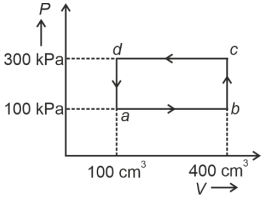
A cyclic process of a thermodynamic system is taken through $a$ $b$ $c$ $d$ $a$. The work done by the gas along the path $b$ $c$ is
- A
$30 \mathrm{~J}$
- B
$-90 \mathrm{~J}$
- C
$-60 \mathrm{~J}$
- ✓
Answerd
Path $b c$ is an isochoric process.
$\therefore \quad$ Work done by gas along path $b c$ is zero.
View full question & answer→MCQ 21 Mark
A Carnot engine has an efficiency of $50 \%$ when its source is at a temperature $327^{\circ}\,C$. The temperature of the sink is $.........^{\circ} C$
Answerb
Efficiency of carnot engine
$\% \eta=\left(1-\frac{T_{\text {sink }}}{T_{\text {source }}}\right) \times 100$
$T_{\text {source }}=327^{\circ}\,C =600\,K$
$50=\left(1-\frac{T_{\text {sink }}}{600}\right) \times 100$
$\frac{1}{2}=1-\frac{T_{\text {sink }}}{600}$
$T _{\text {Sink }}=300\,K$
So temp. of sink is ${ }^{\circ} C =300-2763=27^{\circ}\,C$
View full question & answer→MCQ 31 Mark
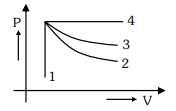
An ideal gas undergoes four different processes from the same initial state as shown in the figure below. Those processes are adiabatic, isothermal, isobaric and isochoric. The curve which represents the adiabatic process among $1,2,3$ and $4$ is
Answera
$1$ : Isochoric
$2$: Adiabatic
$3$ : Isothermal
$4$: Isobaric
View full question & answer→MCQ 41 Mark
An ideal gas follows a process described by the equation $PV ^2= C$ from the initial $\left( P _1, V _1, T _1\right)$ to final $\left(P_2, V_2, T_2\right)$ thermodynamics states, where $C$ is a constant. Then
- A
If $P_1 > P_2$ then $T_1 < T_2$
- B
If $V_2 > V_1$ then $T_2 > T_1$
- ✓
If $V_2 > V_1$ then $T_2 < T_1$
- D
If $P_1 > P_2$ then $V_1 > V_2$
AnswerCorrect option: C. If $V_2 > V_1$ then $T_2 < T_1$
c
$PV ^2= C$
$\Rightarrow \frac{ nRT }{ V } V ^2= C$
$\Rightarrow TV =\text { constant }$
$\therefore V _2 > V _1 \Rightarrow T _1 > T _2$
View full question & answer→MCQ 51 Mark
Two cylinders $A$ and $B$ of equal capacity are connected to each other via a stop cock. A contains an Ideal gas at standard temperature and pressure. $B$ is completely evacuated. The entire system is thermally insulated. The stop cock is suddenly opened. The process is :
Answerc
Free expansion i.e. expansion against vacuum is adiabatic in nature for all type of gases. It should be noted that temperature final temperature is equal to initial temperature for ideal gases.
View full question & answer→MCQ 61 Mark
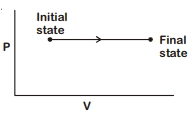
The $P-V$ diagram for an ideal gas in a piston cylinder assembly undergoing a thermodynamic process is shown in the figure. The process is
Answerd
Because pressure remains same during the process, so it is isobaric process.
View full question & answer→MCQ 71 Mark
The efficiency of a Carnot engine depends upon
- A
the temperature of the source only
- B
the temperature of the sink only
- ✓
the temperatures of the source and sink
- D
the volume of the cylinder of the engine
AnswerCorrect option: C. the temperatures of the source and sink
c
Efficiency of Carnot engine
$\eta=\left(1-\frac{T_{2}}{T_{1}}\right) \times 100 \%$
So efficiency depends on temperature of source $\left(T_{1}\right)$ and temperature of $\sin k\left(T_{2}\right)$
View full question & answer→MCQ 81 Mark
In which of the following processes, heat is neither absorbed nor released by a system ?
Answerb
Adiabatic process
$\Delta Q=0$
View full question & answer→MCQ 91 Mark
A sample of $0.1\, g$ of water at $100^o C$ and normal pressure $(1.013 \times 10^5 N m^{-2} )$ requires $54\ cal $ of heat energy to convert to steam at $100^o C.$ If the volume of the steam produced is $167.1 \,cc,$ the change in internal energy of the sample, is ....... $J$
- A
$104.3$
- ✓
$208.7$
- C
$84.5$
- D
$42.2$
AnswerCorrect option: B. $208.7$
b
Using first law of thermodynamics,
$\Delta Q = \Delta U + \Delta W$
$ \Rightarrow 54 \times 4.18 = \Delta U + 1.013 \times {10^5}\left( {167.1 \times {{10}^{ - 6}} - 0} \right)$
$ \Rightarrow \Delta U = 208.7\,J$
View full question & answer→MCQ 101 Mark
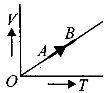
The volume $( V)$ of a monatomic gas varies with its temperature $(T)$ , as shown in the graph. The ratio of work done by the gas , to the heat absorbed by it, when it undergoes a change from state $A$ to state $B$ , is
- ✓
$\;\frac{2}{5}$
- B
$\frac{2}{3}$
- C
$\;\frac{2}{7}$
- D
$\;\frac{1}{3}$
AnswerCorrect option: A. $\;\frac{2}{5}$
a
Given process is isobaric.
$\therefore \,dQ = n{C_p}dT;\,where\,{C_p}\,is\,specific\,heat\,at\,constant\,pressure.$
or $dQ = n\left( {\frac{5}{2}R} \right)dT$
$Also,\,dW = PdV = nRdT\,\left( {PV = nRT} \right)$
Required ratio$ = \frac{{dW}}{{dQ}} = \frac{{nRdT}}{{n\left( {\frac{5}{2}R} \right)dT}} = \frac{2}{5}$
View full question & answer→MCQ 111 Mark
The efficiency of an ideal heat engine working between the freezing point and boiling point of water, is ........ $\%$
- ✓
$26.8$
- B
$20 $
- C
$12.5$
- D
$6.25$
AnswerCorrect option: A. $26.8$
a
Efficiency of an ideal heat engine,
$\eta = \left( {1 - \frac{{{T_2}}}{{{T_1}}}} \right)$
Freezing point of water $ = {0^ \circ }C = 273\,K$
Boiling point of water$ = {100^ \circ }C = \left( {100 + 273} \right)K$
$ = 373\,K$
$T_2$ Sink temperature$=273 K$
$T_1$ Source temperature $=373 K$
$\% \eta = \left( {1 - \frac{{{T_2}}}{{{T_1}}}} \right) \times 100 = \left( {1 - \frac{{273}}{{373}}} \right) \times 100$
$ = \left( {\frac{{100}}{{373}}} \right) \times 100 = 26.8\% $
View full question & answer→MCQ 121 Mark
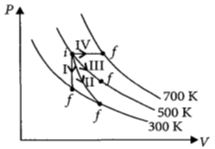
Thermodynamic processes are indicated in the following diagram.
Match the following
$\begin{array}{|l|l|} \hline Column\,\,-\,\,1 & Column\,\,-\,\,2 \\ \hline P\,:\,Process\,\,-\,\,I & \,\,A\,\,:\,\,Adiabatic \\ \hline Q\,:\,Process\,\,-\,\,II & \,\,B\,\,:\,\,Isobaric \\ \hline R\,:\,Process\,\,-\,\,III & \,\,C\,\,:\,\,Isochoric \\ \hline S\,:\,Process\,\,-\,\,IV & \,\,D\,\,:\,\,Isothermal \\ \hline \end{array}$
- ✓
$P \to C,\;\;Q \to A,\;\;\;R \to D,\;\;S \to B$
- B
$P \to C,\;\;Q \to D,\;\;\;R \to B,\;\;S \to A$
- C
$P \to D,\;\;Q \to B,\;\;\;R \to A,\;\;S \to C$
- D
$\;P \to A,\;\;Q \to C,\;\;\;R \to D,\;\;S \to B$
AnswerCorrect option: A. $P \to C,\;\;Q \to A,\;\;\;R \to D,\;\;S \to B$
a
In process $I,$ volume is constant
$\therefore \,\,\,\,process\,I \to Isochoric;\,P \to C$
As slope of curve $II$ is more than the slope of curve $III$.
$process\,II \to Adiabatic\,and\,processIII \to Isothermal$
$\therefore \,\,\,Q \to A,R \to D$
In process $IV$, pressure is constant
Process $IV \to Isobaric;\,S \to B$
View full question & answer→MCQ 131 Mark
The volume of $1\; mole$ of an ideal gas with the adiabatic exponent $\gamma$ is changed according to the relation $V=\frac bT$ where $b =$ constant. The amount of heat absorbed by the gas in the process if the temperature is increased by $\triangle T$ will be
- A
$\frac{R}{{\gamma - 1}} \Delta T$
- ✓
$\left( {\frac{{2 - \gamma }}{{\gamma - 1}}} \right)R \Delta T$
- C
$\;\frac{{R \Delta T}}{{\gamma - 1}}$
- D
$\left( {\frac{{1 - \gamma }}{{\gamma + 1}}} \right)R \Delta T$
AnswerCorrect option: B. $\left( {\frac{{2 - \gamma }}{{\gamma - 1}}} \right)R \Delta T$
b
$V=\frac bT$
$VT=$constant
$V(p V)=$ constant
$\therefore p V^{2}=$ constant
In the process $p V^{x}=$ constant, molar heat capacity is
$C=\frac{R}{\gamma-1}+\frac{R}{1-x}$
Here, $x=2$
$\therefore C=\frac{R}{\gamma-1}+\frac{R}{1-2}=\left(\frac{2-\gamma}{\gamma-1}\right) R$
Now, $Q=n C \Delta T$
$=(1)\left(\frac{2-\gamma}{\gamma-1}\right) R \Delta T$
$=\left(\frac{2-\gamma}{\gamma-1}\right) R \Delta T$
View full question & answer→MCQ 141 Mark
One mole of a gas obeying the equation of state $P(V-b)=R T$ is made to expand from a state with coordinates $\left(P_{1}, V_{1}\right)$ to a state with $\left(P_{2}, V_{2}\right)$ along a process that is depicted by a straight line on a $P-V$ diagram. Then, the work done is given by
- ✓
$\frac{1}{2}$(${P_1} + {P_2})\left( {{V_2} - {V_1}} \right)$
- B
$\;\frac{1}{2}$(${P_2} - {P_1})\left( {{V_2} - {V_1}} \right)$
- C
$\frac{1}{2}$(${P_1} + {P_2})\left( {{V_2} - {V_1} + 2b} \right)$
- D
$\;\frac{1}{2}$(${P_2} - {P_1})\left( {{V_2} + {V_1} + 2b} \right)$
AnswerCorrect option: A. $\frac{1}{2}$(${P_1} + {P_2})\left( {{V_2} - {V_1}} \right)$
a
Workdone during the complete cycle is equal to the area enclosed by the P-V graph
$W=\frac{1}{2} \text { base } \times \text { height }+ \text { Area of rectangular }$
$=\frac{1}{2}\left(V_2-V_1\right) \times\left(P_1-P_2\right)+\left(V_2-V_1\right) P_2$
$=\left(V_2-V_1\right)\left[\frac{P_1}{2}-\frac{P_2}{2}+P_2\right]$
$=\left(V_2-V_1\right)\left[\frac{P_1}{2}+\frac{P_2}{2}\right]$
$=\frac{1}{2}\left(P_1+P_2\right)\left(V_2-V_1\right)$

View full question & answer→MCQ 151 Mark
The temperature inside a refrigerator is $t_2 \,^o C$ and the room temperature is $t_1\,^o C.$ The amount of heat delivered to the room for each joule of electrical energy consumed ideally will be
- A
$\frac{{{t_2} + 273}}{{{t_1} - {t_2}}}$
- B
$\;\frac{{{t_1} + {t_2}}}{{{t_2} + 273}}$
- C
$\;\frac{{{t_1}}}{{{t_1} - {t_2}}}$
- ✓
$\;\frac{{{t_1} + 273}}{{{t_1} - {t_2}}}$
AnswerCorrect option: D. $\;\frac{{{t_1} + 273}}{{{t_1} - {t_2}}}$
d
Temperature inside refrigerator $ = {t_2}{\,^ \circ }C$
Room temperature $ = {t_1}{\,^ \circ }C$
For refrigerator,
$\frac{{Heat\,given\,to\,high\,temperature\,\left( {{Q_1}} \right)}}{{Heat\,taken\,from\,lower\,temperature\,\left( {{Q_2}} \right)}} = \frac{{{T_1}}}{{{T_2}}}$
$\frac{{{Q_1}}}{{{Q_2}}} = \frac{{{t_1} + 273}}{{{t_2} + 273}}$
$ \Rightarrow \frac{{{Q_1}}}{{{Q_1} - W}} = \frac{{{t_1} + 273}}{{{t_2} + 273}}\,\,or\,\,1 - \frac{W}{{{Q_1}}} = \frac{{{t_2} + 273}}{{{t_1} + 273}}$
$or\,\,\frac{W}{Q_1} = \frac{{{t_1} - {t_2}}}{{{t_1} + 273}}$
The amount of heat delivered to the room for each joule pf electrical energy $\left( {W = 1\,J} \right)$
${Q_1} = \frac{{{t_1} + 273}}{{{t_1} - {t_2}}}$
View full question & answer→MCQ 161 Mark
A refrigerator works between $4^o C$ and $30^o C.$ It is required to remove $600$ calories of heat every second in order to keep the temperature of the refrigerated space constant. The power required is ....... $W$ (Take $1\, cal \,=\, 4.2\, Joules\,)$
- A
$23.65$
- ✓
$236.5$
- C
$2365$
- D
$2.365$
AnswerCorrect option: B. $236.5$
b
$Given,\,{T_2} = {4^ \circ }C = 277\,K,{T_1} = {30^ \circ }C = 303\,K$
${Q_2} = 600\,cal\,per\,second$
Coefficient of performance, $\alpha = \frac{{{T_2}}}{{{T_1} - {T_2}}}$
$ = \frac{{277}}{{303 - 277}} = \frac{{277}}{{26}}$
Also,$\alpha = \frac{{{Q_2}}}{W}$
$\therefore $ $Work\,to\,be\,done\,per\,second=power\,required$
$ = W = \frac{{{Q_2}}}{\alpha } = \frac{{26}}{{277}} \times 600\,cal\,per\,second$
$ = \frac{{26}}{{277}} \times 600 \times 4.2\,J\,per\,second = 236.5\,W$
View full question & answer→MCQ 171 Mark
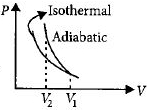
A gas is compressed isothermally to half its initial volume. The same gas is compressed separately through an adiabatic process until its volume is again reduced to half. Then
- ✓
Compressing the gas through adiabatic process will require more work to be done.
- B
Compressing the gas isothermally or adiabatically will require the same amount of work.
- C
Which of the case (whether compression through isothermal or through adiabatic process) requires more work will depend upon the atomicity of the gas.
- D
Compressing the gas isothermally will require more work to be done.
AnswerCorrect option: A. Compressing the gas through adiabatic process will require more work to be done.
a
${V_1} = V,{V_2} = V/2$
$On\,P - V\,diagram,$
$Area\,under\,adiabatic\,curve>Area\,under\,isothermal\,curve,$
So compressing the gas through adiabatic process will require more work to be done.
View full question & answer→MCQ 181 Mark
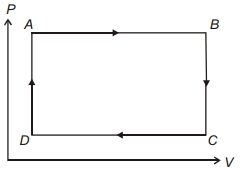
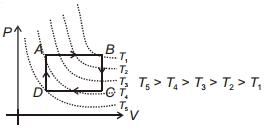
The pressure and volume of a gas are changed as shown in the $P-V$ diagram in this figure. The temperature of the gas will ........
- ✓
Increase as it goes from $A$ to $B$
- B
Increase as it goes from $B$ to $C$
- C
Remain constant during these changes
- D
Decrease as it goes from $D$ to $A$
AnswerCorrect option: A. Increase as it goes from $A$ to $B$
a
(a)
In the process $A \rightarrow B$
Pressure is constant.
$P V=n R T$
So $V \propto T$
and volume is increasing so temperature also increases.
View full question & answer→MCQ 191 Mark
In an isothermal reversible expansion, if the volume of $96\, gm$ of oxygen at $27°C$ is increased from $70$ litres to $140$ litres, then the work done by the gas will be
- A
$300\,R\,{\log _{10}}\,2$
- B
$81\,R\,{\log _e}\,2$
- C
$900\,R\,{\log _{10}}\,2$
- ✓
$2.3 \times 900\,R\,{\log _{10}}\,2$
AnswerCorrect option: D. $2.3 \times 900\,R\,{\log _{10}}\,2$
d
(d) $W = \mu RT{\log _e}\frac{{{V_2}}}{{{V_1}}}$
$ = \left( {\frac{m}{M}} \right)RT{\log _e}\frac{{{V_2}}}{{{V_1}}} = 2.3 \times \frac{m}{M}RT{\log _{10}}\frac{{{V_2}}}{{{V_1}}}$
$ = 2.3 \times \frac{{96}}{{32}}R\,\,(273 + 27)\,{\log _{10}}\frac{{140}}{{70}} = \,2.3 \times 900R{\log _{10}}2$
View full question & answer→MCQ 201 Mark
A vessel containing $5\, litres$ of a gas at $0.8 \,pa$ pressure is connected to an evacuated vessel of volume $3$ litres. The resultant pressure inside will be ...... $pa$ (assuming whole system to be isolated)
- A
$4/3 $
- ✓
$0.5 $
- C
$2.0 $
- D
$3/4 $
AnswerCorrect option: B. $0.5 $
b
(b) $0.8 \times 5 = P \times (3 + 5) \Rightarrow P = 0.5\;pa$
View full question & answer→MCQ 211 Mark
One mole of ${O_2}$ gas having a volume equal to $22.4$ litres at ${0^o}C$ and $1$ atmospheric pressure in compressed isothermally so that its volume reduces to $11.2$ litres. The work done in this process is ...... $J$
- A
$1672.5$
- B
$1728$
- C
$ - 1728$
- ✓
$ - 1572.5$
AnswerCorrect option: D. $ - 1572.5$
d
(d)$W = - \mu RT{\log _e}\frac{{{V_2}}}{{{V_1}}} = - 1 \times 8.31 \times (273 + 0){\log _e}\left( {\frac{{22.4}}{{11.2}}} \right)$
$ = - \,8.31 \times 273 \times {\log _e}2$$ = - 1572.5J$ [${\log _e}2 = 0.693$]
View full question & answer→MCQ 221 Mark
In an isothermal process the volume of an ideal gas is halved. One can say that
- A
Internal energy of the system decreases
- B
Work done by the gas is positive
- ✓
Work done by the gas is negative
- D
Internal energy of the system increases
AnswerCorrect option: C. Work done by the gas is negative
c
(c) For isothermal process
$dU = 0$ and work done $ = dW = P({V_2} - {V_1})$
$\;{V_2} = \frac{{{V_1}}}{2} = \frac{V}{2}$
$dW = - \frac{{PV}}{2}$
View full question & answer→MCQ 231 Mark
When an ideal gas in a cylinder was compressed isothermally by a piston, the work done on the gas was found to be $1.5 \times {10^4}\;joules$. During this process about
- ✓
$3.6 \times {10^3}$ cal of heat flowed out from the gas
- B
$3.6 \times {10^3}$ cal of heat flowed into the gas
- C
$1.5 \times {10^4}$ cal of heat flowed into the gas
- D
$1.5 \times {10^4}$ cal of heat flowed out from the gas
AnswerCorrect option: A. $3.6 \times {10^3}$ cal of heat flowed out from the gas
a
(a)In isothermal compression, there is always an increase of heat. which must flow out the gas.
$\Delta Q = \Delta U + \Delta W \Rightarrow \Delta Q = \Delta W\;\;(\because \;\Delta U = 0)$
==> $\Delta Q = - 1.5 \times {10^4}J = \frac{{1.5 \times {{10}^4}}}{{4.18}}cal = - 3.6 \times {10^3}cal$
View full question & answer→MCQ 241 Mark
$540$ calories of heat convert $1 $ cubic centimeter of water at ${100^o}C$ into $1671 $ cubic centimeter of steam at ${100^o}C$ at a pressure of one atmosphere. Then the work done against the atmospheric pressure is nearly ...... $cal$
Answerb
(b) Amount of heat given $ = 540\;calories$
Change in volume $\Delta V = 1670\;c.c$
Atmospheric pressure $P = 1.01 \times {10^6}\;dyne/c{m^2}$
Work done against atmospheric pressure
$W = P\Delta V$$ = \frac{{1.01 \times {{10}^6} \times 1670}}{{4.2 \times {{10}^7}}} \approx 40\;cal$
View full question & answer→MCQ 251 Mark
One mole of an ideal gas expands at a constant temperature of $300 \,K$ from an initial volume of $10\, litres$ to a final volume of $20\, litres$. The work done in expanding the gas is ...... $J.$ $(R = 8.31 J/mole-K)$
- A
$750$
- ✓
$1728$
- C
$1500$
- D
$3456$
AnswerCorrect option: B. $1728$
b
(b) ${W_{iso}} = \mu RT{\log _e}\frac{{{V_2}}}{{{V_1}}} = 1 \times 8.31 \times 300{\log _e}\frac{{20}}{{10}} = 1728J$
View full question & answer→MCQ 261 Mark
A cylinder fitted with a piston contains $0.2 \,moles$ of air at temperature $27°C.$ The piston is pushed so slowly that the air within the cylinder remains in thermal equilibrium with the surroundings. Find the approximate work done by the system if the final volume is twice the initial volume ...... $J$
- A
$543 $
- ✓
$345 $
- C
$453 $
- D
$600 $
AnswerCorrect option: B. $345 $
b
(b) $W = \mu RT{\log _e}\left( {\frac{{{V_2}}}{{{V_1}}}} \right)$$ = 0.2 \times 8.3 \times {\log _e}2\, \times (27 + 273)$
$ = 0.2 \times 8.3 \times 300 \times 0.693 = 345J$
View full question & answer→MCQ 271 Mark
The volume of an ideal gas is $1$ litre and its pressure is equal to $72cm$ of mercury column. The volume of gas is made $900\, cm^3$ by compressing it isothermally. The stress of the gas will be ...... $cm$ (mercury)
Answera
(a)For isothermal process ${P_1}{V_1} = {P_2}{V_2}$
==> ${P_2} = \frac{{{P_1}{V_1}}}{{{V_2}}} = \frac{{72 \times 1000}}{{900}}=80 \,cm$
Stress $\Delta P = {P_2} - {P_1} = 80 - 72 = 8cm$
View full question & answer→MCQ 281 Mark
The process $C D$ is shown in the diagram. As system is taken from $C$ to $D$, what happens to the temperature of the system?
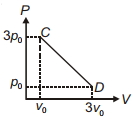
- A
Temperature first decreases and then increases
- ✓
Temperature first increases and then decreases
- C
Temperature decreases continuously
- D
Temperature increases continuously
AnswerCorrect option: B. Temperature first increases and then decreases
b
(b)
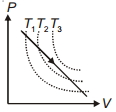
$T_3 > T_2 > T_1$
So from $C \rightarrow D$
Temperature first increases then decreases.
View full question & answer→MCQ 291 Mark
An air bubble of volume $v _0$ is released by a fish at a depth $h$ in a lake. The bubble rises to the surface. Assume constant temperature and standard atmospheric pressure above the lake. The volume of the bubble just before touching the surface will be (density) of water is $\rho$
AnswerCorrect option: D. $v _0\left(1+\frac{\rho g h}{ p }\right)$
d
(d)
As the bubble rises the pressure gets reduced for constant temperature, if $P$ is the standard atmospheric pressure, then $(P+\rho g h) V_0=P V$ or $V = V _0\left(1+\frac{\rho gh }{ P }\right)$
View full question & answer→MCQ 301 Mark
The pressure in the tyre of a car is four times the atmospheric pressure at $300 K$. If this tyre suddenly bursts, its new temperature will be $(\gamma = 1.4)$
- A
$300\,{(4)^{1.4/0.4}}$
- B
$300\,{\left( {\frac{1}{4}} \right)^{ - 0.4/1.4}}$
- C
$300\,{(2)^{ - 0.4/1.4}}$
- ✓
$300\,{(4)^{ - 0.4/1.4}}$
AnswerCorrect option: D. $300\,{(4)^{ - 0.4/1.4}}$
d
(d) For adiabatic process $\frac{{{T^\gamma }}}{{{P^{\gamma - 1}}}} = $ constant
==>$\frac{{{T_2}}}{{{T_1}}} = {\left( {\frac{{{P_1}}}{{{P_2}}}} \right)^{\frac{{1 - \gamma }}{\gamma }}}$
==>$\frac{{{T_2}}}{{300}} = {\left( {\frac{4}{1}} \right)^{\frac{{(1 - 1.4)}}{{1.4}}}}$
==>${T_2} = 300{(4)^{ - \frac{{0.4}}{{1.4}}}}$
View full question & answer→MCQ 311 Mark
A gas at $NTP$ is suddenly compressed to one-fourth of its original volume. If $\gamma $ is supposed to be $\frac{3}{2}$, then the final pressure is........ atmosphere
Answerc
(c) $P{V^\gamma } = {\rm{constant}} \Rightarrow \frac{{{P_2}}}{{{P_1}}} = {\left( {\frac{{{V_1}}}{{{V_2}}}} \right)^\gamma }$$ \Rightarrow \frac{{{P_2}}}{1} = {\left( {\frac{{{V_1}}}{{{V_1}/4}}} \right)^{3/2}} = 8$
==> ${P_2} = 8\;atm$.
View full question & answer→MCQ 321 Mark
The pressure and density of a diatomic gas $(\gamma = 7/5)$ change adiabatically from $(P, d)$ to $(P', d')$. If $\frac{{d'}}{d} = 32$, then $\frac{{P'}}{P}$ should be
Answerc
(c) Volume of the gas $V = \frac{m}{d}$and using $P{V^\gamma }$= constant
We get $\frac{{P'}}{P} = {\left( {\frac{V}{{V'}}} \right)^\gamma } = \,{\left( {\frac{{d'}}{d}} \right)^\gamma } = {(32)^{7/5}} = 128$
View full question & answer→MCQ 331 Mark
The slopes of isothermal and adiabatic curves are related as
- A
Isothermal curve slope = adiabatic curve slope
- B
Isothermal curve slope = $\gamma \times $ adiabatic curve slope
- ✓
Adiabatic curve slope = $\gamma \times $ isothermal curve slope
- D
Adiabatic curve slope = $\frac{1}{2} \times $isothermal curve slope
AnswerCorrect option: C. Adiabatic curve slope = $\gamma \times $ isothermal curve slope
c
(c) For Isothermal process $PV = $constant
$ \Rightarrow \left( {\frac{{dP}}{{dV}}} \right) = \frac{{ - P}}{V} = $ Slope of Isothermal curve
For adiabatic$P{V^\gamma } = $constant
$ \Rightarrow \frac{{dP}}{{dV}} = \frac{{ - \gamma P}}{V} = $ Slop of adiabatic curve slope
Clearly, ${\left( {\frac{{dP}}{{dV}}} \right)_{{\rm{adiabatic}}}} = \gamma {\left( {\frac{{dP}}{{dV}}} \right)_{{\rm{Isothermal }}}}$
View full question & answer→MCQ 341 Mark
The adiabatic elasticity of hydrogen gas $(\gamma = 1.4)$ at $NTP$ is
- A
$1 \times {10^5}\;N/{m^2}$
- B
$1 \times {10^{ - 8}}\;N/m^2$
- C
$1.4\;N/{m^2}$
- ✓
$1.4 \times {10^5}N/{m^2}$
AnswerCorrect option: D. $1.4 \times {10^5}N/{m^2}$
d
(d) ${E_\varphi } = \gamma P = 1.4 \times (1 \times {10^5}) = 1.4 \times {10^5}N/{m^2}$
View full question & answer→MCQ 351 Mark
One gm mol of a diatomic gas $(\gamma = 1.4)$ is compressed adiabatically so that its temperature rises from ${27^o}C$ to ${127^o}C$. The work done will be
- ✓
$2077.5\, joules$
- B
$207.5\, joules$
- C
$207.5 \,ergs$
- D
AnswerCorrect option: A. $2077.5\, joules$
a
(a) $W = \frac{R}{{\gamma - 1}}({T_1} - {T_2})$
$ = \frac{{8.31 \times \{ (273 + 27) - (273 + 127)\} }}{{1.4 - 1}} = - 2077.5\;joules$
View full question & answer→MCQ 361 Mark
A polyatomic gas $\left( {\gamma = \frac{4}{3}} \right)$ is compressed to $\frac{1}{8}$ of its volume adiabatically. If its initial pressure is ${P_o}$, its new pressure will be
- A
$8{P_o}$
- ✓
$16{P_0}$
- C
$6{P_o}$
- D
$2{P_o}$
AnswerCorrect option: B. $16{P_0}$
b
(b)$\frac{{{P_2}}}{{{P_1}}} = {\left( {\frac{{{V_1}}}{{{V_2}}}} \right)^\gamma }$==> ${P_2} = {P_1}{\left( {\frac{{{V_1}}}{{{V_2}}}} \right)^\gamma } = {P_0}{(8)^{4/3}} = 16{P_0}.$
View full question & answer→MCQ 371 Mark
An ideal gas is expanded adiabatically at an initial temperature of $300 K$ so that its volume is doubled. The final temperature of the hydrogen gas is $(\gamma = 1.40)$
- ✓
$227.36 K$
- B
$500.30 K$
- C
$454.76 K$
- D
$ - {47^o}C$
AnswerCorrect option: A. $227.36 K$
a
(a) $T{V^{\gamma - 1}} = $constant
==> $\frac{{{T_2}}}{{{T_1}}} = {\left( {\frac{{{V_1}}}{{{V_2}}}} \right)^\gamma }$
==> ${T_2} = {T_1}{\left( {\frac{{{V_1}}}{{{V_2}}}} \right)^\gamma }$
$ \Rightarrow {T_2} = 300{\left( {\frac{1}{2}} \right)^{0.4}} = 227.36\;K$
View full question & answer→MCQ 381 Mark
Helium at ${27^o}C$ has a volume of $8$ litres. It is suddenly compressed to a volume of $1$ litre. The temperature of the gas will be ....... $^oC$ $[\gamma = 5/3]$
- A
${108}$
- B
${9327}$
- C
${1200}$
- ✓
${927}$
AnswerCorrect option: D. ${927}$
d
(d) $T{V^{\gamma - 1}} = $constant$ \Rightarrow {T_2} = {T_1}{\left( {\frac{{{V_1}}}{{{V_2}}}} \right)^{\gamma - 1}} = {927^o}C$
View full question & answer→MCQ 391 Mark
At $N.T.P.$ one mole of diatomic gas is compressed adiabatically to half of its volume $\gamma = 1.41$. The work done on gas will be ....... $J$
- A
$1280 $
- B
$1610 $
- ✓
$1815 $
- D
$2025 $
AnswerCorrect option: C. $1815 $
c
(c)${T_2} = {T_1}{\left( {\frac{{{V_1}}}{{{V_2}}}} \right)^{\gamma - 1}} = 273{(2)^{0.41}}$$ = 273 \times 1.328 = 363K$
$W = \frac{{R({T_1} - {T_2})}}{{\gamma - 1}} = \frac{{8.31(273 - 363)}}{{1.41 - 1}}$$ = - \,1824$
==> $|W| \approx 1815 J$
View full question & answer→MCQ 401 Mark
Two moles of an ideal monoatomic gas at ${27^o}C$ occupies a volume of $V.$ If the gas is expanded adiabatically to the volume $2V,$ then the work done by the gas will be ....... $J$ $[\gamma = 5/3,\,R = 8.31J/mol\,K]$
- A
$ - 2767.23$
- ✓
$2767.23$
- C
$2500$
- D
$ - 2500$
AnswerCorrect option: B. $2767.23$
b
(b) $W = \frac{{\mu R({T_1} - {T_2})}}{{(\gamma - 1)}} = \frac{{\mu R{T_1}}}{{(\gamma - 1)}}\left[ {1 - \frac{{{T_2}}}{{{T_1}}}} \right]$
$ = \frac{{\mu R{T_1}}}{{(\gamma - 1)}}\left[ {1 - {{\left( {\frac{{{V_1}}}{{{V_2}}}} \right)}^{\gamma - 1}}} \right]$
$ = \frac{{2 \times 8.31 \times 300}}{{\left( {\frac{5}{3} - 1} \right)}}\left[ {1 - {{\left( {\frac{1}{2}} \right)}^{\frac{5}{3} - 1}}} \right]$$ = + 2767.23\;J$
View full question & answer→MCQ 411 Mark
At ${27^o}C$ a gas is suddenly compressed such that its pressure becomes $\frac{1}{8}th$ of original pressure. Temperature of the gas will be $(\gamma = 5/3)$
- A
$420K$
- B
${327^o}C$
- C
$300K$
- ✓
$ - {142^o}C$
AnswerCorrect option: D. $ - {142^o}C$
d
(d) ${T^\gamma }{P^{1 - \gamma }} = $constant ==> $T \propto {P^{\frac{{\gamma - 1}}{\gamma }}}$
==> $\frac{{{T_2}}}{{{T_1}}} = {\left( {\frac{{{P_2}}}{{{P_1}}}} \right)^{\frac{{\gamma - 1}}{\gamma }}} = {\left( {\frac{1}{8}} \right)^{\frac{{5/3 - 1}}{{5/3}}}}$
${T_2} = 300 \times {\left( {\frac{1}{8}} \right)^{0.4}} = 131K = - 142^\circ C$
View full question & answer→MCQ 421 Mark
An ideal gas at a pressures of $1$ atmosphere and temperature of ${27^o}C$ is compressed adiabatically until its pressure becomes $8$ times the initial pressure, then the final temperature is ..... $^oC$ ($\gamma = 3/2$)
Answerd
(d)Using relation$\frac{{{T_2}}}{{{T_1}}} = {\left( {\frac{{{P_2}}}{{{P_1}}}} \right)^{\frac{{\gamma - 1}}{\gamma }}} = {(8)^{\frac{{3/2 - 1}}{{3/2}}}} = 2$.
==> ${T_2} = 2{T_1}$==> ${T_2} = 2\,(273 + 27) = 600K = 327^\circ C$
View full question & answer→MCQ 431 Mark
Air is filled in a motor tube at ${27^o}C$ and at a pressure of $8$ atmospheres. The tube suddenly bursts, then temperature of air is $[{\rm{Given}}\,\,\gamma \,{\rm{of}}\,{\rm{air}} = \,1.5]$
- A
${27.5^o}C$
- B
${75^o}K$
- ✓
$150\,K$
- D
${150^o}C$
AnswerCorrect option: C. $150\,K$
c
(c) $\frac{{{T_2}}}{{{T_1}}} = {\left( {\frac{{{P_2}}}{{{P_1}}}} \right)^{\frac{{\gamma - 1}}{\gamma }}}$
$ \Rightarrow \frac{{{T_2}}}{{{T_1}}} = {\left( {\frac{1}{8}} \right)^{\frac{{1.5 - 1}}{{1.5}}}} = {\left( {\frac{1}{8}} \right)^{\frac{1}{3}}} = \frac{1}{2}$
$ \Rightarrow {T_2} = \frac{{{T_1}}}{2} = \frac{{300}}{2} = 150K$.
View full question & answer→MCQ 441 Mark
If $\gamma = 2.5$ and volume is equal to $\frac{1}{8}$ times to the initial volume then pressure $P' $ is equal to (Initial pressure $= P$)
AnswerCorrect option: C. $P' = P \times {(2)^{15/2}}$
c
(c)$\frac{{{P_2}}}{{{P_1}}} = {\left( {\frac{{{V_1}}}{{{V_2}}}} \right)^\gamma } \Rightarrow \frac{{P'}}{P} = {(8)^{5/2}} \Rightarrow P' = P \times {(2)^{15/2}}$
View full question & answer→MCQ 451 Mark
A gas is suddenly compressed to $1/4$ th of its original volume at normal temperature. The increase in its temperature is ....... $K$ $(\gamma = 1.5)$
- ✓
$273 $
- B
$573 $
- C
$373 $
- D
$473 $
AnswerCorrect option: A. $273 $
a
(a) $\because \;T{V^{\gamma - 1}} = $constant $⇒$ ${T_1}V_1^{\gamma - 1} = {T_2}V_2^{\gamma - 1}$
$⇒$ ${T_2} = {T_1}{\left( {\frac{{{V_1}}}{{{V_2}}}} \right)^{\gamma - 1}} = {T_1}{(4)^{1.5 - 1}} = 2{T_1}$
change in temperature
$ = {T_2} - {T_1} = 2{T_1} - {T_1} = {T_1} = 273\,K$
View full question & answer→MCQ 461 Mark
A gas ($\gamma = 1.3)$ is enclosed in an insulated vessel fitted with insulating piston at a pressure of ${10^5}\,N/{m^2}$. On suddenly pressing the piston the volume is reduced to half the initial volume. The final pressure of the gas is
- A
${2^{0.7}} \times {10^5}$
- ✓
${2^{1.3}} \times {10^5}$
- C
${2^{1.4}} \times {10^5}$
- D
AnswerCorrect option: B. ${2^{1.3}} \times {10^5}$
b
(b)$\because \;P{V^\gamma } = k$(constant) ==> ${P_1}V_1^\gamma = {P_2}V_2^\gamma $
$⇒$ ${P_2} = {P_1}{\left( {\frac{{{V_1}}}{{{V_2}}}} \right)^\gamma } = {10^5} \times {(2)^{1.3}}$ $(\because \;{V_2} = \frac{{{V_1}}}{2})$
View full question & answer→MCQ 471 Mark
A certain mass of gas at $273 K$ is expanded to $81$ times its volume under adiabatic condition. If $\gamma = 1.25$ for the gas, then its final temperature is ..... $^oC$
AnswerCorrect option: B. $-182$
b
(b) For adiabatic process $T{V^{\gamma - 1}}$= constant
==> $\frac{{{T_2}}}{{{T_1}}} = {\left( {\frac{{{V_1}}}{{{V_2}}}} \right)^{\gamma - 1}}$==> ${T_2} = {\left( {\frac{{{V_1}}}{{{V_2}}}} \right)^{\gamma - 1}} \times {T_1}$
==> ${T_2} = {\left( {\frac{1}{{81}}} \right)^{1.25 - 1}} \times 273$$ = {\left( {\frac{1}{{81}}} \right)^{0.25}} \times 273$
$ = \frac{{273}}{3} = 91K = \,-182°C$
View full question & answer→MCQ 481 Mark
A gas is compressed adiabatically till its temperature is doubled. The ratio of its final volume to initial volume will be
- A
$1/2$
- B
More than $1 / 2$
- ✓
Less than $1 / 2$
- D
Between $1$ and $2$
AnswerCorrect option: C. Less than $1 / 2$
c
(c) $\frac{{{T_2}}}{{{T_1}}} = {\left( {\frac{{{V_1}}}{{{V_2}}}} \right)^{\gamma - 1}} = 2 \Rightarrow {\left( {\frac{{{V_2}}}{{{V_1}}}} \right)^{\gamma - 1}} = \frac{1}{2} \Rightarrow \frac{{{V_2}}}{{{V_1}}} = {\left( {\frac{1}{2}} \right)^{\frac{1}{{\gamma - 1}}}} < \frac{1}{2}$
==> ${V_2} < \frac{{{V_1}}}{2}$
View full question & answer→MCQ 491 Mark
A tyre filled with air $({27^o}C,$ and $2$ atm) bursts, then what is temperature of air ....... $^oC$ $(\gamma = 1.5)$
AnswerCorrect option: A. $ - 33$
a
(a) $\frac{{{T_2}}}{{{T_1}}} = {\left( {\frac{{{P_2}}}{{{P_1}}}} \right)^{\frac{{\gamma - 1}}{\gamma }}}$==> $\frac{{{T_2}}}{{(273 + 27)}} = {\left( {\frac{1}{2}} \right)^{\frac{{1.5 - 1}}{{1.5}}}} = $${\left( {\frac{1}{2}} \right)^{\frac{1}{3}}} = \frac{1}{{2.5}}$
==> ${T_2} = \frac{{{T_1}}}{{1.25}} = \frac{{(273 + 27)}}{{1.25}} = 238\,K = - \,34.8^\circ C$
View full question & answer→MCQ 501 Mark
Three samples of the same gas $A, B$ and $C(\gamma = 3/2)$ have initially equal volume. Now the volume of each sample is doubled. The process is adiabatic for $A$ isobaric for $B $ and isothermal for $C$. If the final pressures are equal for all three samples, the ratio of their initial pressures are
- A
$2\sqrt 2 \,\,:\,\,2\,\,:\,\,1$
- ✓
$2\sqrt 2 \,\,:\,\,1\,\,:\,\,2$
- C
$\sqrt 2 \,\,:\,\,1\,\,:\,\,2$
- D
$2\,\,:\,\,1\,\,:\,\,\sqrt 2 $
AnswerCorrect option: B. $2\sqrt 2 \,\,:\,\,1\,\,:\,\,2$
b
(b) Let the initial pressure of the three samples be ${P_A},\,{P_B}$ and ${P_C}$, then ${P_A}{(V)^{3/2}} = {(2V)^{3/2}}P$, ${P_B} = P$ and
${P_C}(V) = P(2V)$
==> ${P_A}\,:\,{P_B}\,:\,{P_C} = {(2)^{3/2}}:\,1\,\,:\,\,2 = 2\sqrt 2 \,:\,1\,:\,\,2$
View full question & answer→