MCQ
A Carnot’s engine is made to work between $200°C$ and $0°C$ first and then between $0°C$ and $-200°C.$ The ratio of efficiencies of the engine in the two cases is
  • A
    $1.73 : 1$
  • $1:1.73$
  • C
    $1:1$
  • D
    $1:2$

Answer

Correct option: B.
$1:1.73$
b
(b) In first case ${\eta _1} = 1 - \frac{{{T_2}}}{{{T_1}}} = 1 - \frac{{(273 + 0)}}{{(273 + 200)}} = \frac{{200}}{{473}}$
In second case ${\eta _2} = 1 - \frac{{(273 - 200)}}{{(273 + 0)}} = \frac{{200}}{{273}}$
==> $\frac{{{\eta _1}}}{{{\eta _2}}} = \frac{1}{{\left( {\frac{{473}}{{273}}} \right)}} = 1:1.73$

Need a full question paper?

Generate a complete, print-ready paper with questions like this in minutes — across 16+ boards, with answer keys.
Start Generating Free

Similar questions

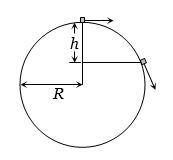
A particle originally at rest at the highest point of a smooth vertical circle is slightly displaced. It will leave the circle at a vertical distance $h$ below the highest point such that
A sphere of mass $10\; kg$ and radius $0.5\; m$ rotates about a tangent. The moment of inertia of the sphere is
A gale blows over the house. The force due to gale on the roof is:
A body falling vertically downwards under gravity breaks in two parts of unequal masses. The centre of mass of the two parts taken together shifts horizontally towards:
Which is constant for a satellite in orbit
A rocket with a lift- off mass $3.5 \times {10^4}$$kg$ is blasted upwards with an initial acceleration of $10m/{s^2}.$ Then the initial thrust of the blast is
A particle with restoring force proportional to displacement and resisting force proportional to velocity is subjected to a force $F\sin \omega t$. If the amplitude of the particle is maximum for $\omega = {\omega _1}$ and the energy of the particle is maximum for $\omega = {\omega _2}$, then (where ${\omega _0}$ natural frequency of oscillation of particle)
In a linear simple harmonic motion $(SHM)$

$(A)$ Restoring force is directly proportional to the displacement.

$(B)$ The acceleration and displacement are opposite in direction.

$(C)$ The velocity is maximum at mean position.

$(D)$ The acceleration is minimum at extreme points.

Choose the correct answer from the options given below :
The work done in joules in increasing the extension of a spring of stiffness $10\, N/cm$ from $4\, cm$ to $6\, cm$ is: