MCQ
A Carnot's engine is made to work between $200^{\circ} \mathrm{C}$ and $0^{\circ} \mathrm{C}$ first and then between $0^{\circ} \mathrm{C}$ and $-200^{\circ} \mathrm{C}$. The ratio of efficiencies of the engine in the two cases is
  • $1.73: 1$
  • B
    $1: 1.73$
  • C
    $1: 1$
  • D
    $1: 2$

Answer

Correct option: A.
$1.73: 1$
In first case $\eta_1=1-\frac{T_2}{T_1}=1-\frac{(273+0)}{(273+200)}=\frac{200}{473}$
In second case $\eta_2=1-\frac{(273-200)}{(273+0)}=\frac{200}{273}$
$\Rightarrow\frac{\eta_1}{\eta_2}=\frac{1}{\left(\frac{473}{273}\right)}=1: 1.73$

Need a full question paper?

Generate a complete, print-ready paper with questions like this in minutes — across 16+ boards, with answer keys.

Start Generating Free

Similar questions

A beam of metal supported at the two ends is loaded at the centre. The depression at the centre is proportional to
The Rydberg constant $R$ for hydrogen is
Two pieces of glass plate one upon the other with a little water in between them cannot be separated easily because of
A $500 \mathrm{~Hz}$ modulating voltage fed into an FM generator produces a frequency deviation of $2.25 \mathrm{kHz}$. If amplitude of the voltage is kept constant but frequency is raised to $6 \mathrm{kHz}$ then the new deviation will be
A body of $5 kg$ is moving with a velocity of $20 m / s$. If a force of $100 N$ is applied on it for $10 s$ in the same direction as its velocity, what will now be the velocity of the body
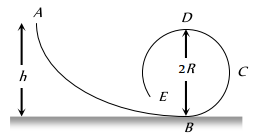
A frictionless track $A B C D E$ ends in a circular loop of radius $R$. A body slides down the track from point $A$ which is at $a$ height $h=5$ $\mathrm{cm}$. Maximum value of $R$ for the body to successfully complete the loop isImage
When $N P N$ transistor is used as an amplifier
Which is different from others by units
If temperature of a black body increases from $7^{\circ} \mathrm{C}$ to $287^{\circ} \mathrm{C}$, then the rate of energy radiation increases by
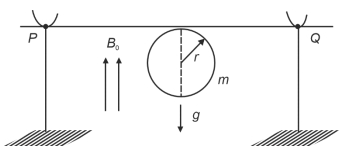
A thin stiff insulated metal wire is bent into a circular loop with its two ends extending tangentially from the same point of the loop. The wire loop has mass $m$ and radius $r$ and it is in a uniform vertical magnetic field $B_0$, as shown in the figure. Initially, it hangs vertically downwards, because of acceleration due to gravity $g$, on two conducting supports at $P$ and $Q$. When a current $/$ is passed through the loop, the loop turns about the line $P Q$ by an angle $\theta$ given by