Question
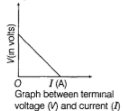
$A$ cell of emf $E$ and internal resistance $r$ is connected across a variable load resistor $R$. Draw the plots of the terminal voltage $V$ versus $(i)$ resistance $R$ and $(ii)$ current $I$.
It is found that when $R=4 \Omega$, the current is $1 A$ and when $R$ is increased to $9 \Omega$, the current reduces to $0.5 A$ .Find the values of the emf $E$ and internal resistance $r$.
Answer

Internal resistance usually means the electrical resistance inside batteries and power supplies that can limit the potential difference that can be supplied to an external load
$\because V=\left(\frac{E}{R+r}\right) R=\frac{E}{1+r / R}$
$\Rightarrow$ with the increase of $R , V$ increases
Graph between terminal voltage $(V)$ and Current $(I)$
Image
When $R=4 \Omega$ and $I =1 A$.
We know that, terminal voltage $, V = E - Ir.$
$\Rightarrow V=I R=4=E-I r$
$\Rightarrow E-r=4 \ldots \text { (i) }$
When $R=9 \Omega$ and $I =0.5 A$, then
$V=I R=0.5 \times 9=E-0.5 r$
$\Rightarrow E-05 r=4.5 \ldots(i i)$
On solving Eqs. $(i)$ and $(ii),$ we get
$r=1 \Omega$ and $E =5 V$
So from the above calculation, it was found that the internal resistance of the cell is $1 \text { ohm}$ and emf is $5$ volt.

Need a full question paper?

Generate a complete, print-ready paper with questions like this in minutes — across 16+ boards, with answer keys.

Start Generating Free

Similar questions

Consider a point at the focal point of a convergent lens. Another convergent lens of short focal length is placed on the other side. What is the nature of the wavefronts emerging from the final image?
The acceleration of a cart started at $t = 0,$ varies with time as shown in figure. Find the distance travelled in $30$ seconds and draw the position$-$time graph.
Two capacitors of capacitances $4.0\mu\text{F}$ and $6.0\mu\text{F}$ are connected in series with a battery of 20V. Find the energy supplied by the battery.
Suppose that the particle in Exercise in $1.33$ is an electron projected with velocity $v_x= 2.0 \times 10^6 m s^{–1}.$ If $E$ between the plates separated by $0.5 \ cm$ is $9.1 \times 10^2N/C,$ where will the electron strike the upper plate? $(|e|=1.6 \times 10^{–19}C, m_e = 9.1 \times 10^{–31} \ kg.)$
If the operating potential in an X-ray tube is increased by 1%, by what percentage does the cutoff wavelength decrease?
The number of electrons in an insulator is of the same order as the number of electrons in a conductor. What is then the basic difference between a conductor and an insulator?
Explain linear density, surface density and volume density for continuous charge distribution.
A semiconducting material has a band gap of 1eV. Acceptor impurities are doped into it which create acceptor levels 1meV above the valence band. Assume that the transition from one energy level to the other is almost forbidden if kT is less than $\frac{1}{50}$ of the energy gap. Also, if kT is more than twice the gap, the upper levels have maximum population. The temperature of the semiconductor is increased from 0K. The concentration of the holes increases with temperature and after a certain temperature it becomes approximately constant. As the temperature is further increased, the hole concentration again starts increasing at a certain temperature. Find the order of the temperature range in which the hole concentration remains approximately constant.
Give reasons for the following:
  1. The Zener diode is fabricated by heavily doping both the p and n sides of the junction.
  2. A photodiode, when used as a detector of optical signals is operated under reverse bias.
  3. The band gap of the semiconductor used for fabrication of visible LED’s must at least be 1.8eV.
The magnifying power of a simple microscope is given by $1+\frac{\text{D}}{\text{f}},$ where D is the least distance for clear vision. For farsighted persons, D is greater than the usual. Does it mean that the magnifying power of a simple microscope is greater for a farsighted person as compared to a normal person? Does it mean that a farsighted person can see an insect more clearly under a microscope than a normal person?