Question
A cell of emf ‘E’ and internal resistance ‘r’ is connected across a variable resistor ‘R’. Plot a graph showing variation of terminal voltage ‘V’ of the cell versus the current ‘I’. Using the plot, show how the emf of the cell and its internal resistance can be determined.
Answer

The relation between V and I is
V = E – Ir
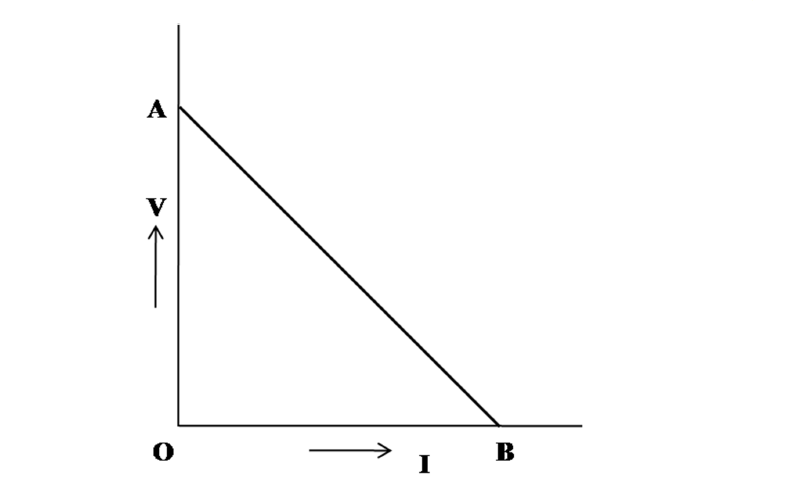
Hence, the graph, between V and I, has the form shown below.

For point A, I=0, Hence, VA= E
For point B, V=0, Hence, E=IBr

Therefore, $\text{r} =\frac{\text{E}}{\text{I}_{B}}$

Alternate Answer

Emf (E) equals the intercept on the vertical axis. Internal resistance (r) equals the negative of the slope of the graph.

Need a full question paper?

Generate a complete, print-ready paper with questions like this in minutes — across 16+ boards, with answer keys.

Start Generating Free

Similar questions

State conditions when resultant magnetic field at a point due to two long straight perpendicular current carrying wires can be zero.
Derive the equation of electric potential due to a system of electric charges.
Give an example for which $\overrightarrow{\text{A}}.\overrightarrow{\text{B}}=\overrightarrow{\text{C}}.\overrightarrow{\text{B}}$ but $\overrightarrow{\text{A}}\neq\overrightarrow{\text{C}}.$
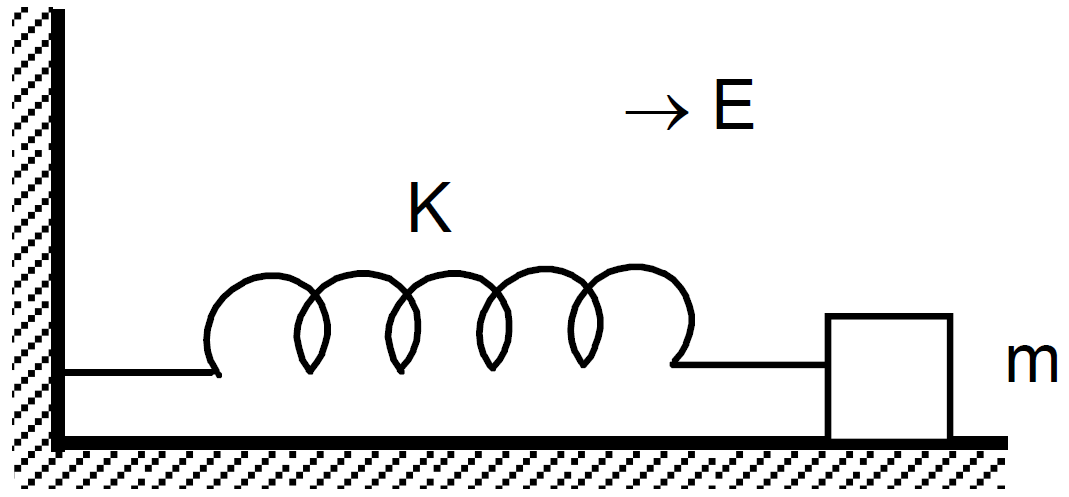
A block of mass m having a charge q is placed on a smooth horizontal table and is connected to a wall through an unstressed spring of spring constant k as shown in figure. A horizontal electric field E parallel to the spring is switched on. Find the amplitude of the resulting SHM of the block.

According to Maxwell's theory of electrodynamics, an electron going in a circle should emit radiation of frequency equal to its frequency of revolution. What should be the wavelength of the radiation emitted by a hydrogen atom in ground state if this rule is followed?
A proton and an a-particle have the same de-Broglie wavelength. Determine the ratio of (i) Their accelerating potentials and (ii) Their speeds.
An electron and a proton are brought nearer; how does the potential energy of system change?
An electron beam projected along the positive X-axis deflects along the positive Y-axis. If this deflection is caused by a magnetic field, what is the direction of the field? Can we conclude that the field is parallel to the Z-axis?
What information would you wish to know about the galvanometer before converting it into an ammeter or voltmeter?
The voice of a person, who has inhaled helium, has a remarkably high pitch. Explain on the basis of resonant vibration of vocal cord filled with air and with helium.