Question types

Current Electricity question types

606 questions across 7 question groups — pick any mix to generate a Physics paper with step-by-step answer keys.

606
Questions
7
Question groups
5
Question types
Sample Questions

Current Electricity questions

One sample from each question group in this chapter. Select any group above to see the full set with answer keys.

Q 1M.C.Q [1M]1 Mark
The conductivity of a metal decreases with the increase in temperature on account of:
  • A
    Decrease in number density of electrons.
  • B
    Decrease in resistivity.
  • C
    Decrease in relaxation time.
  • D
    Increase in mean free path.
View full solution
Q 2M.C.Q [1M]1 Mark
Kirchhoff ’s first rule at a junction in an electrical network, deals with conservation of:
  • A
    Energy.
  • B
    Charge.
  • C
    Momentum.
  • D
    Both energy and charge.
View full solution
Q 3M.C.Q [1M]1 Mark
A potentiometer can measure emf of a cell because:
  • A
    The sensitivity of potentiometer is large.
  • B
    No current is drawn from the cell at balance.
  • C
    No current flows in the wire of potentiometer at balance.
  • D
    Internal resistance of cell is neglected.
View full solution
Q 4M.C.Q [1M]1 Mark
Two resistors R1 and R2 of $4\Omega$ and $6\Omega$ are connected in parallel across a battery. The ratio of power dissipated in them, P1 : P2 will be:
  • A
    4 : 9
  • B
    3 : 2
  • C
    9 : 4
  • D
    2 : 3
View full solution
Q 5M.C.Q [1M]1 Mark
On increasing the temperature of a conductor, its resistance increases because -
  • A
    Relaxation time increases
  • B
    Mass of the electron increases
  • Relaxation time decreases
  • D
    Mass of the electron decreases

Answer: C.

View full solution
For two statements are given-one labelled Assertion (A) and the other labelled Reason (R). Select the correct answer to these questions from the codes (a), (b), (c) and (d) as given below.
  1. Both A and R are true, and R is the correct explanation of A.
  2. Both A and R are true, but R is not the correct explanation of A.
  3. A is true, but R is false.
  4. A is false, and R is also false.
Assertion: A person touching a high power line gets stuck with the line.
Reason: The current carrying wire attracts the man towards it.
View full solution
For two statements are given-one labelled Assertion (A) and the other labelled Reason (R). Select the correct answer to these questions from the codes (a), (b), (c) and (d) as given below.
  1. Both A and R are true, and R is the correct explanation of A.
  2. Both A and R are true, but R is not the correct explanation of A.
  3. A is true, but R is false.
  4. A is false, and R is also false.
Assertion: The 200W bulbs glows with more brightness than 100W bulbs.
Reason: A 100 watt bulb has more resistance than a 200W bulb.
View full solution
For two statements are given-one labelled Assertion (A) and the other labelled Reason (R). Select the correct answer to these questions from the codes (a), (b), (c) and (d) as given below.
  1. Both A and R are true, and R is the correct explanation of A.
  2. Both A and R are true, but R is not the correct explanation of A.
  3. A is true, but R is false.
  4. A is false, and R is also false.
Assertion: The average thermal velocity of the electrons in a conductor is zero.
Reason: Direction of motion of electrons are randomly oriented.
View full solution
For two statements are given-one labelled Assertion (A) and the other labelled Reason (R). Select the correct answer to these questions from the codes (a), (b), (c) and (d) as given below.
  1. Both A and R are true, and R is the correct explanation of A.
  2. Both A and R are true, but R is not the correct explanation of A.
  3. A is true, but R is false.
  4. A is false, and R is also false.
Assertion: The current in a wire is due to flow of free electrons in a definite direction.
Reason: A current carrying wire should have non-zero charge.
View full solution
For two statements are given-one labelled Assertion (A) and the other labelled Reason (R). Select the correct answer to these questions from the codes (a), (b), (c) and (d) as given below.
  1. Both A and R are true, and R is the correct explanation of A.
  2. Both A and R are true, but R is not the correct explanation of A.
  3. A is true, but R is false.
  4. A is false, and R is also false.
Assertion: Insulator do not allow flow of current through them.
Reason: Insulator have no free charge carrier.
View full solution
Answer the following questions:
Is Ohm’s law universally applicable for all conducting elements? If not, give examples of elements which do not obey Ohm’s law.
View full solution
Choose the correct alternative:
The resistivity of a typical insulator (e.g., amber) is greater than that of a metal by a factor of the order of (1022/103).
View full solution
Choose the correct alternative:
The resistivity of the alloy manganin is nearly independent of/ increases rapidly with increase of temperature.
View full solution
A negligibly small current is passed through a wire of length 15m and uniform cross-section $6.0\times10^{-7}\ \text{m}^2,$ and its resistance is measured to be $5.0\ \Omega.$ What is the resistivity of the material at the temperature of the experiment?
View full solution
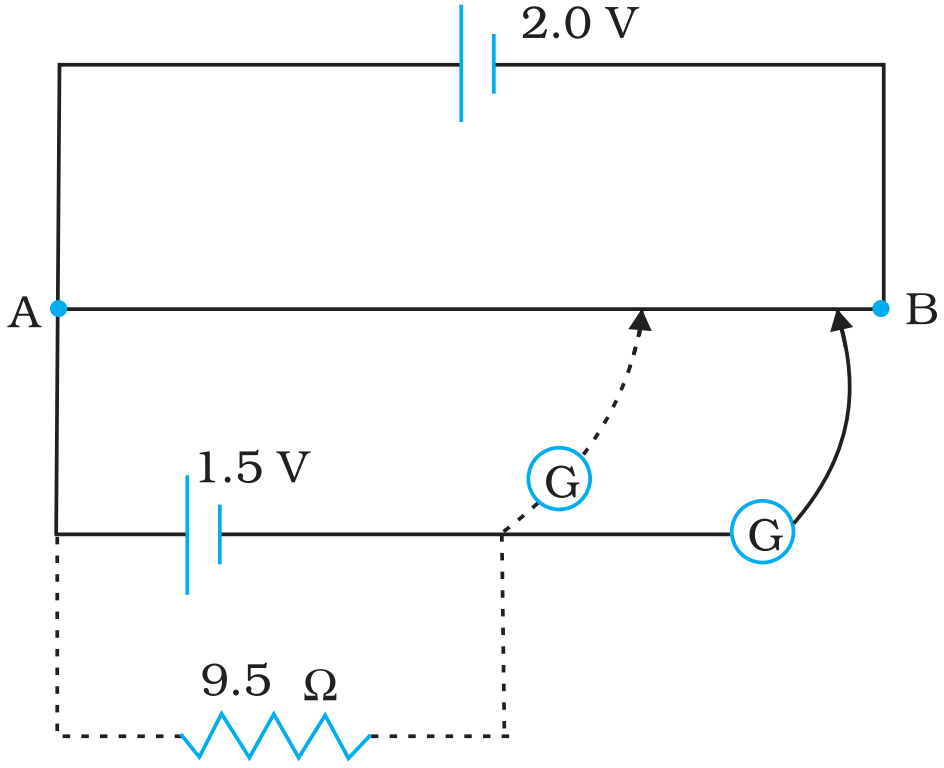
Figure shows a 2.0 V potentiometer used for the determination of internal resistance of a 1.5 V cell. The balance point of the cell in open circuit is 76.3 cm. When a resistor of $9.5\ \Omega$ is used in the external circuit of the cell, the balance point shifts to 64.8 cm length of the potentiometer wire. Determine the internal resistance of the cell.

View full solution
At room temperature (27.0°C) the resistance of a heating element is $100\ \Omega.$ What is the temperature of the element if the resistance is found to be $117\ \Omega,$ given that the temperature coefficient of the material of the resistor is $1.70\times10^{-4}\ ^\circ\text{C}^{-1}.$
View full solution
Q 213 Marks Question3 Marks
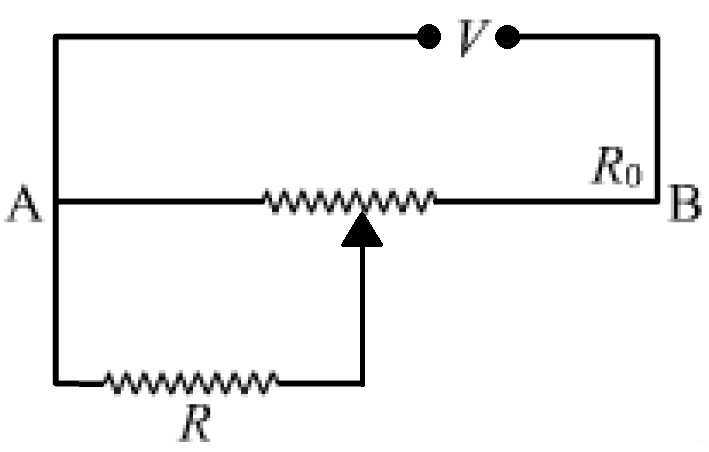
A resistance of R draws current from a potentiometer. The potentiometer wire, AB, has a total resistance of Ro. A voltage V is supplied to the potentiometer. Derive an expression for the voltage across R when the sliding contact is in the middle of potentiometer wire.

View full solution
Q 223 Marks Question3 Marks
Given n resistors each of resistance R, how will you combine them to get the (i) maximum (ii) minimum effective resistance? What is the ratio of the maximum to minimum resistance?
View full solution
Q 233 Marks Question3 Marks
A battery of emf 10 V and internal resistance $3\ \Omega$ is connected to a resistor. If the current in the circuit is 0.5 A, what is the resistance of the resistor? What is the terminal voltage of the battery when the circuit is closed?
View full solution
Q 243 Marks Question3 Marks
  1. Three resistors $2\ \Omega,\ 4\ \Omega\ \text{and}\ 5\ \Omega$ are combined in parallel. What is the total resistance of the combination?
  2. If the combination is connected to a battery of emf 20 V and negligible internal resistance, determine the current through each resistor, and the total current drawn from the battery.
View full solution
Q 253 Marks Question3 Marks
  1. In a metre bridge [Fig. 3.27], the balance point is found to be at 39.5 cm from the end A, when the resistor Y is of $12.5\ \Omega.$ Determine the resistance of X. Why are the connections between resistors in a Wheatstone or meter bridge made of thick copper strips?
  2. Determine the balance point of the bridge above if X and Y are interchanged.
  3. What happens if the galvanometer and cell are interchanged at the balance point of the bridge? Would the galvanometer show any current?
View full solution
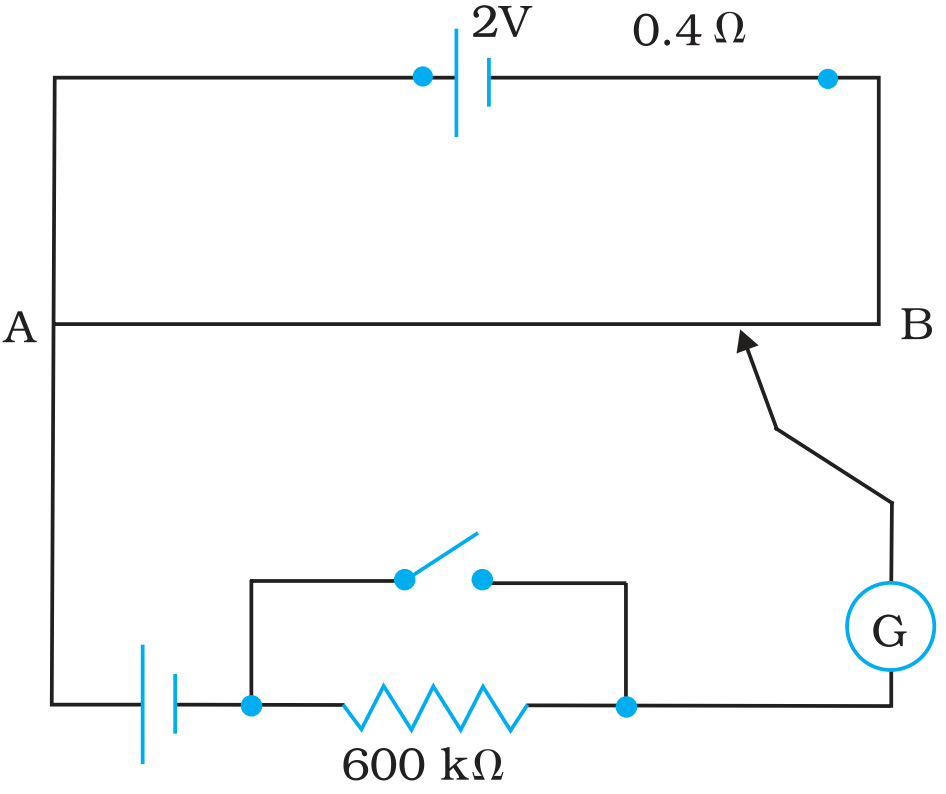
Figure shows a potentiometer with a cell of 2.0 V and internal resistance $0.04\ \Omega$ maintaining a potential drop across the resistor wire AB. A standard cell which maintains a constant emf of 1.02 V (for very moderate currents upto a few mA) gives a balance point at 67.3 cm length of the wire. To ensure very low currents drawn from the standard cell, a very high resistance of $600\ \text{k}\Omega$ is put in series with it, which is shorted close to the balance point. The standard cell is then replaced by a cell of unknown emf $\varepsilon$ and the balance point found similarly, turns out to be at 82.3 cm length of the wire.

  1. What is the value $\varepsilon?$
  2. What purpose does the high resistance of $600\ \text{k}\Omega$ have?
  3. Is the balance point affected by this high resistance?
  4. Is the balance point affected by the internal resistance of the driver cell?
  5. Would the method work in the above situation if the driver cell of the potentiometer had an emf of 1.0 V instead of 2.0 V?
  6. Would the circuit work well for determining an extremely small emf, say of the order of a few mV (such as the typical emf of a thermo-couple)? If not, how will you modify the circuit?
View full solution
Two wires of equal length, one of aluminium and the other of copper have the same resistance. Which of the two wires is lighter? Hence explain why aluminium wires are preferred for overhead power cables.
$(\rho_{\text{A}1}=2.63\times10^{-8}\Omega\ \text{m,}\ \text{Relative density of Al}=2.7,\ \text{of Cu}=8.9)$
View full solution

Generate a Current Electricity paper free

Pick question groups from the list above, set marks and difficulty, and export a branded PDF with step-by-step answer keys. First 3 chapters free — no signup.

Download App