A cell whose e.m.f. is $2\, V$ and internal resistance is $0.1\,\Omega $, is connected with a resistance of $3.9\,\Omega $. The voltage across the cell terminal will be ................ $V$
AIIMS 2001,AIPMT 1999, Medium
Download our app for free and get started
The voltage across cell terminal will be given by
$ = \frac{E}{{R + r}} \times R$ $ = \frac{2}{{(3.9 + 0.1)}} \times 3.9 = 1.95\,V$

Download our appand get started for free
Experience the future of education. Simply download our apps or reach out to us for more information. Let's shape the future of learning together!No signup needed.*
Similar Questions
- 1The potential gradient along the length of a uniform wire is $10\,volt/metre$. $B$ and $C$ are the two points at $30\,cm$ and $60\,cm$ point on a meter scale fitted along the wire. The potential difference between $B$ and $C$ will be ............. $volt$View Solution
- 2Four wires of equal length and of resistances $10$ $ ohms$ each are connected in the form of a square. The equivalent resistance between two opposite corners of the square is ............. $ohm$View Solution
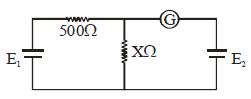
- 3In the adjoining circuit, the battery $E_1$ has an emf of $12\, volt$ and zero internal resistance while the battery $E_2$ has an $emf$ of $2\, volt$. If the galvanometer $G$ reads zero, then the value of the resistance $X$ (in $ohm$ ) isView Solution
- 4A $50\,V$ battery is connected across a $10\, ohm$ resistor. The current is $4.5\, amperes$. The internal resistance of the battery is ............. $ohm$View Solution
- 5View SolutionAssertion : Kirchoff 's junction rule follows from conservation of charge.
Reason : Kirchoff 's loop rule follows from conservation of momentum.
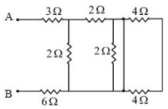
- 6In the given circuit, the equivalent resistance between the terminal $A$ and $B$ is $........\Omega$.View Solution
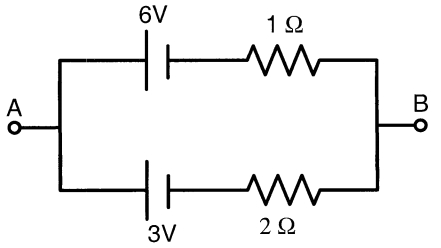
- 7Two batteries of different emfs and different internal resistances are connected as shown. The voltage across $A B$ in volts isView Solution
- 8A $60\, watt$ bulb carries a current of $0.5\, amp$. The total charge passing through it in $1$ hour is ............ $coulomb$View Solution
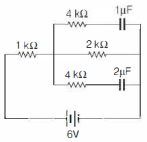
- 9What are the charges stored in the $1 \,\mu F$ and $2 \,\mu F$ capacitors in the circuit below, once the currents become steady?View Solution
- 10A potentiometer wire, $10\,m$ long, has a resistance of $40\,\Omega $. It is connected in series with a resistance box and a $2\,V$ storage cell. If the potential gradient along the wire is $0.1\,m\,V/cm$, the resistance unplugged in the box is .............. $\Omega$View Solution