A potentiometer wire, $10\,m$ long, has a resistance of $40\,\Omega $. It is connected in series with a resistance box and a $2\,V$ storage cell. If the potential gradient along the wire is $0.1\,m\,V/cm$, the resistance unplugged in the box is .............. $\Omega$
Medium
Download our app for free and get started
Potential gradient along wire $=\frac{\text { potential difference along wire }}{\text { length of wire }}$
or, $0.1 \times 10^{-3}=\frac{1 \times 40}{1000} \,\mathrm{V} / \mathrm{cm}$
or, Current in wire, $I$ $=\frac{1}{400} \,\mathrm{A}$
or, $\frac{2}{40+R}=\frac{1}{400}$ or $R=800-40=760\,\Omega$

Download our appand get started for free
Experience the future of education. Simply download our apps or reach out to us for more information. Let's shape the future of learning together!No signup needed.*
Similar Questions
- 1There is a current of $40$ ampere in a wire of ${10^{ - 6}}\,{m^2}$ area of cross-section. If the number of free electron per ${m^3}$ is ${10^{29}}$, then the drift velocity will beView Solution
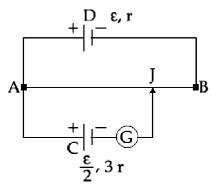
- 2A potentiometer wire $AB$ having length $L$ and resistance $12\, r$ is joined to a cell $D$ of $emf$ $\varepsilon $ and internal resistance $r$. A cell $C$ having $emf$ $\varepsilon /2$ and internal resistance $3r$ is connected. The length $AJ$ at which the galvanometer as shown in figure shows no deflection isView Solution
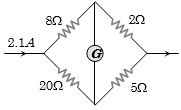
- 3In the given figure, when galvanometer shows no deflection, the current (in $A$) flowing through $5\,\Omega $ resistance will beView Solution
- 4The current in the primary circuit of a potentiometer is $0.2\, A$. The specific resistance and cross section of the potentiometer wire are $4\times10^{-7}\,ohm$ $metre$ and $8\times10^{-7}\, m^2$ respectively. The potential gradient will be equal to .............. $V/m$View Solution
- 5A fuse wire with radius $1\, mm$ blows at $1.5\, amp$. The radius of the fuse wire of the same material to blow at $3\,A$ will beView Solution
- 6A heater coil connected to a supply of a $220\, V$ is dissipating some power ${P_1}.$ The coil is cut into half and the two halves are connected in parallel. The heater now dissipates a power ${P_2}.$ The ratio of power ${P_1}\,\,:\,\,{P_2}$ isView Solution
- 7$32$ cells, each of $emf$ $3V$, are connected in series and kept in a box. Externally, the combination shows an $emf$ of $84\, V$. The number of cells reversed in the combination isView Solution
- 8Match the List $I$ with the List $II$ from the combination shown. In the left side (List $I$) there are four different conditions and in the right side (List $II$), there are ratios of heat produced in each resistance for each condition :View Solution
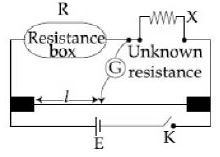
List $I$ List $II$ $(I)$ Two wires of same resistance are connected in series and same current is passed through them $(A)$ $1:2$ $(II)$ Two wires of resistance $R$ and $2R$ $ohm$ are connected in series and same $P . D .$ is applied across them $(B)$ $4:1$ $(III)$ Two wires of same resistance are connected in parallel and same current is flowing through them $(C)$ $1:1$ $(IV)$ Two wires of resistances in the ratio $1: 2$ are connected in parallel and same $P . D .$ is applied across the $(D)$ $2:1$ - 9In a meter bridge experiment, the circuit diagram and the corresponding observation table are shown in figureView Solution
$Sl$. $No$. $R\, (\Omega )$ $l\, (cm)$ $1$. $1000$ $60$ $2$. $100$ $13$ $3$. $10$ $1.5$ $4$. $1$ $1.0$ Which of the readings is inconsistent ?
- 10The charge flowing through a resistance $R$ varies with time according to $Q = at -bt^2.$ The total heat produced in $R$ is : (assume that direction of current not reversed)View Solution