MCQ
A chain reaction is continuous due to:
  • A
    production of more neutrons during fission
  • B
    large energy
  • C
    large mass defect
  • D
    daughter nuclei formed

Answer

A. production of more neutrons during fission
Explanation:
Due to the production of neutrons, a chain of nuclear fission is established which continues until the whole of the source substance is consumed.

Need a full question paper?

Generate a complete, print-ready paper with questions like this in minutes — across 16+ boards, with answer keys.
Start Generating Free

Similar questions

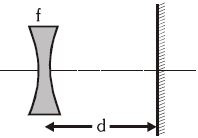
A diverging lens of focal length $10\, cm$ is placed $10\, cm$ in front of a plane mirror as shown in the figure. Light from a very far away source falls on the lens. The final image is at a distance
A solid sphere and a hollow cylinder roll up without slipping on same inclined plane with same initial speed $v$. The sphere and the cylinder reaches upto maximum heights $h_1$ and $h_2$, respectively, above the initial level. The ratio $h_1: h_2$ is $\frac{n}{10}$. The value of $\mathrm{n}$ is__________.
If a current of $3.0$ $amperes$ flowing in the primary coil is reduced to zero in $0.001$ $second,$ then the induced $e.m.f$ in the secondary coil is $15000$ $volts$. The mutual inductance between the two coils is....$henry$
If a hole is made at the centre of a bar magnet, then its magnetic moment will
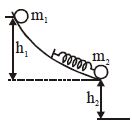
A ball of mass $m_1$ falls from height $h_1$ from rest to strike a spring of force constant $K$, which forces another ball of mass $m_2$ to jump on a horizontal floor at a height $h_2$ below from it. Find the horizontal distance at which ball of mass $m_2$ strikes from the position of start :- [Spring does not move]
In a charged capacitor, the energy resides
Image formed on the retina is
A small ball of mass $M$ and density $\rho$ is dropped in a viscous liquid of density $\rho_0$. After some time, the ball falls with a constant velocity. What is the viscous force on the ball ?
In a Young's double slit experiment the intensity at a point where the path difference is $\frac \lambda {6}$ ($\lambda$  being the wavelength of the light used) is $I.$ If $I_0$ denotes the maximum intensity, $I_0$/$I$ is equal to
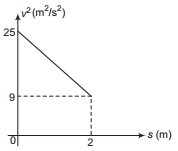
A graph between the square of the velocity of a particle and the distance $s$ moved by the particle is shown in the figure. The acceleration of the particle is $...........m/s^2$