MCQ
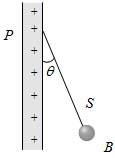
A charged ball $B$ hangs from a silk thread $S,$ which makes an angle $\theta$ with a large charged conducting sheet $P,$ as shown in the figure. The surface charge density $\sigma$ of the sheet is proportional to
​​​​​​​
  • A
    $\sin \theta$
  • $\tan \theta$
  • C
    $\cos \theta$
  • D
    $\cos \theta$

Answer

Correct option: B.
$\tan \theta$
$\tan \theta$

Need a full question paper?

Generate a complete, print-ready paper with questions like this in minutes — across 16+ boards, with answer keys.

Start Generating Free

Similar questions

A $50$ ohm galvanometer gets full scale deflection when a current of $0.01\ A$ passes through the coil.  When it is converted to a $10\ A$ ammeter, the shunt resistance is
If a full wave rectifier circuit is operating from 50 Hz mains, the fundamental frequency in the ripple will be(a) 50 Hz (b) 70.7 Hz(c) 100 Hz(d) 25 Hz
       
A ray of light is incident on a transparent glass slab of refractive index $1.62 .$ The reflected and the refracted rays are mutually perpendicular. The angle of incidence is
The large scale destruction, that would be caused due to the use of nuclear weapons is called(a) Nuclear holocaust(b) Thermo-nuclear reaction(c) Nuetron reproduction factor(d) None of these
   
   
The peak voltage in a 220V AC source is:
Two charge + q  and  -q  are situated at a certain distance.  At the point exactly midway between them(a) Electric field and potential both are zero(b) Electric field is zero but potential is not zero(c) Electric field is not zero but potential is zero(d) Neither electric field nor potential is zero


Bonds in semiconductors are :
A small, conducting circular loop is placed inside a long solenoid carrying a current. The plane of the loop contains the axis of the solenoid. If the current in the solenoid is varied, the current induced in the loop is:
A convex lens is in contact with concave lens. The magnitude of the ratio of their focal length is 2/3. Their equivalent focal length is 30 cm. What are their individual focal lengths(a) – 75, 50(b) – 10, 15(c) 75, 50(d) – 15, 10
       
The transition from the state n = 4 to n = 3 in a hydrogen like atom results in ultraviolet radiation. Infrared radiation will be obtained in the transition from: