Question
A charged metallic sphere A is suspended by a nylon thread. Another charged metallic sphere B held by an insulating
Image
handle is brought close to A such that the distance between their centres is 10 cm, as shown in Fig. 1.4(a). The resulting repulsion of A is noted (for example, by shining a beam of light and measuring the deflection of its shadow on a screen). Spheres A and B are touched by uncharged spheres C and D respectively, as shown in Fig. 1.4(b). C and D are then removed and B is brought closer to A to a distance of 5.0 cm between their centres, as shown in Fig. 1.4(c). What is the expected repulsion of A on the basis of Coulomb’s law? Spheres A and C and spheres B and D have identical sizes. Ignore the sizes of A and B in comparison to the separation between their centres.
Answer

Let the original charge on sphere A be $q$ and that on B be $q^{\prime}$. At a distance $r$ between their centres, the magnitude of the electrostatic force on each is given by
$
F=\frac{1}{4 \pi \varepsilon_0} \frac{q q^{\prime}}{r^2}
$
neglecting the sizes of spheres A and B in comparison to $r$. When an identical but uncharged sphere $C$ touches $A$, the charges redistribute on A and $C$ and, by symmetry, each sphere carries a charge q/2. Similarly, after D touches B, the redistributed charge on each is $q^{\prime} / 2$. Now, if the separation between A and B is halved, the magnitude of the electrostatic force on each is
$
F^{\prime}=\frac{1}{4 \pi \varepsilon_0} \frac{(q / 2)\left(q^{\prime} / 2\right)}{(r / 2)^2}=\frac{1}{4 \pi \varepsilon_0} \frac{\left(q q^{\prime}\right)}{r^2}=F
$
Thus the electrostatic force on A, due to B, remains unaltered.

Need a full question paper?

Generate a complete, print-ready paper with questions like this in minutes — across 16+ boards, with answer keys.

Start Generating Free

Similar questions

The equation of a wave travelling on a string is:

$\text{y}=(0.10\text{mm})\sin\big[(31.4\text{m}^{-1})\text{x}+(314\text{s}^{-1})\text{t}\big].$

  1. In which direction does the wave travel?
  2. Find the wave speed, the wavelength and the frequency of the wave.
  3. What is the maximum displacement and the maximum speed of a portion of the string?
The magnetic field due to a long straight wire has been derived in terms of $\mu_0,$ i and d. Express this in terms of $\in_0,$ C, i and d.
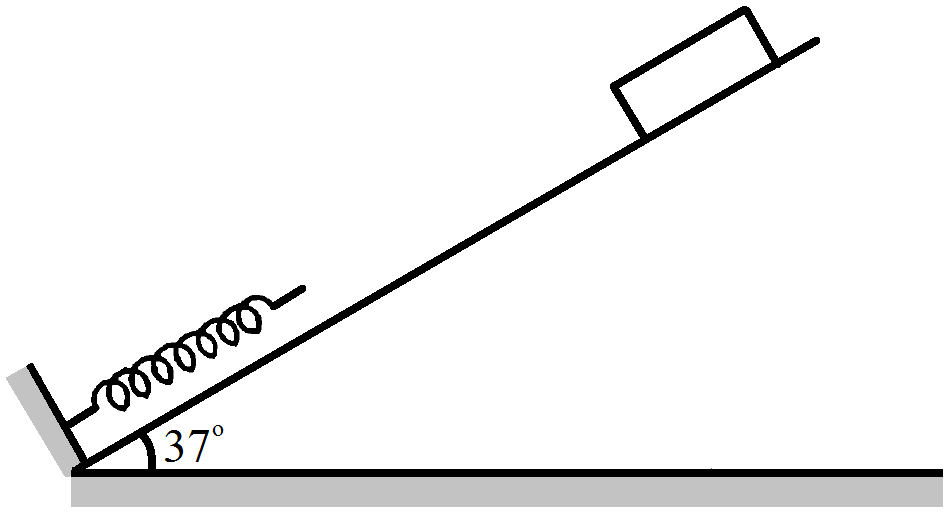
Figure shows a spring fixed at the bottom end of an incline of inclination 37°. A small block of mass 2kg starts slipping down the incline from a point 4.8m away from the spring. The block compresses the spring by 20cm, stops momentarily and then rebounds through a distance of 1m up the incline. Find.
  1. The friction coefficient between the plane and the block.
  2. The spring constant of the spring. Take g = 10m/s2.

A change of 0.2mA in the base current causes a change of 5mA in the collector current for a common emitter amplifier.
  1. Find the ac current gain of the transistor.
  2. If the input resistance is $2\text{k}\Omega$ and its voltage gain is 75, calculate the load resistor used in the circuit.
A radioactive isotope is being produced at a constant rate $\frac{\text{dN}}{\text{dt}}=\text{R}$ in an experiment. The isotope has a half-life $\text{t}_{\frac{1}2{}}.$ Show that after a time $\text{t}>>\text{t}_{\frac{1}{2}},$ the number of active nuclei will become constant. Find the value of this constant.
Use the mirror equation to show that.
  1. An object placed between f and 2f of a concave mirror produces a real image beyond 2f.
  2. A convex mirror always produces a virtual image independent of the location of the object.
  3. An object placed between the pole and focus of a concave mirror produces a virtual and enlarged image.
A small telescope has an objective lens of focal length 144 cm and an eyepiece of focal length 6.0 cm. What is the magnifying power of the telescope? What is the separation between the objective and the eyepiece?
Mass of a particle depends on its speed. Does the attraction of the earth on the particle also depend on the particle's speed?
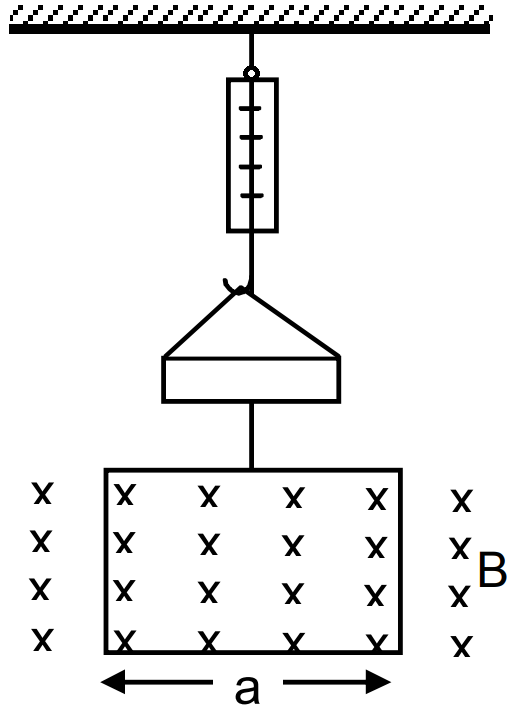
A rectangular wire loop of width a is suspended from the insulated pan of a spring balance, as shown in A current i exists in the anti-clockwise direction in the loop. A magnetic field Bexists in the lower region. Find the change in the tension of the spring if the current in the loop is reversed.

Calculate the number of states per cubic metre of sodium in 3s band. The density of sodium is 1013kg/ m3. How many of them are empty?