Question
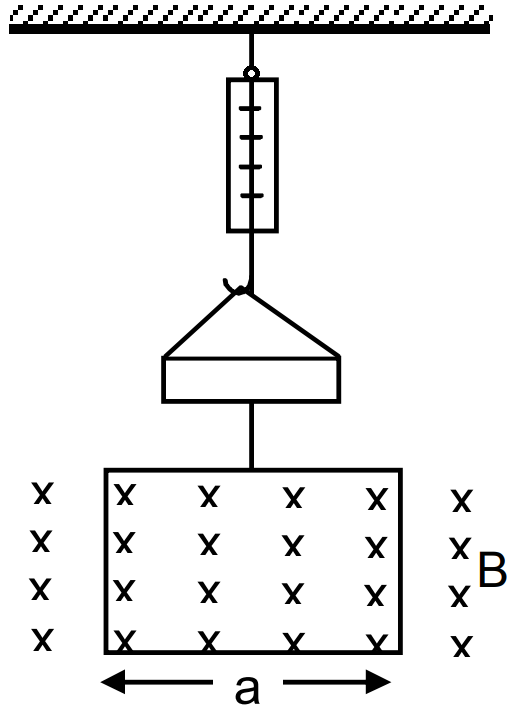
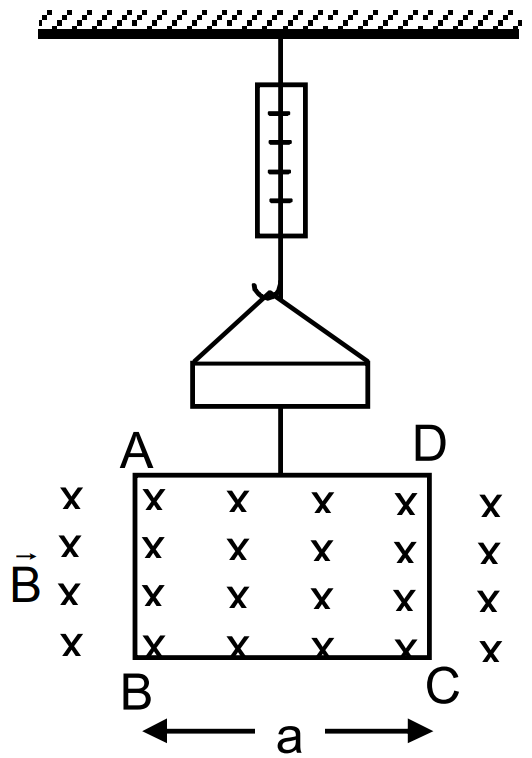
A rectangular wire loop of width a is suspended from the insulated pan of a spring balance, as shown in A current i exists in the anti-clockwise direction in the loop. A magnetic field Bexists in the lower region. Find the change in the tension of the spring if the current in the loop is reversed.
Answer


Current anticlockwise

Since the horizontal Forces have no effect.

Let us check the forces for current along AD & BC [Since there is no $\overrightarrow{\text{B}}$ ]

In AD, F = 0

For BC

F = iaB upward

Current clockwise

Similarly, F = - iaB downwards

Hence change in force = change in tension

= iaB - (-iaB) = 2 iaB

Need a full question paper?

Generate a complete, print-ready paper with questions like this in minutes — across 16+ boards, with answer keys.

Start Generating Free

Similar questions

Calculate the energy that can be obtained from 1kg of water through the fusion reaction
2H + 2H → 3H + p.
Assume that 1.5 × 10⁻²% of natural water is heavy water D2O (by number of molecules) and all the deuterium is used for fusion.
What do you mean by colour code of carbon resistance ?
A small telescope has an objective lens of focal length 144 cm and an eyepiece of focal length 6.0 cm. What is the magnifying power of the telescope? What is the separation between the objective and the eyepiece?
  1. Drive the expression for electric field at a point on the equatorial line of an electric dipole.
  2. Depict the orientation of the dipole in (i) stable, (ii) unstable equilibrium in a uniform electric field.
In a p-n junction, the depletion region is 400nm wide and an electric field of 5 × 10⁵V/m exists in it.
  1. Find the height of the potential barrier.
  2. What should be the minimum kinetic energy of a conduction electron which can diffuse from the n-side to the p-side?
A particle is subjected to two simple harmonic motions of same time period in the same direction. The amplitude of the first motion is 3.0cm and that of the second is 4.0cm. Find the resultant amplitude if the phase difference between the motions is:
  1. 60°
  2. 90°
A monkey of mass 15kg is climbing on a rope with one end fixed to the ceiling. If it wishes to go up with an acceleration of 1m/s2, how much force should it apply to the rope? If the rope is 5m long and the monkey starts from rest, how much time will it take to reach the ceiling?
(a) Magnetic field lines show the direction (at every point) along which a small magnetised needle aligns (at the point). Do the magnetic field lines also represent the lines of force on a moving charged particle at every point?
(b) If magnetic monopoles existed, how would the Gauss's law of magnetism be modified?
(c) Does a bar magnet exert a torque on itself due to its own field? Does one element of a current-carrying wire exert a force on another element of the same wire?
(d) Magnetic field arises due to charges in motion. Can a system have magnetic moments even though its net charge is zero?
How much is the minimum energy of electron of excited hydrogen atom so that three spectral lines of hydrogen spectrum could be obtained?