A chimpanzee swinging on a swing in a sitting position, stands up suddenly, the time period will
AIEEE 2002,AIIMS 2012, Easy
Download our app for free and get started
(d)After standing centre of mass of the oscillating body will shift upward therefore effective length will decrease and by $T \propto \sqrt l $, time period will decrease.

Download our appand get started for free
Experience the future of education. Simply download our apps or reach out to us for more information. Let's shape the future of learning together!No signup needed.*
Similar Questions
- 1The equation of motion of a particle is $x = a\,cos (\alpha\, t)$ . The motion isView Solution
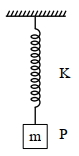
- 2The time period of a mass suspended from a spring is $T$. If the spring is cut into four equal parts and the same mass is suspended from one of the parts, then the new time period will beView Solution
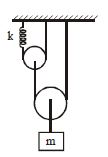
- 3What is the period of small oscillations of the block of mass $m$ if the springs are ideal and pulleys are massless ?View Solution
- 4A particle undergoing simple harmonic motion has time dependent displacement given by $x(t)\, = \,A\,\sin \,\frac{{\pi t}}{{90}}$. The ratio of kinetic to potential energy $o$ the particle at $t=210\,s$ will beView Solution
- 5Two particles $P$ and $Q$ describe simple harmonic motions of same period, same amplitude, along the same line about the same equilibrium position $O.$ When $P$ and $Q$ are on opposite sides of $O$ at the same distance from $O$ they have the same speed of $1.2 \,m/s$ in the same direction, when their displacements are the same they have the same speed of $1.6\, m/s$ in opposite directions. The maximum velocity in $m/s$ of either particle isView Solution
- 6View SolutionA simple pendulum is taken from the equator to the pole. Its period
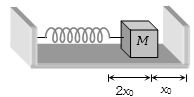
- 7One end of a spring of force constant k is fixed to a vertical wall and the other to a block of mass m resting on a smooth horizontal surface. There is another wall at a distance ${x_0}$ from the black. The spring is then compressed by $2{x_0}$ and released. The time taken to strike the wall isView Solution
- 8If particle is executing simple harmonic motion with time period $T$, then the time period of its total mechanical energy is ...........View Solution
- 9View SolutionWhen the displacement is half the amplitude, the ratio of potential energy to the total energy is
- 10In simple harmonic motion, the total mechanical energy of given system is E. If mass of oscillating particle $P$ is doubled then the new energy of the system for same amplitude is:View Solution