The time period of a mass suspended from a spring is $T$. If the spring is cut into four equal parts and the same mass is suspended from one of the parts, then the new time period will be
AIPMT 2003, Easy
Download our app for free and get started
(b)By cutting spring in four equal parts force constant (K) of each parts becomes four times so by using $T = 2\pi \sqrt {\frac{m}{K}} ;$ time period will be half i.e. $T' = T/2$

Download our appand get started for free
Experience the future of education. Simply download our apps or reach out to us for more information. Let's shape the future of learning together!No signup needed.*
Similar Questions
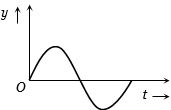
- 1The displacement time graph of a particle executing $S.H.M.$ is as shown in the figureThe corresponding force-time graph of the particle isView Solution
- 2Two masses $m_1$ and $m_2$ connected by a spring of spring constant $k$ rest on a frictionless surface. If the masses are pulled apart and let go, the time period of oscillation isView Solution
- 3A particle moves with simple harmonic motion in a straight line. In first $\tau \,s$, after starting from rest, it travels a distance $a$, and in next $\tau \,s$, it travels $2a$ in same direction thenView Solution
- 4A mass $0.9\,kg$, attached to a horizontal spring, executes $SHM$ with an amplitude $A _{1}$. When this mass passes through its mean position, then a smaller mass of $124\,g$ is placed over it and both masses move together with amplitude $A _{2}$. If the ratio $\frac{ A _{1}}{ A _{2}}$ is $\frac{\alpha}{\alpha-1}$, then the value of $\alpha$ will be$......$View Solution
- 5Function $x$ = $A sin^2 wt + B cos^2 wt + C sin wt \ cos wt$ does not represents $SHM$ for this conditionView Solution
- 6A simple pendulum of mass $m$ executes $S.H.M.$ with total energy $E$. If at an instant it is at one of extreme positions, then its linear momentum after a phase shift of $\frac{\pi}{3} \,rad$ will beView Solution
- 7View SolutionThe phase difference between displacement and acceleration of a particle in a simple harmonic motlon is
- 8A particle executes simple harmonic motion with an amplitude of $4 \mathrm{~cm}$. At the mean position, velocity of the particle is $10 \mathrm{~cm} / \mathrm{s}$. The distance of the particle from the mean position when its speed becomes $5 \mathrm{~cm} / \mathrm{s}$ is $\sqrt{\alpha} \mathrm{cm}$, where $\alpha=$____________.View Solution
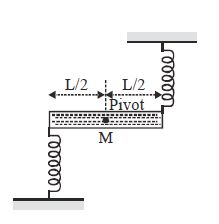
- 9A uniform stick of mass $M$ and length $L$ is pivoted at its centre. Its ends are tied to two springs each of force constant $K$ . In the position shown in figure, the strings are in their natural length. When the stick is displaced through a small angle $\theta $ and released. The stickView Solution
- 10The acceleration of a particle performing S.H.M. is at a distance of $3\; cm$ from the mean position is $ 12\,cm/sec^2 $. Its time period is ..... $\sec$View Solution