MCQ
A chlorine atom whose nucleus contains 17 protons and 20 neutrons. Find out the composition of the nucleus of an isotope of chlorine?
- A20 protons, 17 neutrons
- B19 protons, 18 neutrons
- C18 protons, 18 neutrons
- D17 protons, 19 neutrons
Explanation:
Isotope nucleus means that those nucleus has same protons number but different neutrons and mass number. Since chlorine has 17 protons so its isotope also will have 17 protons.
Generate a complete, print-ready paper with questions like this in minutes — across 16+ boards, with answer keys.
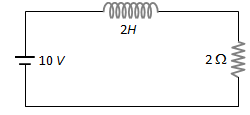
In the figure magnetic energy stored in the coil is
|
(a) Zero |
(b) Infinite |
(c) 25 joules |
(d) None of the above |
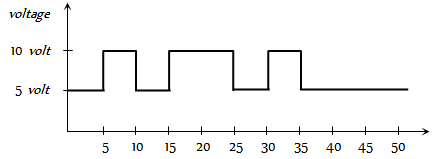
In a negative logic the following wave form corresponds to the
|
(a) 0000000000 |
(b) 0101101000 |
(c) 1111111111 |
(d) 1010010111 |
The dipole moment of each molecule of a paramagnetic gas is 1.5 × 10⁻²³ amp × m2. The temperature of gas is 27oC and the number of molecules per unit volume in it is 2 × 1026 m–3. The maximum possible intensity of magnetisation in the gas will be
|
(a) 3 × 10³ amp/m |
(b) 4 × 10⁻³ amp/m |
(c) 5 × 10⁵ amp/m |
(d) 6 ×10⁻⁴ amp/m |
There are certain types of stars called visible stars which undergo periodic change in their light output. If such a star quadruple it's light output, how much does it's magnitude change
|
(a) – 1.25 |
(b) – 1.5 |
(c) – 1.75 |
(d) – 2 |
When a PN junction diode is reverse biased
|
(a) Electrons and holes are attracted towards each other and move towards the depletion region |
|
(b) Electrons and holes move away from the junction depletion region |
|
(c) Height of the potential barrier decreases |
|
(d) No change in the current takes place |