MCQ
A clamped string is oscillating in $n^{th}$ harmonic, then
  • A
    total energy of oscillations will be $n^2$ times that of fundamental frequency
  • B
    total energy of oscillations will be $(n-1)^2$ times that of fundamental frequency
  • C
    average kinetic energy of the string over a complete oscillations is half of that of the total energy of the string.
  • both $(A)$ and $(C)$

Answer

Correct option: D.
both $(A)$ and $(C)$
d
For a sine wave, $y=A \sin (k x-\Omega t)$

Velocity equation for this wave is $V_{y}=\Omega A \cos (k x-\Omega t)$ Kinetic energy $=d(K E)=1 / 2\left(V_{y}^{2} \times d m\right)=1 / 2\left(V_{y}^{2} \times \mu d x\right), \mu$ is the linear mass density.

$\Rightarrow 1 / 2\left(\mu \times \Omega^{2} \times A^{2} \times \cos ^{2}(k x-\Omega t)\right) d x$

integrating at $t=0,$ with limits as 0 and $\lambda,$ we have

$K . E=1 / 4\left(\mu \times \Omega^{2} \times A^{2} \times \lambda\right)$

Potential energy, $d U=1 / 2\left(\Omega^{2} \times y^{2} \times \mu\right) d x$

integrating at $t=0,$ with limits as 0 and $\lambda,$ we have $U=1 / 4\left(\mu \times \Omega^{2} \times A^{2} \times \lambda\right)$

Total energy $E=K . E+U$ $\Rightarrow E=1 / 2\left(\mu A^{2} \lambda\right)$

Therefore, for the first and fundamental frequency, energy is $E_{1}=\left(1 / 2\left(\mu A^{2} \lambda\right)\right) / n^{2}$

And clearly from the above derivation, we have, $K.E$ is half the total energy.
Need a full question paper?

Generate a complete, print-ready paper with questions like this in minutes — across 16+ boards, with answer keys.

Start Generating Free

Similar questions

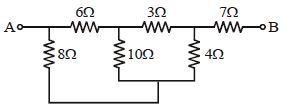
The equivalent resistance between the points $A$ and $B$ is :-
An endoscope is employed by a physician to view the internal parts of a body organ. It is based on the principle of
A step down transformer converts transmission line voltage from $11000\, V$ to $220\, V$. The primary of the transformer has $6000\, turns$ and efficiency of the transformer is $60\%$. If the output power is $9\, kW$, then the input power will be........$kW$
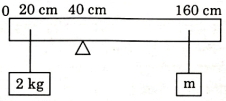
A uniform rod of length $200 \,\mathrm{~cm}$ and mass $500 \,\mathrm{~g}$ is balanced on a wedge placed at $40\,cm$ mark. A mass of $2\, \mathrm{~kg}$ is suspended from the rod at $20\, \mathrm{~cm}$ and another unknown mass $'m'$ is suspended from the rod at $160\, \mathrm{~cm}$ mark as shown in the figure. Find the value of $'m'$ such that the rod is in equilibrium. $\left(\mathrm{g}=10 \,\mathrm{~m} / \mathrm{s}^{2}\right)$
A train is running at $20 \,m / s$ on a railway line with radius of curvature $40,000$ metres. The distance between the two rails is $1.5$ metres. For safe running of train the elevation of outer rail over the inner rail is ......$mm$ $\left( g =10 \,m / s ^2\right)$
For a particular resonance tube, following are four of the six harmonics below $1000 Hz$; $300,600,750$ and $900 \,Hz$. The two missing harmonics are
Radius of a soap bubble is $'r'$, surface tension of soap solution is $T$. Then without increasing the temperature, how much energy will be needed to double its radius
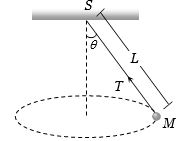
A string of length $L$ is fixed at one end and carries a mass $M$ at the other end. The string makes $2/\pi$ revolutions per second around the vertical axis through the fixed end as shown in the figure, then tension in the string is
A string in musical instrument is $50 cm$ long and its fundamental frequency is $800 Hz.$ If a frequency of $1000 Hz$ is to be produced, then required length of string is ..... $cm$
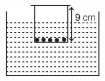
A wide bottom cylindrical massless plastic container of height $9 \,cm$ has $40$ identical coins inside it and is floating on water with $3 \,cm$ inside the water. If we start putting more of such coins on its lid, it is observed that after $N$ coins are put, its equilibrium changes from stable to unstable. Equilibrium in floating is stable if the geometric centre of the submerged portion is above the centre of the mass of the object). The value of $N$ is closed to