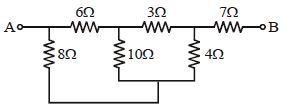
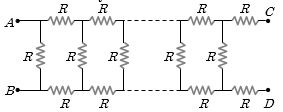
The equivalent resistance between the points $A$ and $B$ is :-
Medium


Download our appand get started for free
Experience the future of education. Simply download our apps or reach out to us for more information. Let's shape the future of learning together!No signup needed.*
Similar Questions
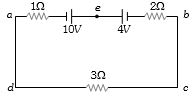
- 1View SolutionThe magnitude and direction of the current in the circuit shown will be
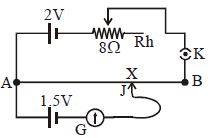
- 2In a potentiometer experiment shown here, for the position $X$ of the jockey $J,$ there occurs a null deflection in the galvanometer. Then the potential difference between points $A$ and $X$ is ................ $V$View Solution
- 3In the given figure the ratio of current in $8\,\Omega $ and $3\,\Omega $ will beView Solution
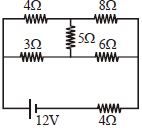
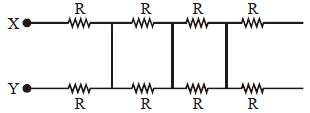
- 4Net resistance between $X$ and $Y$ isView Solution
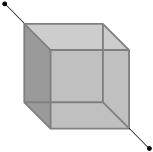
- 5Twelve wires of equal length and same cross-section are connected in the form of a cube. If the resistance of each of the wires is $R$, then the effective resistance between the two diagonal ends would beView Solution
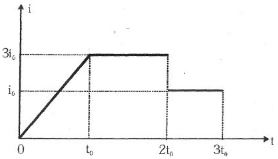
- 6A time varying current $i$ is passed through a resistance $R$ as shown in figure. The total heat generated in the resistance isView Solution
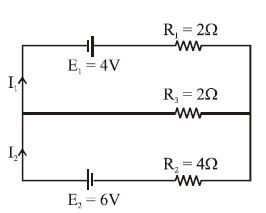
- 7In the circuit shown below $E_1\, =4.0\, V$, $R_1\, = 2\,\Omega$, $E_2\, = 6.0\, V$, $R_2\, = 4\,\Omega$ and $R_3\, = 2\,\Omega$. The current $I_1$ is ............... $\mathrm{A}$View Solution
- 8In the figure, the value of resistors to be connected between $C$ and $D$ so that the resistance of the entire circuit between $A$ and $B$ does not change with the number of elementary sets used isView Solution
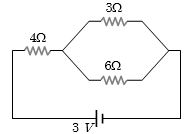
- 9The potential drop across the $3$ $\Omega$ resistor is ............... $V$View Solution
- 10The resistance of a conductor is $5\, ohm$ at $50\,^oC$ and $6\, ohm$ at $100\,^oC$. Its resistance at $0\,^oC$ is ................ $ohm$View Solution