Question
A compound microscope has a magnifying power of 100 when the image is formed at infinity. The objective has a focal length of 0.5cm and the tube length is 6.5cm. Find the focal length of the eyepiece.

Answer

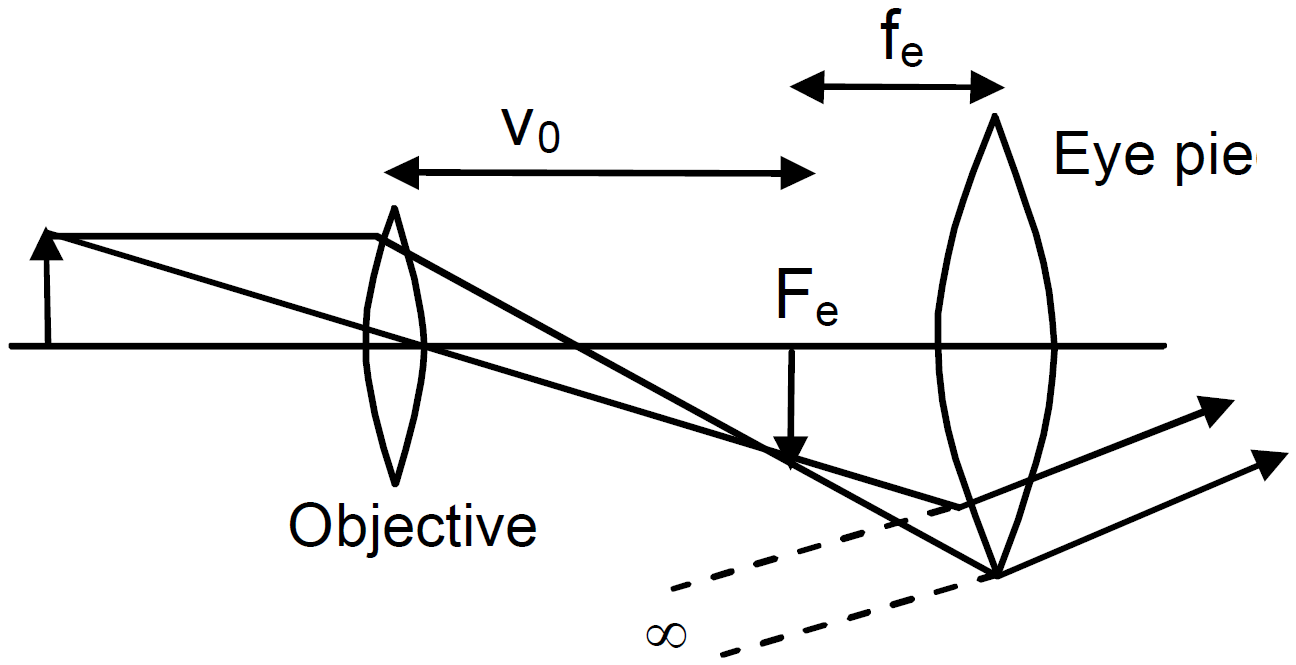
For the give compound microscope, f0 = 0.5cm, tube length = 6.5cm magnifying power = 100 (normal adjustment) Since, the image is formed at infinity, the real image produced by the objective lens should lie on the focus of the eye piece.

So, vo + fe = 6.5cm ...(1)

Again, magnifying power $\text{m}=\frac{\text{v}_0}{\text{u}_0}\times\frac{\text{D}}{\text{f}_\text{e}}$ [for normal adjustment]

$\Rightarrow\text{m}=\Big[1-\frac{\text{V}_0}{\text{f}_0}\Big]\frac{\text{D}}{\text{f}_\text{e}}$ 

$\Rightarrow100=-\Big[1-\frac{\text{V}_0}{0.5}\Big]\times\frac{25}{\text{f}_\text{e}}$ [Taking D = 25cm]

$\Rightarrow100\text{f}_\text{e}=-(1-2\text{v}_0)\times25$

$\Rightarrow2\text{v}_0-4\text{f}_\text{e}=1 $ ...(2)

Solving equation (1) and (2) we can get,

V0 = 4.5cm and fe = 2cm

So, the focal length of the eye piece is 2cm.
Need a full question paper?

Generate a complete, print-ready paper with questions like this in minutes — across 16+ boards, with answer keys.

Start Generating Free

Similar questions

A body cools from 80 °C to 50 °C in 5 minutes. Calculate the time it takes to cool from 60°C to 30 °C. The temprature of the surroundings is 20°C.
Mathematically describe the motion of a particle along a plane (or along a two-dimensional plane).
Use the formula $v =\sqrt{\frac{\gamma P }{\rho}}$ explain why the speed of sound in air
(a) is independent of pressure,
(b) increases with temperature,
(c) increases with humidity.
A particle A having a charge of 2.0 × 10-6C is held fixed on a horizontal table. A second charged particle of mass 80g stays in equilibrium on the table at a distance of 10cm from the first charge. The coefficient of friction between the table and this second particle is $\mu=0.2.$ Find the range within which the charge of this second particle may lie.
A laser light bean sent to the moon takes 2.56s to return after reflection at the Moon's surface. Calculate the radius of the lunar orbit around the earth.
What are progressive wave? Establish the equation representing progressive wave and explain phase and path difference.
OR
Establish the equation of plane progressive wave and find out phase difference.
The transverse displacement of a string (clamped at its both ends) is given by
$\text{y}(\text{x, t})=0.06\sin\Big(\frac{2\pi}{3}\text{x}\Big)\cos(120\pi\text{ t})$
where x and y are in m and t in s. The length of the string is 1.5m and its mass is 3.0 × 10–2kg.
Answer the following:
Interpret the wave as a superposition of two waves travelling in opposite directions. What is the wavelength, frequency, and speed of each wave?
Use the formula $\text{v}=\sqrt{\frac{\gamma\text{P}}{\rho}}$ to explain why the speed of sound in air:
Increases with temperature,
Two cylindrical hollow drums of radii R and 2R, and of a common height h, are rotating with angular velocities $\omega$ (anti-clockwise) and $\omega$ (clockwise), respectively. Their axes, fixed are parallel and in a horizontal plane separated by $(3\text{R}+\delta).$ They are now brought in contact $(\delta\rightarrow0){:}$
  1. Show the frictional forces just after contact.
  2. Identify forces and torques external to the system just after contact.
  3. What would be the ratio of final angular velocities when friction ceases?
A famous relation in physics relates ‘moving mass’ m to the ‘rest mass’ mo of a particle in terms of its speed v and the speed of light, c. (This relation first arose as a consequence of special relativity due to Albert Einstein). A boy recalls the relation almost correctly but forgets where to put the constant c. He writes:

$\text{m}=\frac{\text{m}_0}{(1-\text{v}^2)^{1/2}}.$

Guess where to put the missing c.