Question
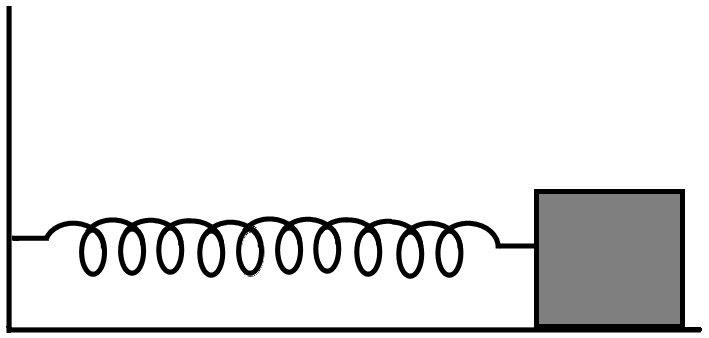
A particle A having a charge of 2.0 × 10-6C is held fixed on a horizontal table. A second charged particle of mass 80g stays in equilibrium on the table at a distance of 10cm from the first charge. The coefficient of friction between the table and this second particle is $\mu=0.2.$ Find the range within which the charge of this second particle may lie.
Answer


$\text{q}_\text{A}=2\times10^{-6}\text{C},\ \text{M}_\text{b}=80\text{g},\ \mu=0.2$

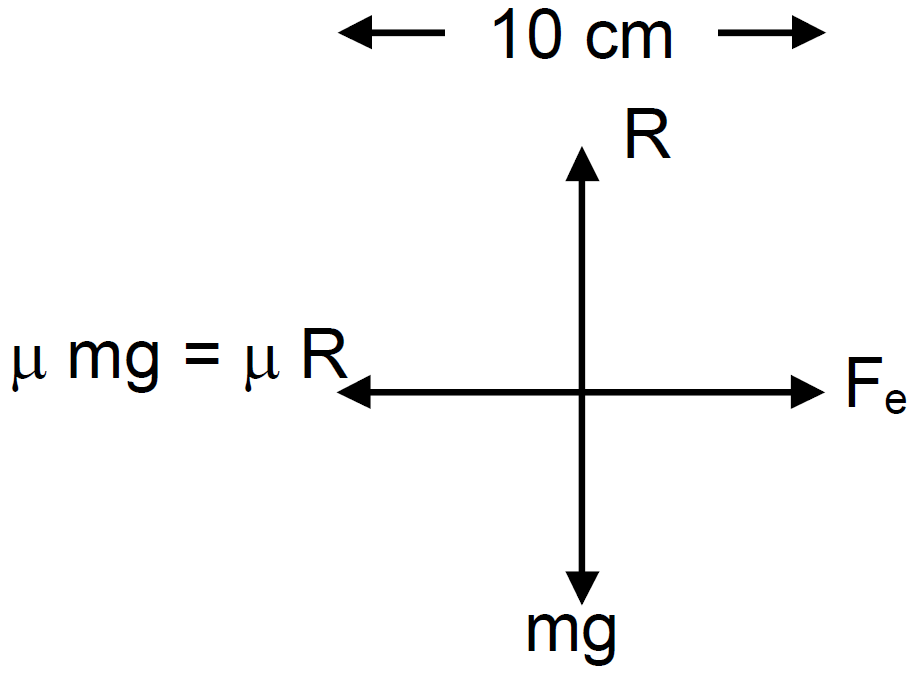
Since B is at equilibrium,

So, $\text{Fe}=\mu\text{R}$

$\Rightarrow\frac{\text{Kq}_\text{A}\text{q}_\text{B}}{\text{r}^2}=\mu\text{R}=\mu\text{m}\times\text{g}$

$\Rightarrow\frac{9\times10^9\times2\times10^{-6}\times\text{q}_\text{B}}{0.01}=0.2\times0.08\times9.8$

$\Rightarrow\text{q}_\text{B}=\frac{0.2\times0.08\times9.8\times0.01}{9\times10^9\times2\times10^{-6}}$

$=8.7\times10^{-8}\text{C}$

Range $=\pm8.7\times10^{-8}\text{C}$

Need a full question paper?

Generate a complete, print-ready paper with questions like this in minutes — across 16+ boards, with answer keys.

Start Generating Free

Similar questions

One end of a U-tube containing mercury is connected to a suction pump and the other end to atmosphere. A small pressure difference is maintained between the two columns. Show that, when the suction pump is removed, the column of mercury in the U-tube executes simple harmonic motion.
For three situations, the initial and final positions respectively, along x-axis for the block in Fig are (a) - 3cm, 2cm. (b) 2cm, 3 cm and (c) -2cm, 2cm. In each situation, is the work done by the spring force on the block positive, negative or zero?

An ideal gas is trapped between a mercury column and the closed-end of a narrow vertical tube of uniform base containing the column. The upper end of the tube is open to the atmosphere. The atmospheric pressure equals 76cm of mercury. The lengths of the mercury column and the trapped air column are 20cm and 43cm respectively. What will be the length of the air column when the tube is tilted slowly in a vertical plane through an angle of 60°? Assume the temperature to remain constant.
Two mercury droplets of radii 0.1cm. and 0.2cm. collapse into one single drop. What amount of energy is released? The surface tension of mercury T = 435.5 × 10-3N m-1
Explain fluid pressure.
Two trains A and B of length 400m each are moving on two parallel tracks with a uniform speed of 72km h–1 in the same direction, with A ahead of B. The driver of B decides to overtake A and accelerates by 1m s–2. If after 50s, the guard of B just brushes past the driver of A, what was the original distance between them?
Calculate the center of mass of a uniform thin rod.
An ideal gas at pressure 2.5 × 10⁵Pa and temperature 300K occupies 100cc. It is adiabatically compressed to half its original volume. Calculate,
  1. The final pressure.
  2. The final temperature.
  3. The work done by the gas in the process. Take $\gamma=1.5.$
Two masses m1 and m2 are connected by a spring of spring constant k and are placed on a frictionless horizontal surface. Initially the spring is stretched through a distance x0 when the system is released from rest. Find the distance moved by the two masses before they again come to rest.
What is meant by limit of elasticity? Write Hooke's law of elasticity. Based on this establish the formula of Young's Modulus of elasticity and give the definition of Young's Modulus of elasticity.