Question
A compound microscope has a magnifying power of 100 when the image is formed at infinity. The objective has a focal length of 0.5cm and the tube length is 6.5cm. Find the focal length of the eyepiece.
Answer

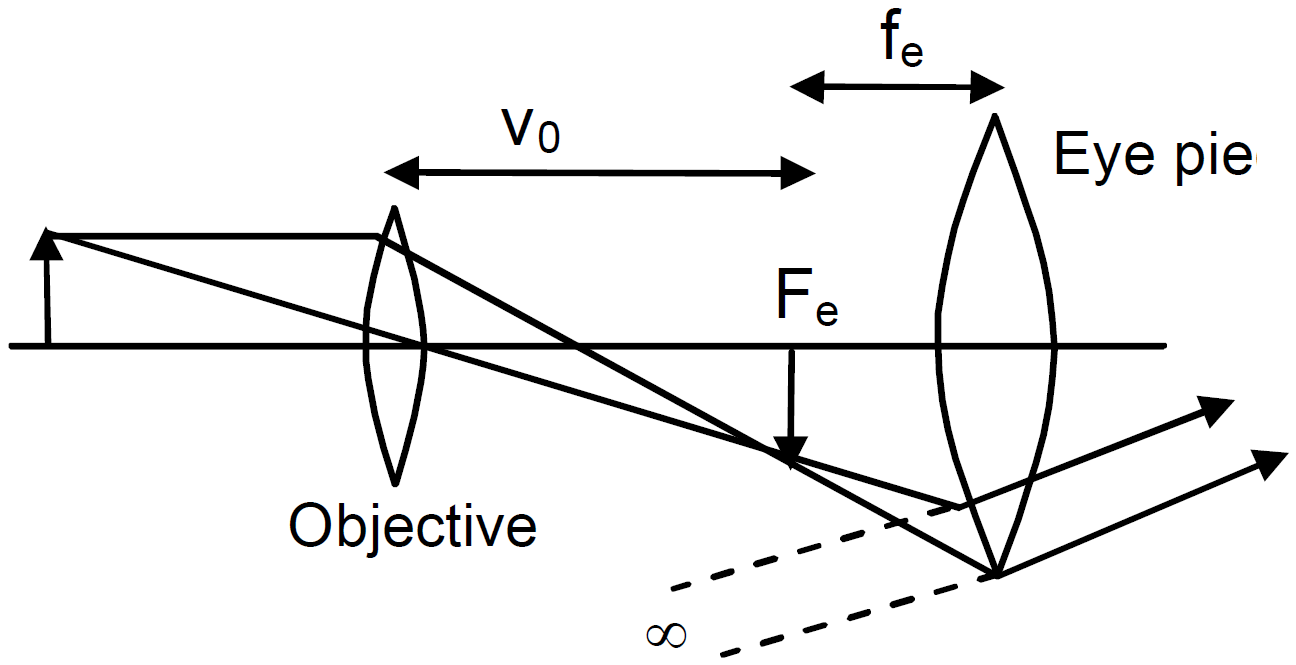
For the give compound microscope, $f_0 = 0.5cm$, tube length = 6.5cm magnifying power = 100 (normal adjustment) Since, the image is formed at infinity, the real image produced by the objective lens should lie on the focus of the eye piece.So, $v_o + f_e = 6.5cm ...(1)$
Again, magnifying power $\text{m}=\frac{\text{v}_0}{\text{u}_0}\times\frac{\text{D}}{\text{f}_\text{e}}$ [for normal adjustment]
$\Rightarrow\text{m}=\Big[1-\frac{\text{V}_0}{\text{f}_0}\Big]\frac{\text{D}}{\text{f}_\text{e}}$
$\Rightarrow100=-\Big[1-\frac{\text{V}_0}{0.5}\Big]\times\frac{25}{\text{f}_\text{e}}$ [Taking D = 25cm]
$\Rightarrow100\text{f}_\text{e}=-(1-2\text{v}_0)\times25$
$\Rightarrow2\text{v}_0-4\text{f}_\text{e}=1 $ ...(2)
Solving equation (1) and (2) we can get,
$V_0 = 4.5cm$ and $f_e = 2cm$
So, the focal length of the eye piece is 2cm.

Need a full question paper?

Generate a complete, print-ready paper with questions like this in minutes — across 16+ boards, with answer keys.
Start Generating Free

Similar questions

An ammeter is to be constructed that can read currents up to 2.0A. If the coil has resistance of $25\Omega$ and takes 1mA for full-scale deflection, what should be the resistance of the shunt used?
With the help of a labelled diagram, state the underlying principle of a cyclotron.
Explain clearly how it works to accelerate the charged particles. Show that cyclotron frequency is independent of energy of the particle. Is there an upper limit on the energy acquired by the particle? Give reason.
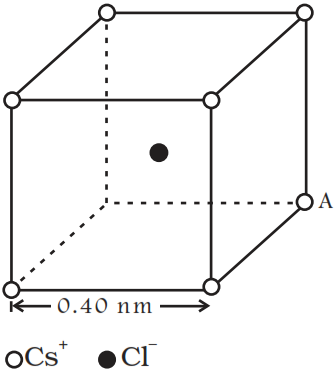
Fig. represents a crystal unit of cesium chloride, CsCl. The cesium atoms, represented by open circles are situated at the corners of a cube of side 0.40nm, whereas a Cl atom is situated at the centre of the cube. The Cs atoms are deficient in one electron while the Cl atom carries an excess electron.
  1. What is the net electric field on the Cl atom due to eight Cs atoms?
  2. Suppose that the Cs atom at the corner A is missing. What is the net force now on the Cl atom due to seven remaining Cs atoms?
An aeroplane has to go from a point A to another point B, 500km away due 30° east of north. A wind is blowing due north at a speed of 20m/s. The air-speed of the
plane is 150m/s.
  1. Find the direction in which the pilot should head the plane to reach the point B.
  2. Find the time taken by the plane to go from A to B.
Two charges $2.0 \times 10^{-6}C$ and $1.0 \times 10^{-6}C$ are placed at a separation of 10cm. Where should a third charge be placed such that it experiences no net force due to these charges?
When a circuit element ‘X’ is connected across an a.c. source, a current of $\sqrt{2}\text{A}$ flows through it and this current is in phase with the applied voltage. When another element ‘Y’ is connected across the same a.c. source, the same current flows in the circuit but it leads the voltage by $\frac{\pi}{2}$ radians.
  1. Name the circuit element X and Y.
  2. Find the current that flows in the circuit when the series combination of X and Y is connected across the same a.c. voltage.
  3. Net impedance.
There are two current carrying planar coils made each from identical wires of length L. $C_1$ is circular (radius R ) and $C_2$ is square (side a). They are so constructed that they have same frequency of oscillation when they are placed in the same uniform B and carry the same current. Find a in terms of R.
Explain the vector form of Coulomb's law and write its important facts.
Consider a metal ring kept (supported by a cardboard) on top of a fixed solenoid carrying a current I (see Fig). The centre of the ring coincides with the axis of the solenoid. If the current in the solenoid is switched off, what will happen to the ring?
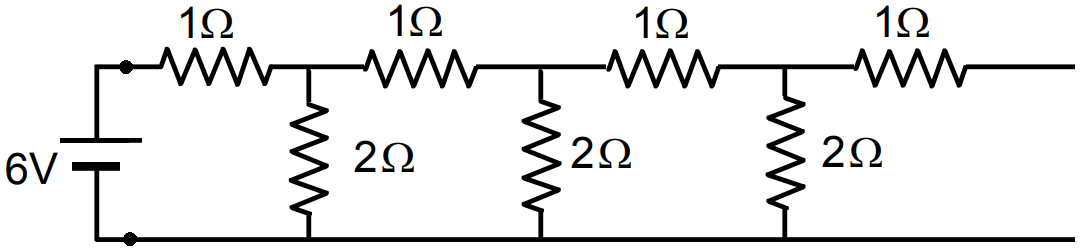
An infinite ladder is constructed with $1\Omega$ and $2\Omega$ resistors, as shown in the figure. (a) Find the effective resistance between the points A and B. (b) Find the current that passes through the $2\Omega$ resistor nearest to the battery.