MCQ
A compound $X$  with molecular formula ${C_3}{H_8}O$ can be oxidised to a compound $Y$  with the molecular formula ${C_3}{H_6}{O_2}$  $X$  is most likely to be
  • Primary alcohol
  • B
    Secondary alcohol
  • C
    Aldehyde
  • D
    Ketone

Answer

Correct option: A.
Primary alcohol
a
(a)$\underset{X}{\mathop{C{{H}_{3}}-C{{H}_{2}}-C{{H}_{2}}-OH}}\,\xrightarrow{\text{Oxidation}}\underset{Y}{\mathop{C{{H}_{3}}C{{H}_{2}}COOH}}\,$
Since on oxidation same no. of carbon atoms are obtained in as therefore alcohol is primary

Need a full question paper?

Generate a complete, print-ready paper with questions like this in minutes — across 16+ boards, with answer keys.

Start Generating Free

Similar questions

Pair of ions which gives blue colour in aqueous state :

$V^{+4},\,Ni^{+2},\, Ti^{+3}, \,Co^{+2}, \,Fe^{+3}, \,Cu^{+2}$

The Gibb's energy for the decomposition of $Al_2O_3$ at $500^oC$ is as follows

$\frac{2}{3} Al_2 O_3 \rightarrow \frac{4}{3} Al + O_2$

$\Delta _rG = + 960\, kJ\, mol^{-1}$

The potential difference needed for the electrolytic reduction of aluminium oxide $(Al_2O_3)$ at $500^oC$ is at least ........ $V$.

The half-life of $2 $ sample are $0.1 $ and $ 0.4 $ seconds. Their respective concentration are $200 $ and  $ 50 $ respectively. What is the order of the reaction
Geometrical as well as optical isomerism is shown by
Given below are two statements :

Statement I: Both $\left[\mathrm{Co}\left(\mathrm{NH}_3\right) 6\right]^{3+}$ and $\left[\mathrm{CoF}_6\right]^3$ complexes are octahedral but differ in their magnetic behaviour.

Statement II: $\left[\mathrm{Co}\left(\mathrm{NH}_3\right)\right]^{3+}$ is diamagnetic whereas $\left[\mathrm{CoF} \mathrm{F}_6\right]^{3-}$ is paramagnetic.

In the light of the above statements, choose the correct answer from the options given below:
Which of the following has lowest percentage of carbon
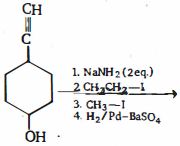
Product $(X)$ is
The molar conductance of $\mathrm{NaCl}, \mathrm{HCl}$ and $\mathrm{CH}_{3} COONa$ at infinite dilution are $126.45,426.16$ and $91.0\, \mathrm{~S} \,\mathrm{~cm}^{2} \,\mathrm{~mol}^{-1}$ respectively. The molar conductance of $\mathrm{CH}_{3} \mathrm{COOH}$ at infinite dilution is. Choose the right option for your answer. (In $\mathrm{~S} \mathrm{~cm}^{2} \mathrm{~mol}^{-1}$)
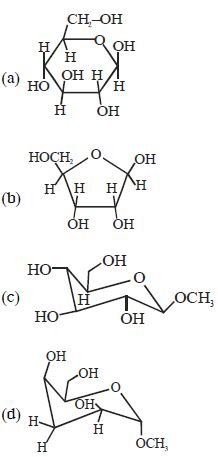
Which of the following compound will show mutarotation
Which of the following is not an interstitial compound?