MCQ
A conductor with a positive charge
  • A
    Is always at $ + \,ve$ potential
  • B
    Is always at zero potential
  • C
    Is always at negative potential
  • May be at $ + \,ve$, zero or $ - ve$ potential

Answer

Correct option: D.
May be at $ + \,ve$, zero or $ - ve$ potential
d
(d) May be at positive, zero or negative potential, it is according to the way one defines the zero potential.

Need a full question paper?

Generate a complete, print-ready paper with questions like this in minutes — across 16+ boards, with answer keys.

Start Generating Free

Similar questions

Planets producing larger magnetic field have larger
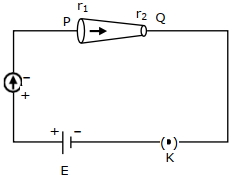
In the given figure, a battery of emf $E$ is connnected across a conductor $P Q$ of length $'Y'$ and different area of cross-sections having radii $r_{1}$ and $r_{2}\left(r_{2}\,<\,r_{1}\right)$.

Choose the correct option as one moves from $P$ to $Q$ :
Two point charges of the same polarities are hung with the help of two threads and kept close. The angle between the threads will be $........$ if the system is taken to space.
Which of the following is used to investigate the structure of solids?
Magnetic flux ∅ (in weber) linked with a closed circuit of resistance 10 ohm varies with time t (in seconds) as $\varnothing=5 t^2-4 t+1$ The induced electromotive force in the circuit at t = 0.2 sec. is
For high frequency, a capacitor offers
Three capacitors of capacitance $3\,\mu \,F,\,10\,\mu \,F\,$ and $15\,\mu \,F\,$ are connected in series to a voltage source of $100\,V$. The charge on $15\,\mu \,F\,$is.......$\mu C$
The de-Broglie wavelength of a particle moving with a velocity $2.25 × 10^8$ m/s is equal to the wavelength of photon. The ratio of kinetic energy of the particle to the energy of the photon is (velocity of light is $3 × 10^8$ m/s)
In AM, the centpercent modulation is achieved when
The $x-z$ plane separates two media $A$ and $B$ with refractive indices $\mu_1$ and $\mu_2$ respectively. $A$ ray of light travels from $A$ to $B$. Its directions in the two media are given by the unit vectors,${\vec r_A} = a\,\hat i + b\,\hat j$ & ${\vec r_B} = \alpha \,\hat i + \beta \,\hat j$ respectively where $\hat i$ & $\hat j$ are unit vectors in the $x$ and $y$ directions. Then