MCQ
A constant potential difference is applied to the ends of a graphite rod, whose resistance decreases with a rise of temperature. The rod can be $(1)$ covered with asbestos or $(2)$ left open to atmosphere. Answer for steady state.
  • A
    in both cases power lost is same but temperature of rod is more in case- $1$
  • in case- $1$ power lost as well as temperature of rod is more
  • C
    in case- $2$ power lost as well as temperature of rod is more
  • D
    in case- $1$ power lost is more but temperature of rod is less
Answer

Correct option: B.
in case- $1$ power lost as well as temperature of rod is more
b
In steady state, as asbestos is a poor conductor of heat than air, temperature of rod $( 1 )$ will be higher.

Also as temperature of rod $(1)$ is high

$\Rightarrow r \downarrow \Rightarrow \frac{v^{2}}{r} \uparrow$

Need a full question paper?

Generate a complete, print-ready paper with questions like this in minutes — across 16+ boards, with answer keys.

Start Generating Free

Similar questions

A piece of charcoal and a piece of shining steel of the same surface area are kept for a long time in an open lawn in bright sun:
  1. The steel will absorb more heat than the charcoal.
  2. The temperature of the steel will be higher than that of the charcoal.
  3. If both are picked up by bare hands, the steel will be felt hotter than the charcoal.
  4. If the two are picked up from the lawn and kept in a cold chamber, the charcoal will lose heat at a faster rate than the steel.
A body of mass $5\; kg$ hangs from a spring and oscillates with a time period of $2\pi $ seconds. If the ball is removed, the length of the spring will decrease by
The $M.I.$ of a body about the given axis is $1.2\,kg \times m^2$ and initially the body is at rest. In order to produce a rotational kinetic energy of $1500\,joule$ an angular acceleration of $25\,rad/sec^2$ must be applied about that axis for a duration of ........ $\sec$.
A particle is pushed by forces $2\hat{\text{i}}+3\hat{\text{j}}-2\hat{\text{k}}$ and $5\hat{\text{i}}+\hat{\text{j}}-2\hat{\text{k}}$ simultaneously and it is displaced from point $\hat{\text{i}}+\hat{\text{j}}+\hat{\text{k}}$ to point $2\hat{\text{i}}-\hat{\text{j}}-2\hat{\text{k}}$. The work done is:
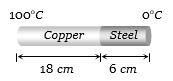
The coefficient of thermal conductivity of copper is nine times that of steel. In the composite cylindrical bar shown in the figure. What will be the temperature at the junction of copper and steel ....... $^oC$
The first overtone of a stretched wire of given length is $320 Hz$. The first harmonic is  .... $Hz$
In case of damped oscillation frequency of oscillation is ............
The equation of a projectile is $y=a x-b x^2$. Its horizontal range is ......
The wavelength of maximum energy released during an atomic explosion was $2.93 \times {10^{ - 10}}m$. Given that Wein's constant is $2.93 \times {10^{ - 3}}m - K$, the maximum temperature attained must be of the order of
A travelling harmonic wave is represented by the equation $y(x, t) = 10^{-3}\,sin\,(50t + 2x)$, where $x$ and $y$ are in meter and $t$ is in seconds. Which of the following is a correct statement about the wave?