MCQ
A particle is pushed by forces $2\hat{\text{i}}+3\hat{\text{j}}-2\hat{\text{k}}$ and $5\hat{\text{i}}+\hat{\text{j}}-2\hat{\text{k}}$ simultaneously and it is displaced from point $\hat{\text{i}}+\hat{\text{j}}+\hat{\text{k}}$ to point $2\hat{\text{i}}-\hat{\text{j}}-2\hat{\text{k}}$. The work done is:
  • A
    7 units.
  • B
    -7 units.
  • C
    10 units.
  • D
    -10 units.

Answer

  1. -7 units.

Explanation:

Net force, $=2\hat{\text{i}}+3\hat{\text{j}}-2\hat{\text{k}+}5\hat{\text{i}}-\hat{\text{j}}-3\hat{\text{k}}$

$=7\hat{\text{i}}+2\hat{\text{j}}-5\hat{\text{k}}$

Diolacement, $\text{d}=2\hat{\text{i}}-\hat{\text{j}}+3\hat{\text{k}-}\hat{\text{i}}-\hat{\text{j}}-\hat{\text{k}}$

$=\hat{\text{i}}-2\hat{\text{j}}+2\hat{\text{k}}$

Work done $=\text{F}.\text{d}=(7\hat{\text{i}}+2\hat{\text{j}}-5\hat{\text{k}}).(\hat{\text{i}}-2\hat{\text{j}}+2\hat{\text{k}})$

$=7-4-10=-7\text{ units}$.

Need a full question paper?

Generate a complete, print-ready paper with questions like this in minutes — across 16+ boards, with answer keys.

Start Generating Free

Similar questions

Two particles start simultaneously from the same point and move along two straight lines, one with uniform velocity $v$ and other with a uniform acceleration $a.$ If $\alpha$ is the angle between the lines of motion of two particles then the least value of relative velocity will be at time given by
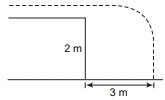
Water is flowing from a horizontal pipe fixed at a height of $2\,m$ from the ground. If it falls at a horizontal distance of $3\,m$ as shown in figure, the speed of water when it leaves the pipe is $............\,ms^{-1}$ (take $g=9.8\,ms ^{-2}$ )
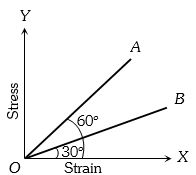
The stress versus strain graphs for wires of two materials $A$ and $B$ are as shown in the figure. If ${Y_A}$ and ${Y_B}$ are the Young ‘s modulii of the materials, then
For rotational equilibrium,
A point moves in $x -y$ plane according to the law $x = 3\, cos\,4t$ and $y = 3\, (1 -sin\,4t)$. The distance travelled by the particle in $2\, sec$ is...........$m$  (where $x$ and $y$ are in $metres$ )
A thin rod of mass $0.9\, kg$ and length $1 \,m$ is suspended, at rest, from one end so that it can freely oscillate in the vertical plane. A particle of move $0.1\, kg$ moving in a straight line with velocity $80\,m / s$ hits the rod at its bottom most point and sticks to it (see figure). The angular speed (in $rad/s$) of the rod immediately after the collision will be
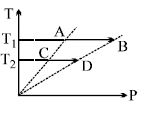
On a $TP$ diagram, two moles of ideal gas perform process $AB$ and $CD$. If the work done by the gas in the process $AB$ is two times the work done in the process $CD$ then what is the value of $T_1/T_2$?
A stone is projected with a velocity $20 \sqrt{2}\,m / s$ at an angle of $45^{\circ}$ to the horizontal. The average velocity of stone during its motion from starting point to its maximum height is $..........\,m/s$ (take $g=10\,m / s ^2$ )
A small spherical ball of radius $r$, falling through a viscous medium of negligible density has terminal velocity ' $v$ '. Another ball of the same mass but of radius $2 r$, falling through the same viscous medium will have terminal velocity:
Vertical displacement of a plank with a body of mass $'m'$ on it is varying according to law $y = \sin \omega t + \cos \omega t.$ The minimum value of $\omega $ for which the mass just breaks off the plank and the moment it occurs first after $t = 0$ are given by : ( $y$ is positive vertically upwards)