$A$ constant voltage is applied between the two ends of a uniform metallic wire. Some heat is developed in it. The heat developed is doubled if
Medium


Download our appand get started for free
Experience the future of education. Simply download our apps or reach out to us for more information. Let's shape the future of learning together!No signup needed.*
Similar Questions
- 1A $1\,m$ long wire is broken into two unequal parts $X$ and $Y$ The $X$ part of the wire is streched into another wire $W$. Length of $W$ is twice the length of $X$ and the resistance of $W$ is twice that of $Y$. Find the ratio of length of $X$ and $Y$.View Solution
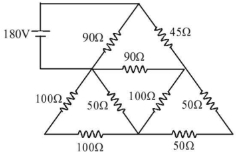
- 2In the circuit shown in the figure, find the current in $45\, \Omega$ $..........\,A$View Solution
- 3Two cells of emf $E_1$ and $E_2\left(E_1 > E_2\right)$ are connected individually to a potentiometer and their corresponding balancing length are $625 \,cm$ and $500 \,cm$, then the ratio $\frac{E_1}{E_2}$ is ...........View Solution
- 4A $1\,m$ long wire is broken into two unequal parts $X$ and $Y$ The $X$ part of the wire is streched into another wire $W$. Length of $W$ is twice the length of $X$ and the resistance of $W$ is twice that of $Y$. Find the ratio of length of $X$ and $Y$.View Solution
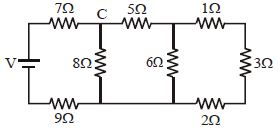
- 5In the ladder network shown, current through the resistor $3\, \Omega$ is $0.25\,A$. The input voltage $'V'$ is equal to:- ........... $V$View Solution
- 6The thermo $e.m.f.$ of a thermo-couple is $25\,\mu V{/^o}C$ at room temperature. A galvanometer of $40\, ohm$ resistance, capable of detecting current as low as ${10^{ - 5}}\,A,$ is connected with the thermocouple. The smallest temperature difference that can be detected by this system is ................ $^oC$View Solution
- 7Assertion : A larger dry cell has higher $emf$View Solution
Reason : The $emf$ of a dry cell is proportional to its size
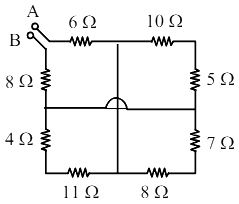
- 8The equivalent resistance between $A$ and $B$ is:View Solution
- 9In India electricity is supplied for domestic use at $220 \,V$. It is supplied at $110 \,V$ in USA. If the resistance of a $60 \,W$ bulb for use in India is $R$, the resistance of a $60 \,W$ bulb for use in USA will beView Solution
- 10A steady current $I$ flows through a wire of radius $r$, length $L$ and resistivity $\rho$. The current produces heat in the wire. The rate of heat loss in a wire is proportional to its surface area. The steady temperature of the wire is independent ofView Solution