The thermo $e.m.f.$ of a thermo-couple is $25\,\mu V{/^o}C$ at room temperature. A galvanometer of $40\, ohm$ resistance, capable of detecting current as low as ${10^{ - 5}}\,A,$ is connected with the thermocouple. The smallest temperature difference that can be detected by this system is ................ $^oC$
AIEEE 2003, Medium


Download our appand get started for free
Experience the future of education. Simply download our apps or reach out to us for more information. Let's shape the future of learning together!No signup needed.*
Similar Questions
- 1A resistance of $2\,\Omega $ is connected across one gap of a meter-bridge and unknown resistance, greater than $2\,\Omega $ , is connected a cross the other gap. When these resistances are interchanged, the balance point shifts by $20\ cm$ , neglecting any end correction, the unknown resistance is ................ $\Omega$View Solution
- 2$A$ wire of length $L$ and $3$ identical cells of negligible internal resistances are connected in series. Due to the current, the temperature of the wire is raised by $\Delta T$ in time $t. N$ number of similar cells is now connected in series with a wire of the same material and cross section but of length $2L$. The temperature of the wire is raised by the same amount $\Delta T$ in the same time $t$. The value of $N$ is :View Solution
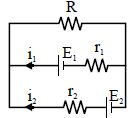
- 3View SolutionSee the electrical circuit shown in the adjoining figure. Which of the following equation is a correct equation for it
- 4By a cell a current of $0.9\, A$ flows through $2\, ohm$ resistor and $0.3\,A$ through $7\, ohm$ resistor. The internal resistance of the cell is ............ $\Omega$View Solution
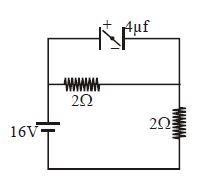
- 5What is net force on the small dipole placed inside the capacitor at steady state if the plates are separated by $1\ cm$ ?......$N$View Solution
- 6In order to increase the resistance of a given wire of uniform cross section to four times its value, a fraction of its length is stretched uniformly till the full length of the wire becomes $\frac{3}{2}$ times the original length what is the value of this fraction?View Solution
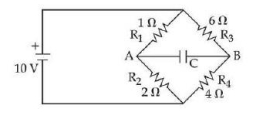
- 7The charge accumulated on the capacitor connected in the following circuit is________ $\mu \mathrm{C}$ (Given $\mathrm{C}=150\ \mu \mathrm{F}$ )View Solution
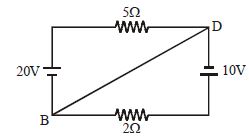
- 8Calculate the current in wire $BD$ ................ $A$View Solution
- 9The heat produced by a $100\, watt$ heater in $2$ minute will be equal toView Solution
- 10Two wires $A$ and $B $ of same material and same mass have radius $2r$ and $r$ . If resistance of wire $A$ is $34\,\Omega $, then resistance of $B$ will be ............ $\Omega$View Solution