Question
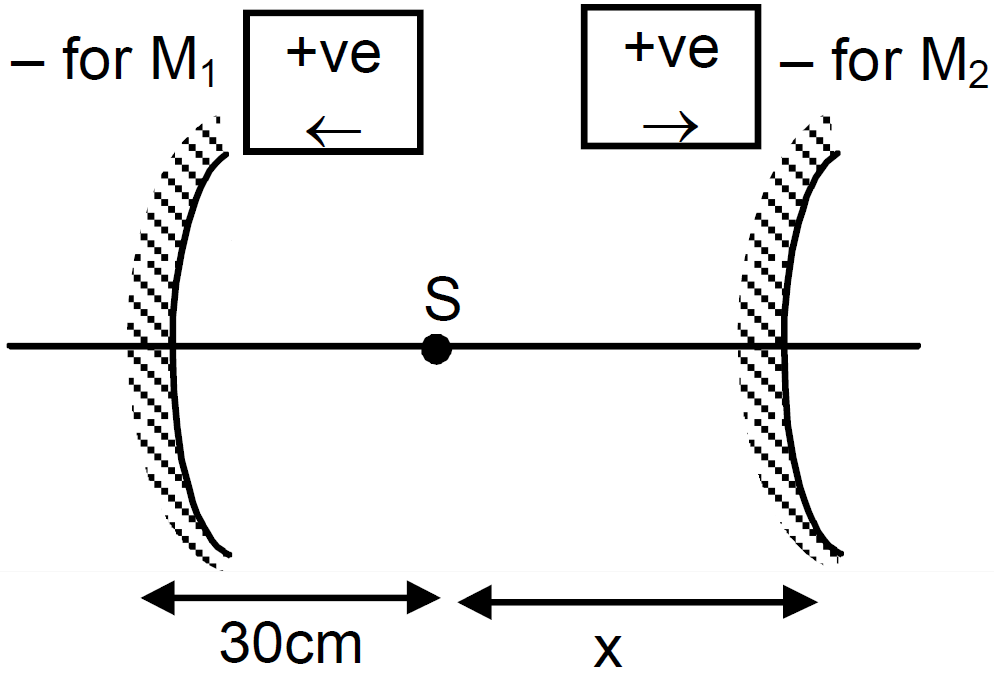
A converging mirror $M_1,$ a point source S and a diverging mirror $M_2$ are arranged as shown in figure. The source is placed at a distance of 30cm from $M_1$. The focal length of each of the mirrors is 20cm. Consider only the images formed by a maximum of two reflections. It is found that one image is formed on the source itself.
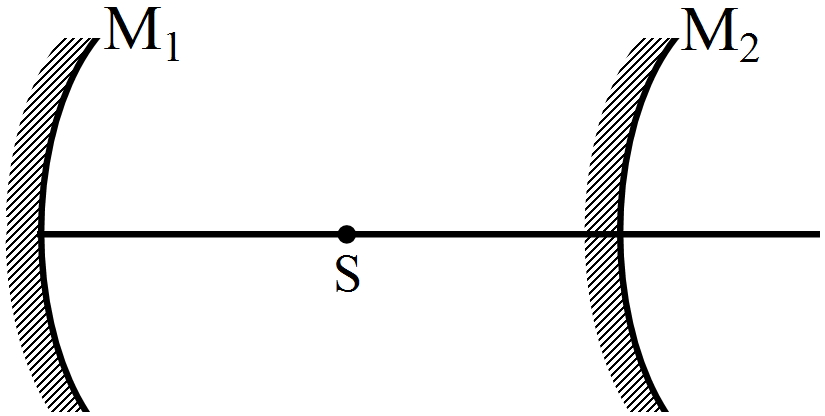
  1. Find the distance between the two mirrors.
  2. Find the location of the image formed by the single reflection from $M_2.$
Answer


  1. As shown in figure, for $1^{st}$ reflection in $M_1, u = -30cm, f = -20cm$
$\Rightarrow\frac{1}{\text{v}}+\frac{1}{-30}=-\frac{1}{20}\Rightarrow\text{v}=-60\text{cm}.$
So, for $2^{nd}$ reflection in $M_2$
$u = 60 - (30 + x) = 30 - x$
$v = -x; f = 20cm$
$\Rightarrow\frac{1}{30-\text{x}}-\frac{1}{\text{x}}=\frac{1}{20}$
$\Rightarrow \frac{\text{x}-30+\text{x}}{\text{x}(30-\text{x})}=\frac{1}{20}$
$\Rightarrow40\text{x}-600=30\text{x}-\text{x}^2$
$\Rightarrow\text{x}^2+10\text{x}-600=0$
$\Rightarrow\text{x}=\frac{10\pm50}{2}=\frac{40}{2}=20\text{cm}$ or $-30\text{cm}$
$\therefore$ Total distance between the two lines is 20 + 30 = 50cm.

Need a full question paper?

Generate a complete, print-ready paper with questions like this in minutes — across 16+ boards, with answer keys.

Start Generating Free

Similar questions

Two Polaroids are placed 90° to each other and the transmitted intensity is zero. What happens when one more Polaroid is placed between these two bisecting the angle between them. Take intensity of unpolarised light 10. How will the intensity of transmitted light vary on further rotating the third Polaroid?
What is magnetic flux. Explain factors on which it depends.
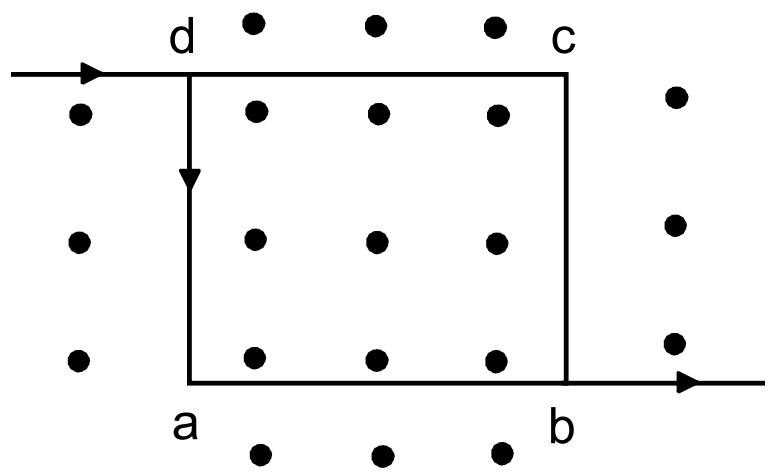
A current of 2A enters at the corner d of a square frame abcd of side 20cm and leaves at the opposite corner b. A magnetic field B = 0.1 T exists in the space in a direction perpendicular to the plane of the frame, as shown in the figure. Find the magnitude and direction of the magnetic forces on the four sides of the frame.
A $5.0\mu\text{F}$ capacitor is charged to 12V. The positive plate of this capacitor is now connected to the negative terminal of a 12V battery and vice versa. Calculate the heat developed in the connecting wires.
  1. Compare the individual dipole moment and the specimen dipole moment for $H_2O $ molecule and $O_2$ molecule when placed in:
  1. Absence of external electric field.
  2. Presence of external eclectic field. Justify your answer.
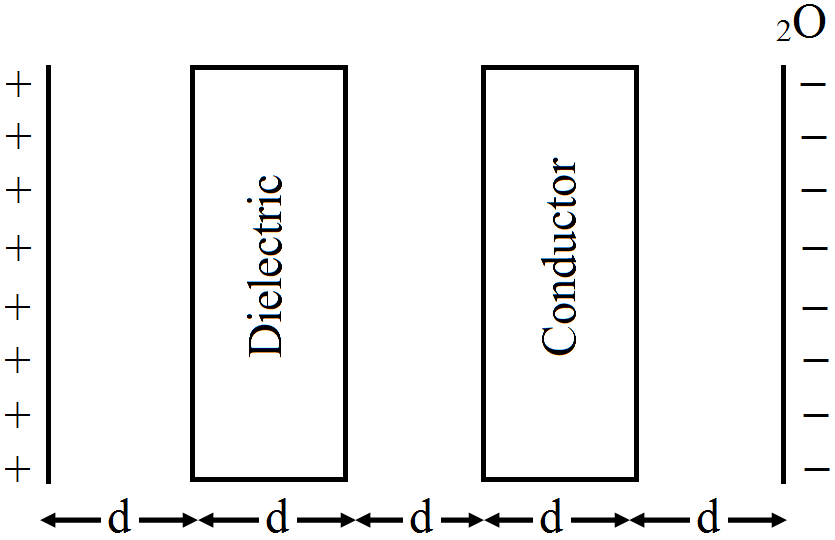
  1. Given two parallel conducting plates of area A and charge densities $+\sigma$ and $-\sigma.$ A dielectric slab of constant K and a conducting slab of thickness d each are inserted in between them as shown.
  1. Find the potential difference between the plates.
  2. Plot E versus x graph, taking x = 0 at positive plate and x = 5d at negative plate.
Repeat part (a) of problem 6 if the push is applied horizontally and not parallel to the incline.
Draw a phasor diagram for series LCR circuit joined with ac voltage source and obtain an expression for impedance of the circuit.
A train starts from rest and moves with a constant acceleration of $2.0m/s^2$ for half a minute. The brakes are then applied and the train comes to rest in one minute. Find:
  1. The total distance moved by the train.
  2. The maximum speed attained by the train.
  3. The position(s) of the train at half the maximum speed.
A person says that he measured the acceleration of a particle to be non-zero while no force was acting on the particle:
  1. He is a liar.
  2. His clock might have run slow.
  3. His meter scale might have been longer than the standard.
  4. He might have used non-inertial frame.
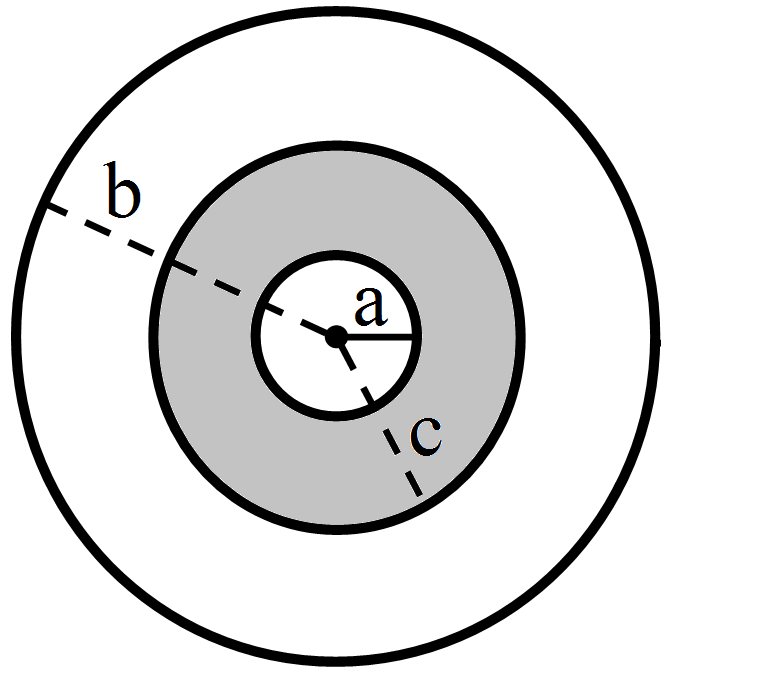
A sphercial capacitor is made of two conducting spherical shells of radii a and b. The space between the shells is filled with a dielectric of dielectric constant K up to a radius c as shown in figure. Calculate the capacitance.