Question
What is magnetic flux. Explain factors on which it depends.

Answer

SELF

Need a full question paper?

Generate a complete, print-ready paper with questions like this in minutes — across 16+ boards, with answer keys.
Start Generating Free

Similar questions

$\text{ }^{212}_{33}\text{Bi}$ can disintegrate either by emitting an $\alpha$-particle of by emitting a $\beta^-$-particle.
  1. Write the two equations showing the products of the decays.
  2. The probabilities of disintegration $\alpha$ and $\beta$ -decays are in the ratio $\frac{7}{13}.$ The overall half-life of $^{212}Bi$ is one hour. If 1g of pure $^{212}Bi$ is taken at 12.00 noon, what will be the composition of this sample at 1P.m. the same day?
A certain element emits $\text{K}_\alpha$ X-ray of energy 3.69keV. Use the data from the previous problem to identify the element.
A resistor of $400 \Omega$, an inductor of $\frac{5}{\pi} H$ and a capacitor of $\frac{50}{\pi} \mu F$ are connected in series across a source of alternating voltage of $140 \sin 100 \pi t V$. Find the voltage $(rms)$ across the resistor, the inductor and the capacitor. Is the algebraic sum of these voltages more than the source voltage? If yes, resolve the paradox. $($Given, $\sqrt{2}=1.414 ).$
A parallel beam of light of wavelength 100nm passes through a sample of atomic hydrogen gas in ground state. (a) Assume that when a photon supplies some of its energy to a hydrogen atom, the rest of the energy appears as another photon. Neglecting the light emitted by the excited hydrogen atoms in the direction of the incident beam, what wavelengths may be observed in the transmitted beam? (b) A radiation detector is placed near the gas to detect radiation coming perpendicular to the incident beam. Find the wavelengths of radiation that may be detected by the detector.
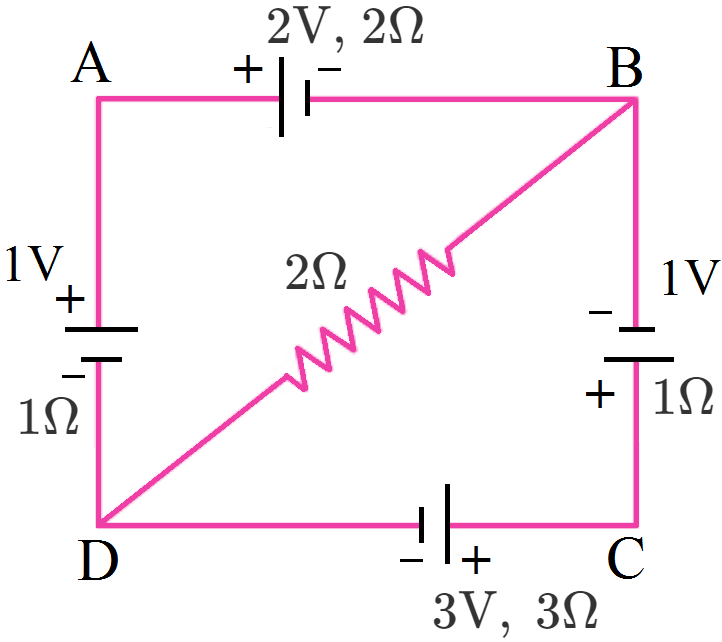
For the circuit shown here, calculate the potential difference between points B and D.
Given below are two electrical circuits A and B. Calculate the ratio of power factor of circuit B to the power factor of circuit A.
Two coherent point sources $S_1$ and $S_2$ vibrating in phase emit light of wavelength $\lambda$. The separation between the sources is $2 \lambda$. Consider a line passing through $\mathrm{S}_2$ and perpendicular to the line $S_1 S_2$. What is the smallest distance from $S_2$ where a minimum of intensity occurs?
If neutrons exert only attractive force, why don't we have a nucleus containing neutrons alone?
Three rigid rods are joined to form an equilateral triangle $\text{ABC}$ of side $1m$. Three particles carrying charges $20\mu\text{C}$ each are attached to the vertices of the triangle. The whole system is at rest in an inertial frame. The resultant force on the charged particle at $A$ has the magnitude:
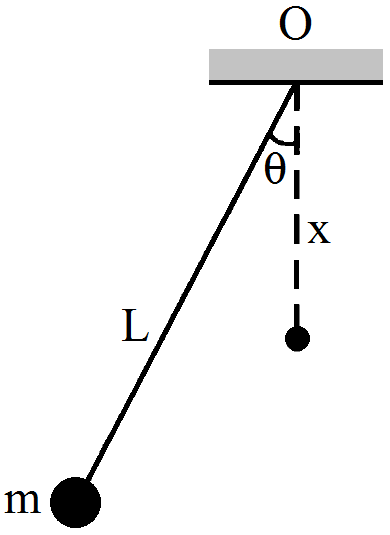
A simple pendulum of length L having a bob of mass m is deflected from its rest position by an angle $\theta$ and released (figure). The string hits a peg which is fixed at a distance x below the point of suspension and the bob starts going in a circle centred at the peg.
  1. Assuming that initially the bob has a height less than the peg, show that the maximum height reached by the bob equals its initial height.
  2. If the pendulum is released with $\theta=90^\circ$ and $\text{x}=\frac{\text{L}}{2}$ find the maximum height reached by the bob above its lowest position before the string becomes slack.
  3. Find the minimum value of $\frac{\text{x}}{\text{L}}$ for which the bob goes in a complete circle about the peg when the pendulum is released from $\theta=90^\circ.$