Question

A convex lens forms a real image of an object for its two different positions on a screen. If height of the image in both the cases be 8 cm and 2 cm, then height of the object is

(a) 16 cm

(b) 8 cm

(c) 4 cm  

(d) 2 cm

Answer

(c) 4 cm  

Need a full question paper?

Generate a complete, print-ready paper with questions like this in minutes — across 16+ boards, with answer keys.

Start Generating Free

Similar questions

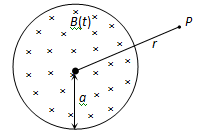
A uniform but time-varying magnetic field B(t) exists in a circular region of radius a and is directed into the plane of the paper, as shown. The magnitude of the induced electric field at point P at a distance r from the centre of the circular region

(a) Is zero

(b) Decreases as  

(c) Increases as r

(d) Decreases as  

The binding energy of a nucleus is equal to :
The work done in moving a unit positive test charge over a closed path in an electric field is _____________.

Which of the following statements is not true

(a) The resistance of intrinsic semiconductors decrease with increase of temperature

(b) Doping pure Si with trivalent impurities give P-type semiconductors

(c) The majority carriers in N-type semiconductors are  holes

(d) A PN-junction can act as a semiconductor diode

A converging lens is used to form an image on a screen. When upper half of the lens is covered by an opaque screen

(a) Half the image will disappear

(b) Complete image will be formed of same intensity

(c) Half image will be formed of same intensity

(d) Complete image will be formed of decreased intensity

Assertion  :   The whole charge of a conductor cannot be transferred to another isolated conductor.

Reason     : The total transfer of charge from one to another is not possible.

(a) If both assertion and reason are true and the reason is the correct explanation of the assertion.

(b) If both assertion and reason are true but reason is not the correct explanation of the assertion.

(c) If assertion is true but reason is false.

(d) If the assertion and reason both are false.

The particles which can be added to the nucleus of an atom without changing its chemical properties are called

(a) Electrons

(b) Protons

(c) Neutrons

(d) None of the above

A wire of fixed length is wound on a solenoid of length l and radius r. Its self-inductance is found to be L. Now, if the same wire is wound on a solenoid of length $\frac{1}{2}$ and radius $\frac{\text{r}}{2},$ then the self-inductance will be
Which of the following is wrong for interference fringes?

Assertion :  No interference pattern is detected when two coherent sources are infinitely close to each other.

Reason     : The fringe width is inversely proportional to the distance between the two slits.

(a) If both assertion and reason are true and the reason is the correct explanation of the assertion.

(b) If both assertion and reason are true but reason is not the correct explanation of the assertion.

(c) If assertion is true but reason is false.

(d) If the assertion and reason both are false.