MCQ
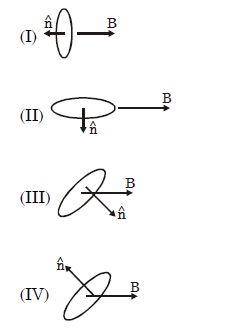
A current carrying loop is placed in a uniform magnetic field in four different orientations; $I,\, II,\, III$ and $IV,$ arrange them in the decreasing order of potential energy
  • A
    $I > III > II > IV$
  • B
    $I > II > III > IV$
  • C
    $I > IV > II > III$
  • D
    $III > IV > I > II$

Answer

$U = \, - \vec M.\vec B =  - MB\cos \theta $

Need a full question paper?

Generate a complete, print-ready paper with questions like this in minutes — across 16+ boards, with answer keys.

Start Generating Free

Similar questions

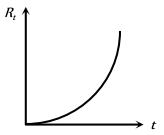
The resistance $R_t$ of a conductor varies with temperauce $t$ as shown in the figure. If the variation is represented by $R_t=R_0\left[1+\alpha t+\beta t^2\right]$, then

Image

Ultraviolet light of wavelength $300 \mathrm{~nm}$ and intensity $1.0 \mathrm{watt} / \mathrm{m}$ falls on the surface of a photosensitive material. If $1 \%$ of the incident photons produce photoelectrons, then the number of photoelectrons emitted from an area of $1.0 \mathrm{~cm}$ of the surface is nearly
Infrared radiation is detected by
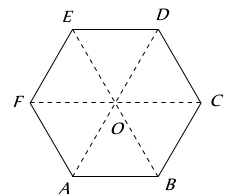
Figure shows $A B C D E F$ as a regular hexagon. What is the value of $\overrightarrow{A B}+\overrightarrow{A C}+\overrightarrow{A D}+\overrightarrow{A E}+\overrightarrow{A F}$
Image
Two spheres $P$ and $Q$, of same colour having radii $8 \mathrm{~cm}$ and $2 \mathrm{~cm}$ are maintained at temperatures $127^{\circ} \mathrm{C}$ and $527^{\circ} \mathrm{C}$ respectively. The ratio of energy radiated by $P$ and $Q$ is
Relation between the colour and the temperature of a star is given by
A body moves due East with velocity $20 km / hour$ and then due North with velocity $15 km / hour$. The resultant velocity
Which of the following expressions represent simple harmonic motion
  1. $x=A \sin (\omega t+\delta)$
  2. $x=B \cos (\omega t+\phi)$
  3. $x=A \tan (\omega t+\phi)$
  4. $x=A \sin \omega t \cos \omega t$
The quality factor of $\text{LCR}$ circuit having resistance $(R)$ and inductance $(L)$ at resonance frequency $(\omega)$ is given by
The periodic time of a body executing simple harmonic motion is $3$ sec. After how much interval from time $t=0$, its displacement will be half of its amplitude